Linnaea borealis var. longiflora
Twin flower
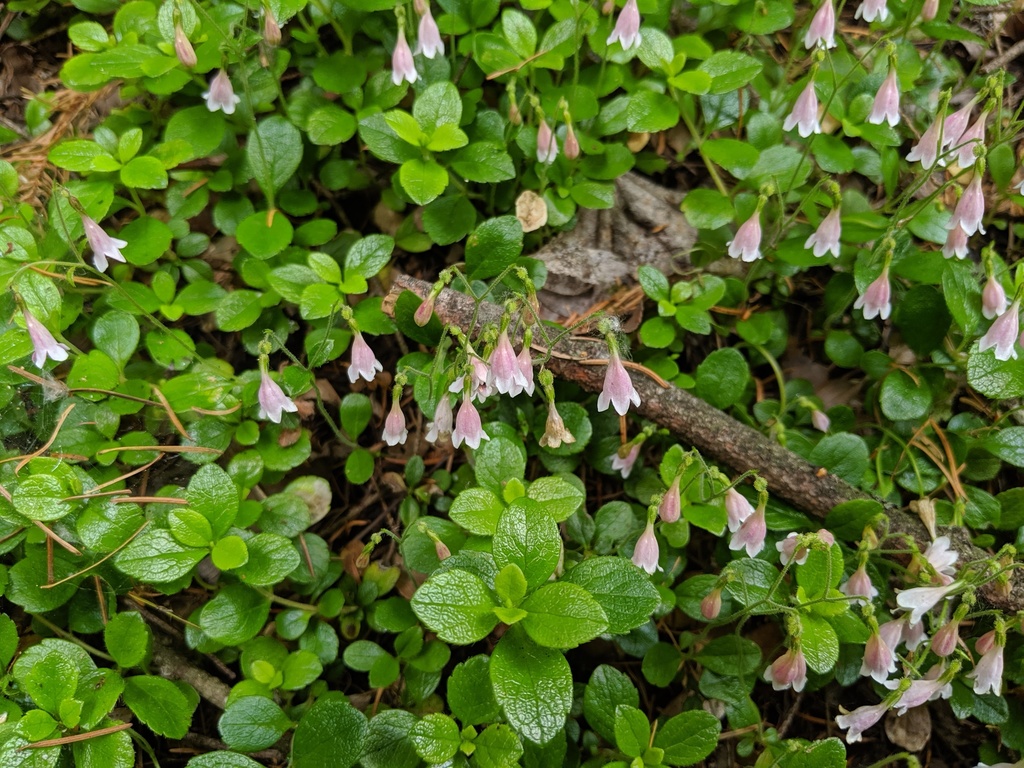
(c) Chris Johnson, some rights reserved (CC BY), uploaded by Chris Johnson · licence
Family: Linnaeaceae · Type: Subshrub · Native
Linnaea borealis var. longiflora (Twin flower) is a native California subshrub in the Linnaeaceae family, recognized by Circumboreal species at southern range limit; California variety has longer flowers than typical form.
Twin flower is a California native shrub found in northwestern California, the Cascade Range, northern Sierra Nevada, and Modoc Plateau in moist shady places within conifer forests at elevations of 200 to 2,600 meters. Flowering from June to August, this plant produces delicate white to pink flowers 10 to 13 millimeters long, hanging in pairs with a distinctive drooping appearance. Growing with slender stems 15 to 20 centimeters tall, it forms a low, delicate ground-hugging structure. Its small ovate leaves measure 12 to 18 millimeters long, with serrated edges above the middle and short petioles around 2 millimeters in length. The flower's inner bracts are straight-hairy, with outer bracts densely glandular-hairy and surrounding the ovary.
Identification and appearance
Key characters: Circumboreal species at southern range limit; California variety has longer flowers than typical form
Habitat and range
Habitat: Moist shady places in conifer forest
Elevation: 200-2600 m
California counties: Del Norte, Butte, Siskiyou, Shasta, Sierra, Plumas, Trinity, Glenn, Yuba, Humboldt, El Dorado, Modoc, Nevada
Outside California: to northern Alaska
Bloom period
Linnaea borealis var. longiflora blooms Jun-Aug.
How to tell it apart
vs Chimaphila: Chimaphila (prince's pine) is an erect little subshrub with whorled, toothed, leathery leaves and waxy nodding pink flowers; Linnaea trails along the ground with small paired leaves and twin flowers on a slender forked stalk.; vs Gaultheria: creeping Gaultheria has alternate leaves and solitary urn-shaped flowers; Linnaea has opposite leaves and flowers borne in nodding pairs.; vs Vaccinium: mat-forming Vaccinium have alternate leaves and single urn-shaped flowers; Linnaea's paired trumpet flowers on a forked peduncle are unmistakable.; vs Arctostaphylos: even prostrate manzanitas are woody with alternate leathery leaves and urn flowers; Linnaea is a delicate, herb-like trailing shrub with twin pink bells.; vs Mitchella: Mitchella (partridgeberry, absent from California) also trails with paired flowers but has round white-veined leaves and white flowers; Linnaea has ovate serrate leaves and pink bell flowers.
Frequently asked questions
Is Linnaea borealis var. longiflora native to California?
Yes. Linnaea borealis var. longiflora is native to California (recorded as native).
When does Linnaea borealis var. longiflora bloom?
Linnaea borealis var. longiflora blooms Jun-Aug.
Where in California does Linnaea borealis var. longiflora grow?
Linnaea borealis var. longiflora occurs in Del Norte, Butte, Siskiyou, Shasta, Sierra, Plumas, Trinity, Glenn and other counties, at elevations of 200-2600 m.
What plant family does Linnaea borealis var. longiflora belong to?
Linnaea borealis var. longiflora is in the Linnaeaceae family, genus Linnaea.
What habitat does Linnaea borealis var. longiflora grow in?
Linnaea borealis var. longiflora grows in Moist shady places in conifer forest.
Related species
Other California species in the same genus, family, or bioregion.
Sources: Jepson eFlora · Index of California Plant Names · CalPhotos
Last updated 2026-10-07
Data from The California Species Project — 14,000+ California species with verified data from CNPS, CDFW, USFWS, Cal-IPC, and more.