Lithophragma cymbalaria
Mission star
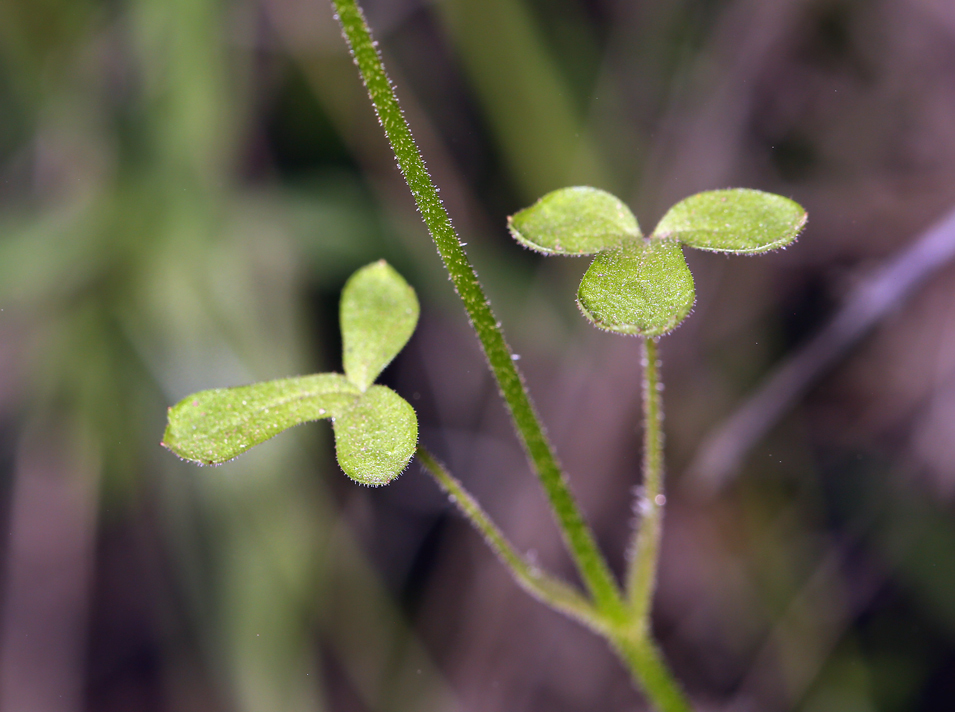
(c) Steve Matson, some rights reserved (CC BY), uploaded by Steve Matson · licence
Family: Saxifragaceae · Type: Herb · Native
Lithophragma cymbalaria (Mission star) is a native California herb in the Saxifragaceae family, recognized by toothless leaves and opposite cauline leaves are distinctive.
Mission star is a California native perennial found in the San Joaquin Valley near Antioch, San Francisco Bay Area, southern Coast Ranges, southern California, northern Channel Islands, and western Transverse Ranges in shady, moist areas at elevations up to 1,200 meters. Flowering from March to May, this plant produces delicate white flowers 4 to 8 millimeters long with ovate-elliptic petals. Growing 10 to 35 centimeters tall with slender stems, it has distinctive basal leaves with shallow three-lobed blades and two opposite cauline leaves. Its basal leaves feature unique shallow lobes without teeth, creating a delicate architectural structure. The plant produces spiny seeds in small clusters of 2 to 8 flowers, each mounted on slender 4 to 10 millimeter pedicels.
Identification and appearance
Key characters: 7 sympatric species; toothless leaves and opposite cauline leaves are distinctive
Habitat and range
Habitat: Shady, moist areas
Elevation: < 1200(2500) m
California counties: Mariposa, Santa Barbara, San Luis Obispo, Monterey, Kern, Ventura, Stanislaus, Contra Costa, Orange, San Bernardino
Bloom period
Lithophragma cymbalaria blooms Mar-May.
How to tell it apart
vs Delphinium: Lithophragma has regular 5-petaled flowers; Delphinium has irregular spurred flowers with hood-like upper petals.; vs Bowlesia: Lithophragma has showy pink-white flowers in clusters; Bowlesia has tiny greenish flowers in tight umbels.; vs Geranium: Lithophragma petals are fringed/lobed and has 3 styles; Geranium petals are entire and has 5 styles.; vs Lysimachia: Lithophragma has 3 styles and deeply lobed leaves; Lysimachia has 1 style and simple leaves.; vs Horkelia: Lithophragma has 3 styles and palmately lobed leaves; Horkelia has many styles and pinnately compound leaves.
Frequently asked questions
Is Lithophragma cymbalaria native to California?
Yes. Lithophragma cymbalaria is native to California (recorded as native).
When does Lithophragma cymbalaria bloom?
Lithophragma cymbalaria blooms Mar-May.
Where in California does Lithophragma cymbalaria grow?
Lithophragma cymbalaria occurs in Mariposa, Santa Barbara, San Luis Obispo, Monterey, Kern, Ventura, Stanislaus, Contra Costa and other counties, at elevations of < 1200(2500) m.
What plant family does Lithophragma cymbalaria belong to?
Lithophragma cymbalaria is in the Saxifragaceae family, genus Lithophragma.
What habitat does Lithophragma cymbalaria grow in?
Lithophragma cymbalaria grows in Shady, moist areas.
Related species
Other California species in the same genus, family, or bioregion.
- Lithophragma glabrum — Bulbed woodland star
- Lithophragma heterophyllum — Hill star
- Lithophragma maximum — San clemente island woodland star
- Lithophragma parviflorum — Pink woodland star
- Lithophragma parviflorum var. parviflorum — Pink woodland star
- Lithophragma parviflorum var. trifoliatum — Prairie woodland star
Sources: Jepson eFlora · Index of California Plant Names · CalPhotos
Last updated 2026-10-07
Data from The California Species Project — 14,000+ California species with verified data from CNPS, CDFW, USFWS, Cal-IPC, and more.