Lithospermum ruderale
Western stoneseed, Western Stoneseed
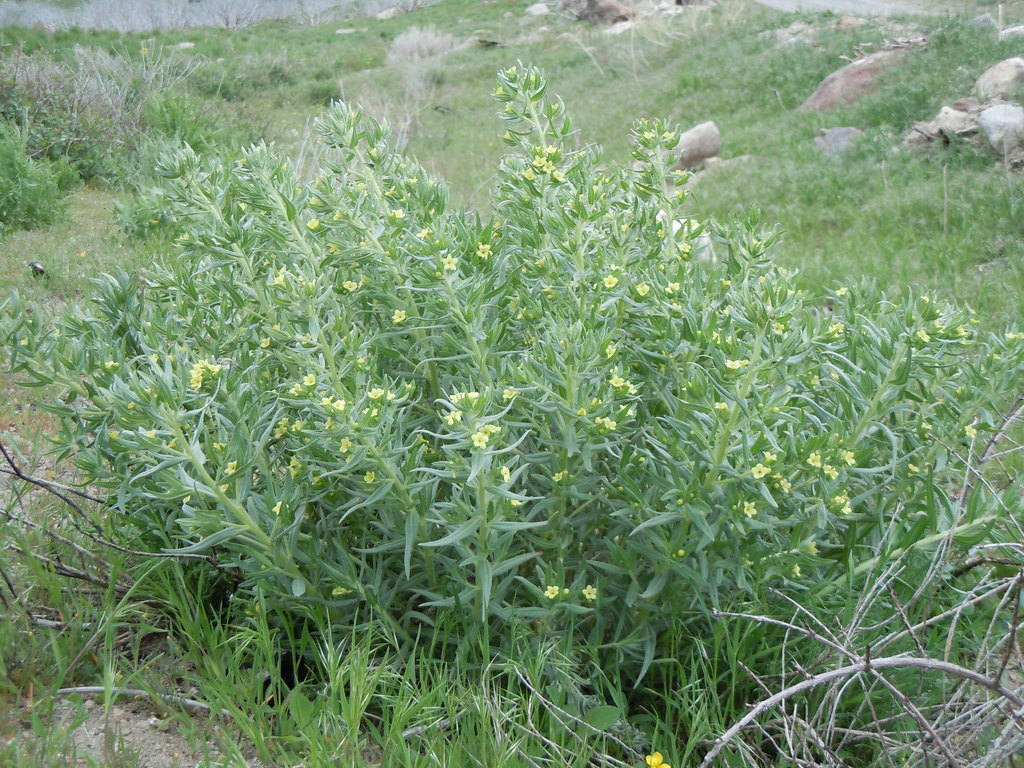
(c) Matt Lavin, some rights reserved (CC BY-SA) · licence
Family: Boraginaceae · Type: Herb · Native
Lithospermum ruderale (Western stoneseed) is a native California herb in the Boraginaceae family.
Western stoneseed is a California native perennial found in northern Sierra Nevada, Modoc Plateau, and high Cascade Range regions in open, dry slopes, sagebrush steppe, conifer forest, and chaparral at elevations of 1,200 to 1,800 meters. Flowering from April to June, this plant produces pale- to green-yellow flowers approximately 9 to 12 millimeters long with salverform corollas. Growing with clustered stems 20 to 50 centimeters tall that are relatively unbranched and have spreading hairs, it develops a somewhat woody caudex. Its numerous crowded leaves are 3 to 8 centimeters long, ranging from lanceolate to linear in shape. The fruit consists of smooth, shiny white to pale brown nutlets 5 to 6 millimeters long with a wide-ovoid shape tapering to a stout tip.
Identification and appearance
Key characters: 2 sympatric species; key differentiator is pale yellow flowers vs bright golden yellow or white in co-occurring species
Habitat and range
Habitat: Open, dry slopes, plains, sagebrush steppe, conifer forest, chaparral
Elevation: (750)1200-1800 m
California counties: Modoc, Siskiyou, Lassen, Plumas, Nevada, Shasta, Placer, Sierra, El Dorado
Outside California: northwestern North America
Bloom period
Lithospermum ruderale blooms Apr-Jun.
How to tell it apart
vs Diplacus: Lithospermum has tiny tubular flowers in leafy clusters; Diplacus has showy snapdragon-like flowers.; vs Amsinckia: Lithospermum has leafy bracts throughout the flower cluster; Amsinckia has naked coiled spikes.; vs Lantana: Lithospermum has tubular single flowers; Lantana has dense rounded flower heads with square stems.; vs Echium: Lithospermum flowers are radially symmetrical; Echium flowers are irregular with protruding stamens.; vs Mertensia: Lithospermum has white/yellow flowers in dry habitats; Mertensia has blue/pink bells in moist sites.
Frequently asked questions
Is Lithospermum ruderale native to California?
Yes. Lithospermum ruderale is native to California (recorded as native).
When does Lithospermum ruderale bloom?
Lithospermum ruderale blooms Apr-Jun.
Where in California does Lithospermum ruderale grow?
Lithospermum ruderale occurs in Modoc, Siskiyou, Lassen, Plumas, Nevada, Shasta, Placer, Sierra and other counties, at elevations of (750)1200-1800 m.
What plant family does Lithospermum ruderale belong to?
Lithospermum ruderale is in the Boraginaceae family, genus Lithospermum.
What habitat does Lithospermum ruderale grow in?
Lithospermum ruderale grows in Open, dry slopes, plains, sagebrush steppe, conifer forest, chaparral.
Related species
Other California species in the same genus, family, or bioregion.
Sources: Jepson eFlora · Index of California Plant Names · CalPhotos
Last updated 2026-10-07
Data from The California Species Project — 14,000+ California species with verified data from CNPS, CDFW, USFWS, Cal-IPC, and more.