Lobularia maritima
Sweet alyssum
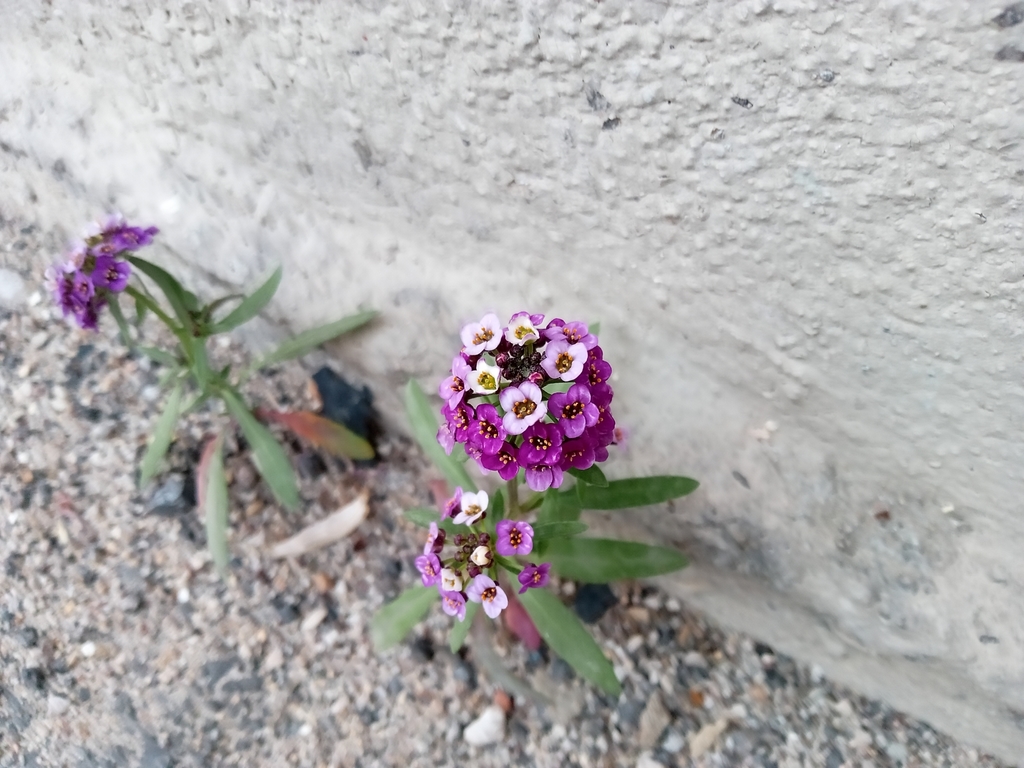
(c) Eleftherios Katsillis, some rights reserved (CC BY) · licence
Family: Brassicaceae · Type: Herb · Not Native
Conservation status: Cal-IPC Yes
Lobularia maritima (Sweet alyssum) is a non-native California herb in the Brassicaceae family, recognized by Mediterranean naturalized species; widely planted and escaped throughout temperate regions.
Sweet alyssum is a naturalized perennial herb found in coastal California bioregions including Northern Coast, Central Coast, San Francisco Bay, and Southern Coast in disturbed areas and fields at elevations below 600 meters. Flowering from March to October, this plant produces small white to pale lavender flowers in delicate clusters, typically 2 to 3 millimeters long. Growing with erect to prostrate green stems 15 to 40 centimeters tall that branch from the base, it forms dense, spreading mats. Its narrow linear leaves are 1.6 to 2.5 centimeters long and 2 to 3 millimeters wide, with a pointed acute tip. The small round-elliptic fruits are 2 to 2.7 millimeters long, contributing to its compact and delicate appearance.
Identification and appearance
Key characters: Mediterranean naturalized species; widely planted and escaped throughout temperate regions
Habitat and range
Habitat: Disturbed areas, fields
Elevation: < 600 m
California counties: Los Angeles, Riverside, San Bernardino, Monterey, Orange, San Diego, San Francisco, Santa Cruz, Ventura, San Luis Obispo, Santa Clara, Santa Barbara, Sonoma, San Mateo, Marin, Fresno, Mendocino, Napa, Butte, Humboldt, Contra Costa, Alameda, Yolo
Outside California: Canada, United States, native to Mediterranean, Europe
Bloom period
Lobularia maritima blooms Mar-Oct.
Conservation status
Cal-IPC Yes
How to tell it apart
vs Nasturtium: Lobularia has white/purple flowers and two-pronged hairs; Nasturtium has yellow/white flowers and pinnately divided leaves.; vs Lepidium: Lobularia has two-pronged fork hairs and round pods; Lepidium has simple hairs and notched heart-shaped pods.; vs Lantana: Lobularia has 4 petals in cross shape; Lantana has 5 petals fused into tube with flowers in dense rounded clusters.; vs Heliotropium: Lobularia has 4 separate petals in cross; Heliotropium has 5 petals fused into tube with coiled scorpion-tail flower clusters.; vs Iberis: Lobularia has equal-sized petals and two-pronged hairs; Iberis has two enlarged outer petals and simple hairs.
Frequently asked questions
Is Lobularia maritima native to California?
No. Lobularia maritima is not native to California (recorded as not native).
When does Lobularia maritima bloom?
Lobularia maritima blooms Mar-Oct.
Where in California does Lobularia maritima grow?
Lobularia maritima occurs in Los Angeles, Riverside, San Bernardino, Monterey, Orange, San Diego, San Francisco, Santa Cruz and other counties, at elevations of < 600 m.
What plant family does Lobularia maritima belong to?
Lobularia maritima is in the Brassicaceae family, genus Lobularia.
Is Lobularia maritima invasive in California?
Lobularia maritima is listed by Cal-IPC with an invasiveness rating of Yes.
Related species
Other California species in the same genus, family, or bioregion.
Sources: Jepson eFlora · Index of California Plant Names · CalPhotos
Last updated 2026-10-07
Data from The California Species Project — 14,000+ California species with verified data from CNPS, CDFW, USFWS, Cal-IPC, and more.