Logfia filaginoides
California cottonrose
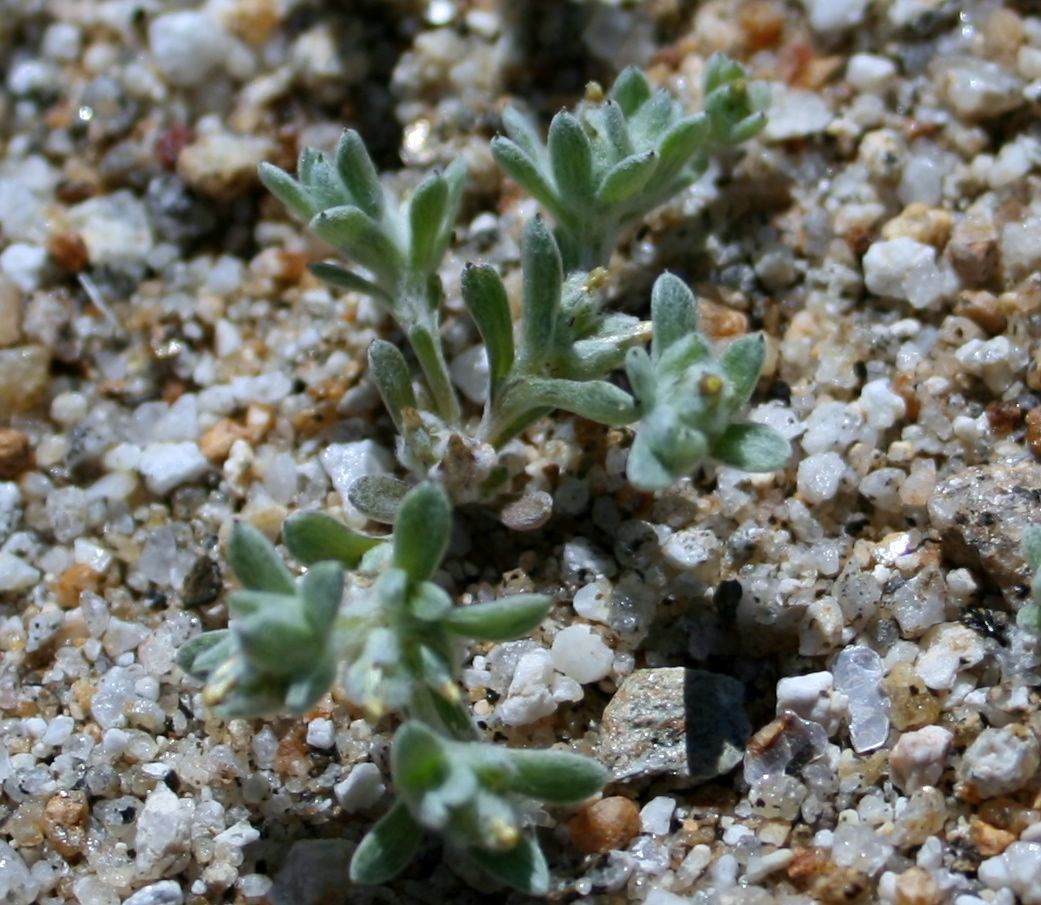
Photo by Chez Brungraber
Family: Asteraceae · Type: Herb · Native
Logfia filaginoides (California cottonrose) is a native California herb in the Asteraceae family, recognized by distinctive red-purple disk flowers and growth habit.
California cottonrose is a native annual found in the California Floristic Province, Sierra Nevada East, and Desert regions, including uncommon populations in the northwestern and California Ranges, occurring in bare, rocky, or grassy sites and drainages at elevations below 1,800 meters. Flowering from February to May, this plant produces small, inconspicuous flowers with bright red to purple disk lobes in compact heads. Growing 1 to 30 centimeters tall with generally forked stems that are grayish to green and covered in a cobwebby texture, it has a central dominant axis. Its leaves are flexible and oblanceolate, with the largest measuring 10 to 15 millimeters long and 2 to 3 millimeters wide, becoming smaller and more acute toward the stem tips. The plant's distinctive flower heads are pear-shaped, clustered at stem forks, with outer paleae curved inward and inner flowers bearing delicate pappus bristles.
Identification and appearance
Key characters: 3 sympatric species; distinctive red-purple disk flowers and growth habit
Habitat and range
Habitat: Common, +- weedy. Bare, rocky, or grassy sites, drainages
Elevation: < 1800 m
California counties: Kern, San Luis Obispo, San Diego, Los Angeles, Ventura, Inyo, San Bernardino, Imperial, Riverside, Santa Barbara, Tulare, Colusa, Orange, Mono, Alameda, Amador, Calaveras, Contra Costa, El Dorado, Glenn, San Francisco, San Joaquin, Santa Clara, Solano, Sonoma, Stanislaus, Sutter, Tuolumne, Butte, Fresno, Lake, Madera, Marin, Mariposa, Mendocino, Monterey, Napa, San Benito, San Mateo, Shasta, Merced, Tehama, Santa Cruz, Humboldt, Kings, Placer, Trinity, Yolo
Outside California: to southwestern Utah, western Texas, northwestern Mexico
Bloom period
Logfia filaginoides blooms Feb-May.
How to tell it apart
vs Stylocline: Logfia has fluffy white pappus bristles; Stylocline completely lacks them.; vs Micropus: Logfia has mushroom-shaped heads; Micropus has 4-6 prominent spoon-shaped bracts resembling petals.; vs Eriophyllum: Logfia has tiny, inconspicuous heads nestled low; Eriophyllum has showy yellow ray flowers on upright stems.; vs Gnaphalium: Logfia has mushroom-shaped heads wider than tall; Gnaphalium has cylindrical heads taller than wide.; vs Ancistrocarphus: Logfia lacks hooked spine-tipped bracts; Ancistrocarphus has distinctive inward-curved fishhook tips.
Frequently asked questions
Is Logfia filaginoides native to California?
Yes. Logfia filaginoides is native to California (recorded as native).
When does Logfia filaginoides bloom?
Logfia filaginoides blooms Feb-May.
Where in California does Logfia filaginoides grow?
Logfia filaginoides occurs in Kern, San Luis Obispo, San Diego, Los Angeles, Ventura, Inyo, San Bernardino, Imperial and other counties, at elevations of < 1800 m.
What plant family does Logfia filaginoides belong to?
Logfia filaginoides is in the Asteraceae family, genus Logfia.
What habitat does Logfia filaginoides grow in?
Logfia filaginoides grows in Common, +- weedy. Bare, rocky, or grassy sites, drainages.
Related species
Other California species in the same genus, family, or bioregion.
Sources: Jepson eFlora · Index of California Plant Names · CalPhotos
Last updated 2026-10-07
Data from The California Species Project — 14,000+ California species with verified data from CNPS, CDFW, USFWS, Cal-IPC, and more.