Logfia gallica
Daggerleaf cottonrose, Daggerleaf Cottonrose
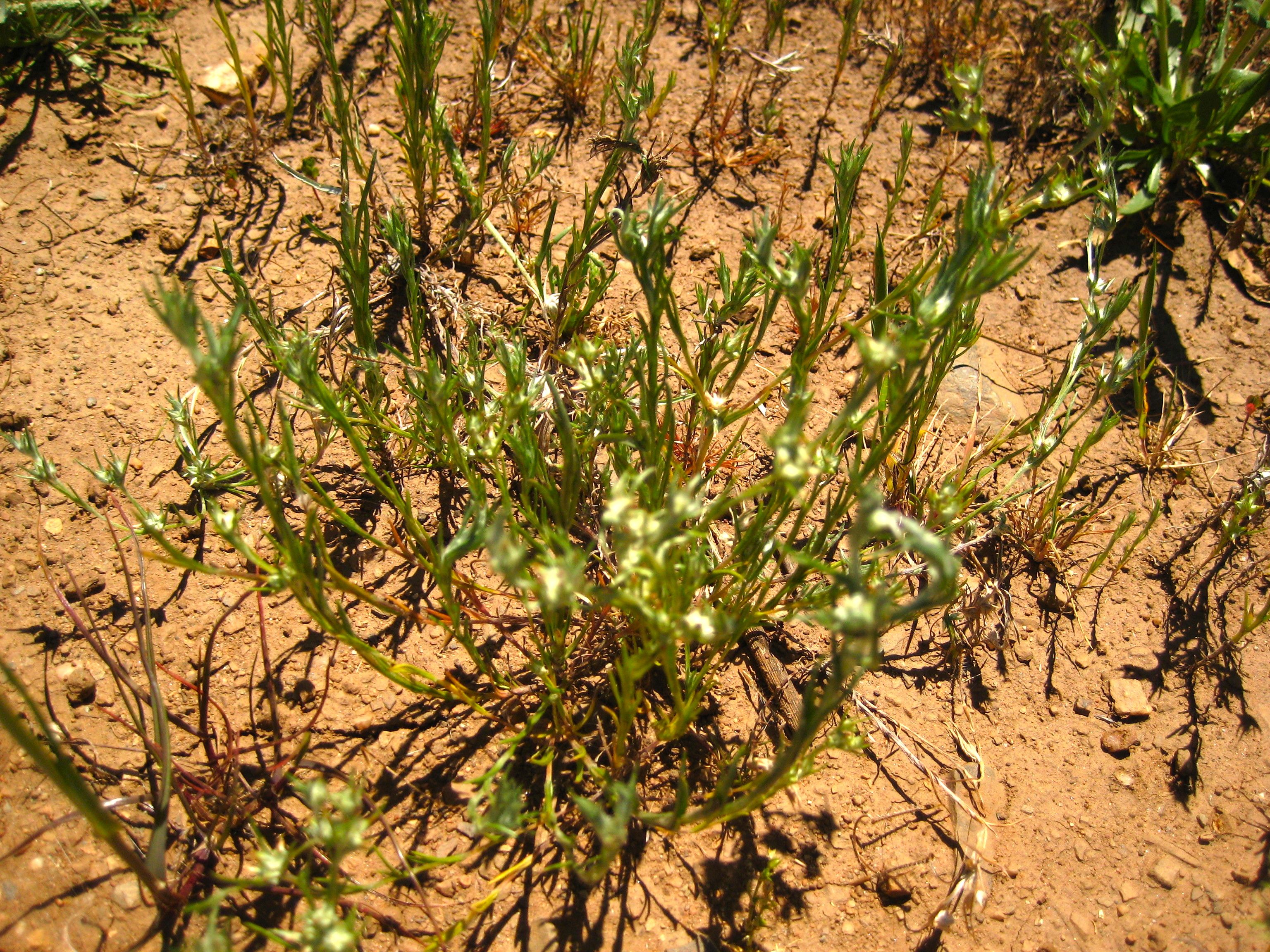
Photo by Chez Brungraber
Family: Asteraceae · Type: Herb · Not Native
Logfia gallica (Daggerleaf cottonrose) is a non-native California herb in the Asteraceae family, recognized by distinctive stiff awl-shaped leaves and translucent phyllaries.
Daggerleaf cottonrose is a naturalized annual found in northwestern California, the California Roasted Flats, Sierra Nevada foothills, western Sierra Nevada, Central Valley, central western, and southwestern California in bare or grassy openings at elevations below 1,100 meters. Flowering from March to July, this plant produces small whitish flowers in compact, flask-shaped clusters 3 to 4.5 millimeters wide. Growing with multiple forked stems 2 to 50 centimeters tall, it has a grayish to green appearance with a cobwebby texture. Its leaves are distinctively stiff and awl-shaped, with the largest leaves measuring 20 to 30 millimeters long and only 1 to 1.5 millimeters wide, tapering to acute or nearly spiny tips. The plant's intricate structure includes 3 to 10 heads at stem forks and tips, with phyllaries that are translucent and obovate.
Identification and appearance
Key characters: 3 sympatric species; distinctive stiff awl-shaped leaves and translucent phyllaries
Habitat and range
Habitat: Bare or grassy openings, burns
Elevation: < 1100 m
California counties: San Diego, San Luis Obispo, Los Angeles, Contra Costa, Kern, Tulare, Riverside, San Bernardino, Marin, Fresno, Monterey, Alameda, Amador, El Dorado, Humboldt, Lake, Madera, Mariposa, Placer, Sacramento, San Joaquin, Santa Cruz, Shasta, Solano, Stanislaus, Yuba, Butte, Calaveras, Merced, Mendocino, Napa, Nevada, San Benito, San Francisco, San Mateo, Santa Barbara, Santa Clara, Sonoma, Sutter, Tuolumne, Ventura, Tehama, Glenn, Colusa, Trinity, Orange, Yolo
Outside California: to southwestern Oregon, northwestern Baja California, native to Mediterranean, introduced +- worldwide
Bloom period
Logfia gallica blooms Mar-Jul.
How to tell it apart
vs Stylocline: Logfia has fluffy white pappus bristles; Stylocline completely lacks them.; vs Micropus: Logfia has mushroom-shaped heads; Micropus has 4-6 prominent spoon-shaped bracts resembling petals.; vs Eriophyllum: Logfia has tiny, inconspicuous heads nestled low; Eriophyllum has showy yellow ray flowers on upright stems.; vs Gnaphalium: Logfia has mushroom-shaped heads wider than tall; Gnaphalium has cylindrical heads taller than wide.; vs Ancistrocarphus: Logfia lacks hooked spine-tipped bracts; Ancistrocarphus has distinctive inward-curved fishhook tips.
Frequently asked questions
Is Logfia gallica native to California?
No. Logfia gallica is not native to California (recorded as not native).
When does Logfia gallica bloom?
Logfia gallica blooms Mar-Jul.
Where in California does Logfia gallica grow?
Logfia gallica occurs in San Diego, San Luis Obispo, Los Angeles, Contra Costa, Kern, Tulare, Riverside, San Bernardino and other counties, at elevations of < 1100 m.
What plant family does Logfia gallica belong to?
Logfia gallica is in the Asteraceae family, genus Logfia.
What habitat does Logfia gallica grow in?
Logfia gallica grows in Bare or grassy openings, burns.
Related species
Other California species in the same genus, family, or bioregion.
Sources: Jepson eFlora · Index of California Plant Names · CalPhotos
Last updated 2026-10-07
Data from The California Species Project — 14,000+ California species with verified data from CNPS, CDFW, USFWS, Cal-IPC, and more.