Lomatium macrocarpum
Bigseed biscuitroot
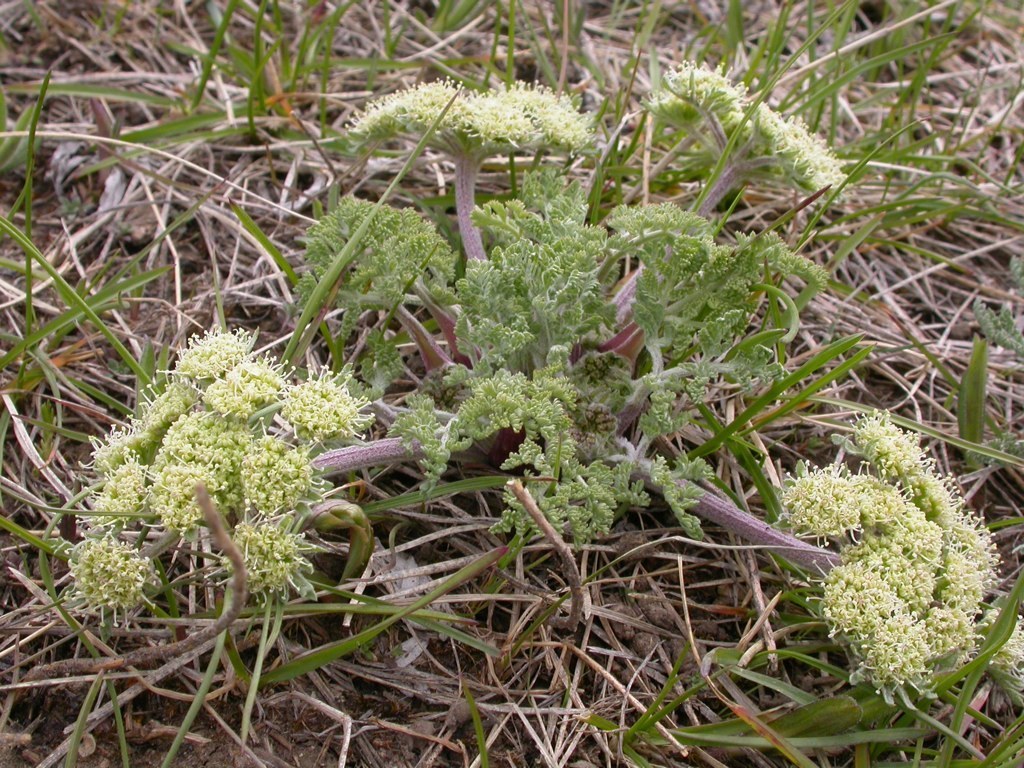
(c) Matt Lavin, some rights reserved (CC BY-SA) · licence
Family: Apiaceae · Type: Herb · Native
Lomatium macrocarpum (Bigseed biscuitroot) is a native California herb in the Apiaceae family, recognized by large fruit size and tomentose herbage.
Bigseed biscuitroot is a California native perennial found in northern coastal, Klamath Ranges, Cascade Range, Sierra Nevada Foothills, Tehachapi, San Francisco Bay, and Southern Coastal regions in serpentine rocky slopes within chaparral or woodland at elevations of 150 to 3,000 meters. Flowering from April to June, this plant produces white, cream, or pale purple flowers in umbels with 5 to 25 spreading rays. Growing 10 to 50 centimeters tall with a short stem and grayish tomentose herbage, it has a distinctive taproot occasionally developing swollen tubers. Its finely dissected leaves are 2.5 to 15 centimeters long, with linear to oblong segments 1 to 7 millimeters wide, giving the plant a delicate, lacy appearance. The fruit is 9 to 20 millimeters long, lanceolate to narrowly elliptic, with wings narrower than the central body.
Identification and appearance
Key characters: 31 sympatric species; distinguished by large fruit size and tomentose herbage
Habitat and range
Habitat: Generally serpentine rocky slopes in chaparral or woodland
Elevation: 150-3000 m
California counties: Mendocino, Colusa, Shasta, Lake, Modoc, Humboldt, Calaveras, Trinity, San Benito, San Mateo, Fresno, Plumas, Tehama, Del Norte, Kern, Lassen, Siskiyou, Sonoma, Contra Costa, Santa Clara, Butte, Monterey, Marin, Tuolumne, San Luis Obispo, Tulare, El Dorado, Glenn, Ventura, Solano, Yuba, Sutter, Sierra, Nevada, Napa, Los Angeles, Mariposa, Merced, Alameda, Stanislaus, Amador, Madera, Santa Barbara, Yolo
Outside California: to British Columbia, central Canada, North Dakota, Utah
Bloom period
Lomatium macrocarpum blooms Apr-Jun.
How to tell it apart
vs Tauschia: Lomatium fruits have prominent marginal wings; Tauschia fruits lack wings or have only slight ribs.; vs Sanicula: Lomatium has typical umbrella-shaped flower clusters; Sanicula has dense ball-like flower heads with hooked bristles.; vs Cymopterus: Lomatium grows upright with a stem; Cymopterus is stemless and grows flat to the ground.; vs Conium: Lomatium grows in dry natural habitats; Conium has purple-spotted stems and grows in moist disturbed areas.; vs Daucus: Lomatium fruits are flat with thin wings; Daucus fruits are cylindrical with spiny bristles.
Frequently asked questions
Is Lomatium macrocarpum native to California?
Yes. Lomatium macrocarpum is native to California (recorded as native).
When does Lomatium macrocarpum bloom?
Lomatium macrocarpum blooms Apr-Jun.
Where in California does Lomatium macrocarpum grow?
Lomatium macrocarpum occurs in Mendocino, Colusa, Shasta, Lake, Modoc, Humboldt, Calaveras, Trinity and other counties, at elevations of 150-3000 m.
What plant family does Lomatium macrocarpum belong to?
Lomatium macrocarpum is in the Apiaceae family, genus Lomatium.
What habitat does Lomatium macrocarpum grow in?
Lomatium macrocarpum grows in Generally serpentine rocky slopes in chaparral or woodland.
Related species
Other California species in the same genus, family, or bioregion.
Sources: Jepson eFlora · Index of California Plant Names · CalPhotos
Last updated 2026-10-07
Data from The California Species Project — 14,000+ California species with verified data from CNPS, CDFW, USFWS, Cal-IPC, and more.