Lonicera involucrata var. involucrata
Twinberry honeysuckle
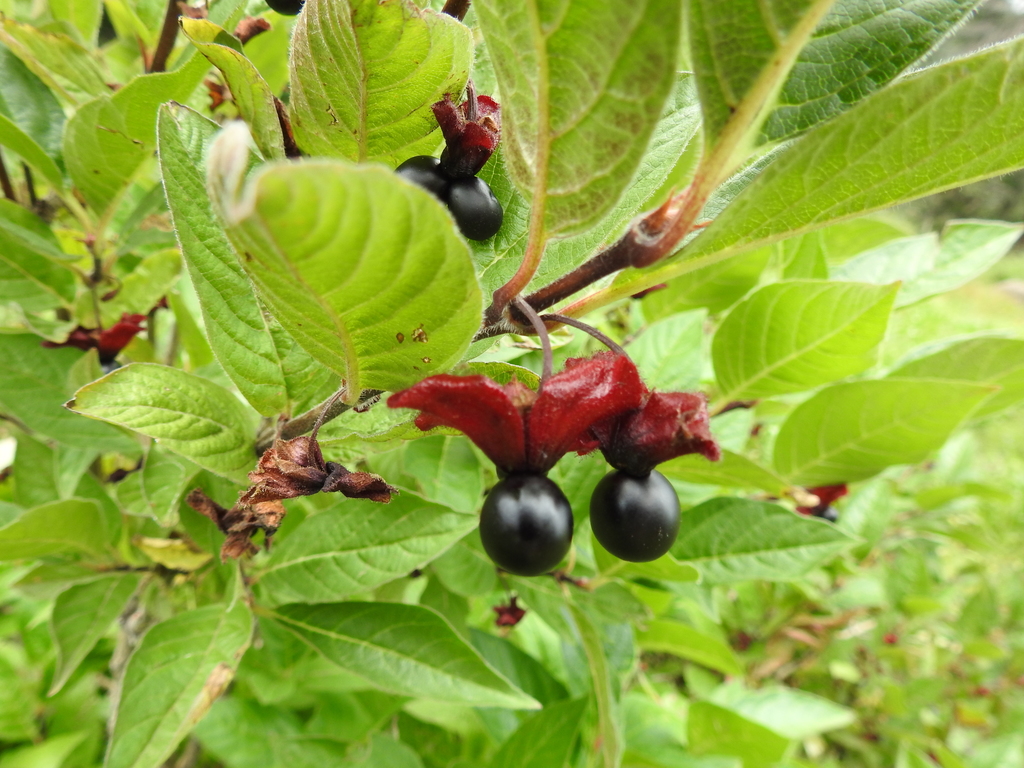
Photo: parent species Lonicera involucrata · (c) Laura Gaudette, some rights reserved (CC BY) · licence
Family: Caprifoliaceae · Type: Shrub · Native
Lonicera involucrata var. involucrata (Twinberry honeysuckle) is a native California shrub in the Caprifoliaceae family, recognized by conspicuous bracts around flowers/fruits, yellow flowers widening upward, black fruits.
Twinberry honeysuckle is a California native shrub found in the Klamath Ranges, northern coastal ranges, high Cascade Range, Sierra Nevada, and North Coast Mountains in moist habitats at elevations of 600 to 2,900 meters. Flowering from May to June, this plant produces yellow flowers with a corolla tube that widens toward the top, creating distinctive bell-shaped blooms. Growing 60 to 90 centimeters tall with an upright, multi-stemmed form, the shrub develops branching stems that create a dense, rounded appearance. Its leaves are soft and non-leathery, arranged oppositely along the stems, providing a lush green backdrop to the bright yellow flowers. The plant's stigma extends beyond the flower tube, a unique characteristic that likely aids in pollination.
Identification and appearance
Key characters: 8 sympatric species; key features are conspicuous bracts around flowers/fruits, yellow flowers widening upward, black fruits
Habitat and range
Habitat: Moist places
Elevation: 600-2900 m
California counties: Plumas, Tulare, Fresno, Alpine, Modoc, Amador, El Dorado, Glenn, Mariposa, Placer, Shasta, Tehama, Butte, Madera, Mono, Nevada, Tuolumne, Sierra, Siskiyou, Yuba, Inyo
Outside California: to Alaska, eastern North America, Mexico
Bloom period
Lonicera involucrata var. involucrata blooms May-Jun.
How to tell it apart
vs Symphoricarpos: Lonicera flowers are tubular and swollen on one side; Symphoricarpos has symmetrical bell-shaped flowers and white berries.; vs Rhamnus: Lonicera has showy tubular two-lipped flowers; Rhamnus has tiny inconspicuous greenish flowers with 4-5 separate petals.; vs Ceanothus: Lonicera has large tubular flowers; Ceanothus has tiny flowers in dense showy clusters.; vs Quercus: Lonicera has tubular flowers and berries; Quercus has catkins and produces acorns.; vs Vaccinium: Lonicera flowers are tubular and two-lipped; Vaccinium has symmetrical urn-shaped flowers.
Frequently asked questions
Is Lonicera involucrata var. involucrata native to California?
Yes. Lonicera involucrata var. involucrata is native to California (recorded as native).
When does Lonicera involucrata var. involucrata bloom?
Lonicera involucrata var. involucrata blooms May-Jun.
Where in California does Lonicera involucrata var. involucrata grow?
Lonicera involucrata var. involucrata occurs in Plumas, Tulare, Fresno, Alpine, Modoc, Amador, El Dorado, Glenn and other counties, at elevations of 600-2900 m.
What plant family does Lonicera involucrata var. involucrata belong to?
Lonicera involucrata var. involucrata is in the Caprifoliaceae family, genus Lonicera.
What habitat does Lonicera involucrata var. involucrata grow in?
Lonicera involucrata var. involucrata grows in Moist places.
Related species
Other California species in the same genus, family, or bioregion.
Sources: Jepson eFlora · Index of California Plant Names · CalPhotos
Last updated 2026-10-07
Data from The California Species Project — 14,000+ California species with verified data from CNPS, CDFW, USFWS, Cal-IPC, and more.