Lonicera involucrata var. ledebourii
Coast twinberry
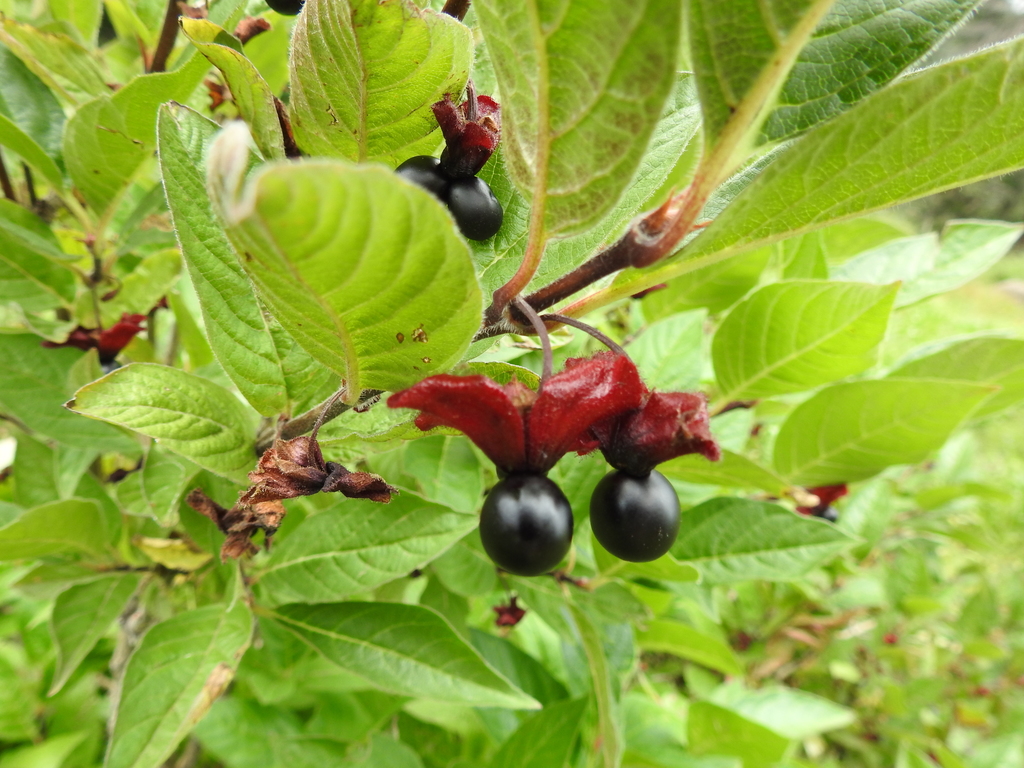
Photo: parent species Lonicera involucrata · (c) Laura Gaudette, some rights reserved (CC BY) · licence
Family: Caprifoliaceae · Type: Shrub · Native
Lonicera involucrata var. ledebourii (Coast twinberry) is a native California shrub in the Caprifoliaceae family, recognized by key features: large size, orange-red tinged flowers, leathery leaves, coastal.
Coast twinberry is a California native shrub found in northern coastal regions including North Coast Ranges, North Coast Interior, and Central Coast at elevations below 1,500 meters in moist habitats. Flowering from May to July, this plant produces distinctive yellow flowers strongly tinged with orange or red, creating a vibrant display. Growing 1.5 to 3.6 meters tall with a leathery, robust structure, the shrub develops a distinctive branching pattern. Its leaves are thick and leathery, providing a sturdy backdrop to the colorful blossoms. The plant's cylindric flower tubes and clustered growth make it a notable feature of coastal California's moist woodland and riparian environments.
Identification and appearance
Key characters: 10 sympatric species; key features: large size, orange-red tinged flowers, leathery leaves, coastal
Habitat and range
Habitat: Moist places
Elevation: < 1500 m
California counties: San Luis Obispo, San Mateo, Mendocino, Humboldt, Lake, Santa Clara, Santa Barbara, Monterey, Madera, San Francisco, Sonoma, Marin, Del Norte, San Benito, Alameda, Mono, Contra Costa, Orange, San Joaquin, Santa Cruz, Colusa, Glenn, Tehama, Napa, Siskiyou
Outside California: southern Oregon
Bloom period
Lonicera involucrata var. ledebourii blooms May-Jul.
How to tell it apart
vs Symphoricarpos: Lonicera flowers are tubular and swollen on one side; Symphoricarpos has symmetrical bell-shaped flowers and white berries.; vs Rhamnus: Lonicera has showy tubular two-lipped flowers; Rhamnus has tiny inconspicuous greenish flowers with 4-5 separate petals.; vs Ceanothus: Lonicera has large tubular flowers; Ceanothus has tiny flowers in dense showy clusters.; vs Quercus: Lonicera has tubular flowers and berries; Quercus has catkins and produces acorns.; vs Vaccinium: Lonicera flowers are tubular and two-lipped; Vaccinium has symmetrical urn-shaped flowers.
Frequently asked questions
Is Lonicera involucrata var. ledebourii native to California?
Yes. Lonicera involucrata var. ledebourii is native to California (recorded as native).
When does Lonicera involucrata var. ledebourii bloom?
Lonicera involucrata var. ledebourii blooms May-Jul.
Where in California does Lonicera involucrata var. ledebourii grow?
Lonicera involucrata var. ledebourii occurs in San Luis Obispo, San Mateo, Mendocino, Humboldt, Lake, Santa Clara, Santa Barbara, Monterey and other counties, at elevations of < 1500 m.
What plant family does Lonicera involucrata var. ledebourii belong to?
Lonicera involucrata var. ledebourii is in the Caprifoliaceae family, genus Lonicera.
What habitat does Lonicera involucrata var. ledebourii grow in?
Lonicera involucrata var. ledebourii grows in Moist places.
Related species
Other California species in the same genus, family, or bioregion.
Sources: Jepson eFlora · Index of California Plant Names · CalPhotos
Last updated 2026-10-07
Data from The California Species Project — 14,000+ California species with verified data from CNPS, CDFW, USFWS, Cal-IPC, and more.