Lotus corniculatus
Bird's-foot trefoil
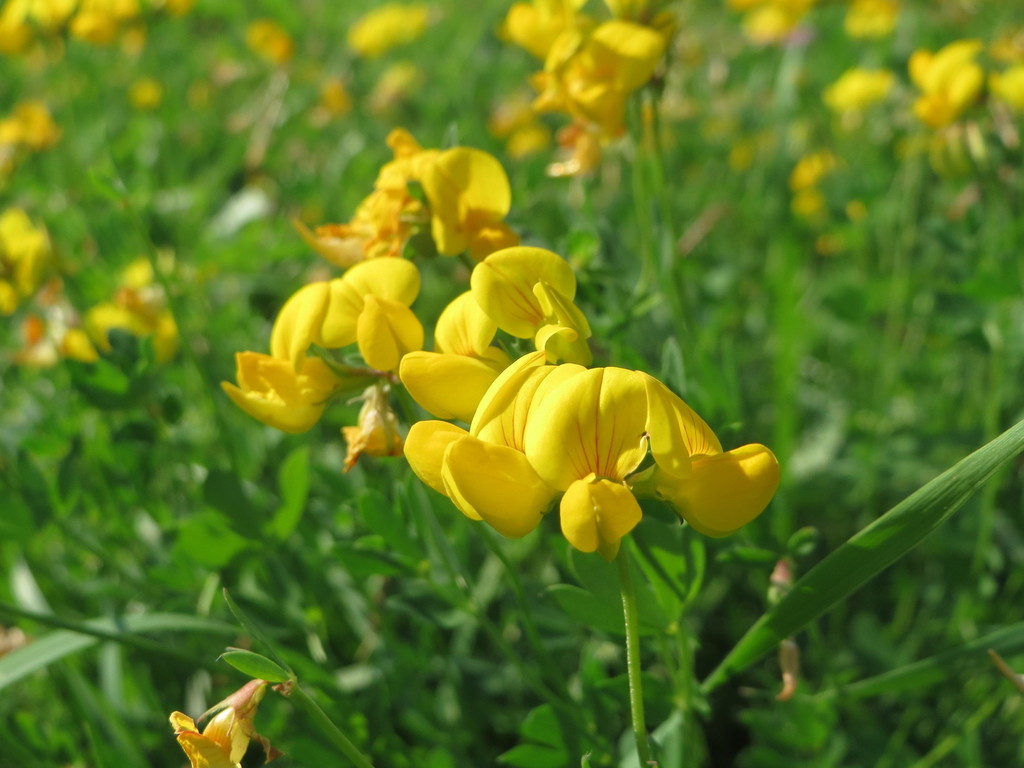
(c) Andreas Rockstein, some rights reserved (CC BY-SA) · licence
Family: Fabaceae · Type: Herb · Not Native
Lotus corniculatus (Bird's-foot trefoil) is a non-native California herb in the Fabaceae family, recognized by differentiated by largest flowers and broad leaflets.
Bird's-foot trefoil is a naturalized perennial herb found in California's Foothill Woodlands and Great Basin regions in open, disturbed areas at elevations below 1,000 meters. Flowering from June to September, this plant produces bright yellow flowers in small clusters of 3 to 7 blooms. Growing with decumbent or ascending stems up to 30 centimeters tall, it forms low-spreading clumps with a delicate, ground-hugging habit. Its distinctive leaves have five leaflets, each 4 to 22 millimeters long, with rounded tips that often have a soft point. The plant develops narrow elongated seed pods 1.5 to 3 centimeters long, which give it the distinctive "bird's foot" appearance that inspired its common name.
Identification and appearance
Key characters: 3 sympatric species; differentiated by largest flowers and broad leaflets
Habitat and range
Habitat: Open, disturbed areas
Elevation: < 1000 m
California counties: San Bernardino, Los Angeles, Santa Barbara, Ventura, San Diego, Riverside, San Francisco, Kern, Inyo, Contra Costa, Shasta, Marin, Plumas, Santa Clara, Solano, San Mateo, Colusa, Butte, Mendocino, Tulare, Humboldt, San Luis Obispo, Lake, Glenn, Orange, Siskiyou, Monterey, Fresno, Sacramento, Yolo, Placer, El Dorado, Alpine, Nevada, Modoc, Alameda, Lassen, Tehama, Sutter, Yuba, Stanislaus, Napa, Del Norte, Kings, Trinity, San Joaquin, Merced, Sonoma, Madera, San Benito
Outside California: to northern United States, southern Canada, native to Eurasia
Bloom period
Lotus corniculatus blooms Jun-Sep.
How to tell it apart
vs Lupinus: Lotus has yellow flowers and leaflets at the base; Lupinus has palmately arranged leaflets radiating from one point.; vs Trifolium: Lotus has yellow flowers and gland-like stipules; Trifolium has pink/white heads and papery stipules.; vs Astragalus: Lotus has 1-3 flowers in umbels; Astragalus has flowers in elongated spike-like clusters.; vs Pediomelum: Lotus has leaves along stems; Pediomelum has leaves clustered at base.; vs Ladeania: Lotus is widespread in disturbed areas; Ladeania occurs only in Great Basin sandy flats.
Frequently asked questions
Is Lotus corniculatus native to California?
No. Lotus corniculatus is not native to California (recorded as not native).
When does Lotus corniculatus bloom?
Lotus corniculatus blooms Jun-Sep.
Where in California does Lotus corniculatus grow?
Lotus corniculatus occurs in San Bernardino, Los Angeles, Santa Barbara, Ventura, San Diego, Riverside, San Francisco, Kern and other counties, at elevations of < 1000 m.
What plant family does Lotus corniculatus belong to?
Lotus corniculatus is in the Fabaceae family, genus Lotus.
What habitat does Lotus corniculatus grow in?
Lotus corniculatus grows in Open, disturbed areas.
Related species
Other California species in the same genus, family, or bioregion.
Sources: Jepson eFlora · Index of California Plant Names · CalPhotos
Last updated 2026-10-07
Data from The California Species Project — 14,000+ California species with verified data from CNPS, CDFW, USFWS, Cal-IPC, and more.