Ludwigia hexapetala
Uruguayan primrose-willow, Uruguayan Primrose-Willow
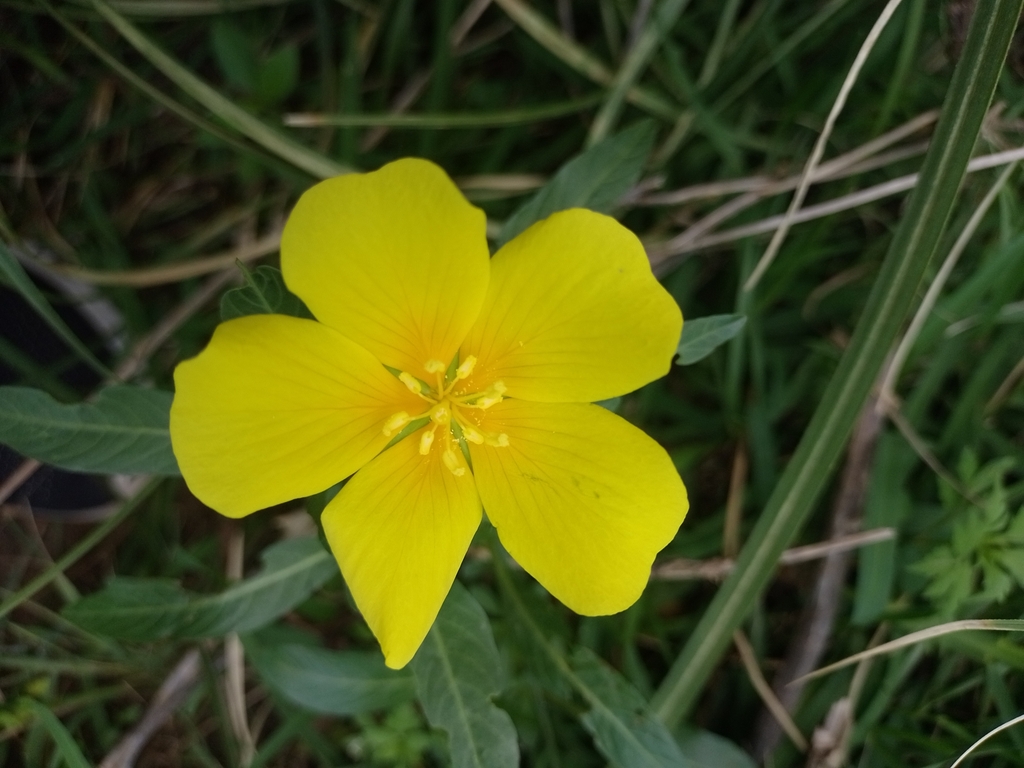
(c) Tomás Carranza Perales, some rights reserved (CC BY), uploaded by Tomás Carranza Perales · licence
Family: Onagraceae · Type: Perennial · Not Native
Conservation status: Cal-IPC Yes
Ludwigia hexapetala (Uruguayan primrose-willow) is a non-native California perennial in the Onagraceae family, recognized by . Largest flowers (18-29mm petals), often 6-petaled, mucronate leaf tips.
Uruguayan primrose-willow is a naturalized perennial herb found in coastal areas of northern and central California, including the Coast Ranges, Great Valley, and southern California coastal regions in lake margins and wetlands at elevations below 300 meters. Flowering from May to December, this plant produces yellow flowers with distinctive 18 to 29 millimeter-long petals that bloom in delicate arrangements. Growing up to 2 meters tall with thick white spongy roots, it spreads through creeping and floating stems that can climb over other plants. Its alternate leaves are narrowly elliptic to widely obovate, measuring 3 to 11 centimeters long with mucronate tips and variable petiole lengths. The distinctive fruit is cylindrical, reflexed, and covered in spreading hairs, measuring 14 to 26 millimeters long.
Identification and appearance
Key characters: 4 sympatric species. Largest flowers (18-29mm petals), often 6-petaled, mucronate leaf tips.
Habitat and range
Habitat: Lake margins, wetlands
Elevation: < 300 m
California counties: Marin, Ventura, Santa Clara, San Diego, Sonoma, Mendocino, Alpine, Orange, Yolo, Glenn, Sutter, Humboldt, San Luis Obispo, Butte, Colusa, Monterey
Outside California: Oregon, Washington, southeastern United States (native?), Central America, southern South America, Europe
Bloom period
Ludwigia hexapetala blooms May-Dec.
Conservation status
Cal-IPC Yes
How to tell it apart
vs Veronica: Ludwigia flowers have 4-5 petals and persistent sepals; Veronica has 4 petals and sepals that fall off.; vs Pistia: Ludwigia has separate petals and normal leaves; Pistia is a free-floating rosette with a spathe-like flower.; vs Portulaca: Ludwigia grows in wet habitats with thin leaves; Portulaca has succulent, fleshy leaves in dry areas.; vs Alternanthera: Ludwigia has slender stems; Alternanthera stems are distinctly swollen at the nodes.; vs Epilobium: Ludwigia flowers have no floral tube; Epilobium has a distinct tubular hypanthium extending above the ovary.
Frequently asked questions
Is Ludwigia hexapetala native to California?
No. Ludwigia hexapetala is not native to California (recorded as not native).
When does Ludwigia hexapetala bloom?
Ludwigia hexapetala blooms May-Dec.
Where in California does Ludwigia hexapetala grow?
Ludwigia hexapetala occurs in Marin, Ventura, Santa Clara, San Diego, Sonoma, Mendocino, Alpine, Orange and other counties, at elevations of < 300 m.
What plant family does Ludwigia hexapetala belong to?
Ludwigia hexapetala is in the Onagraceae family, genus Ludwigia.
Is Ludwigia hexapetala invasive in California?
Ludwigia hexapetala is listed by Cal-IPC with an invasiveness rating of Yes.
Related species
Other California species in the same genus, family, or bioregion.
Sources: Jepson eFlora · Index of California Plant Names · CalPhotos
Last updated 2026-09-30
Data from The California Species Project — 14,000+ California species with verified data from CNPS, CDFW, USFWS, Cal-IPC, and more.