Ludwigia peploides
Floating primrose willow
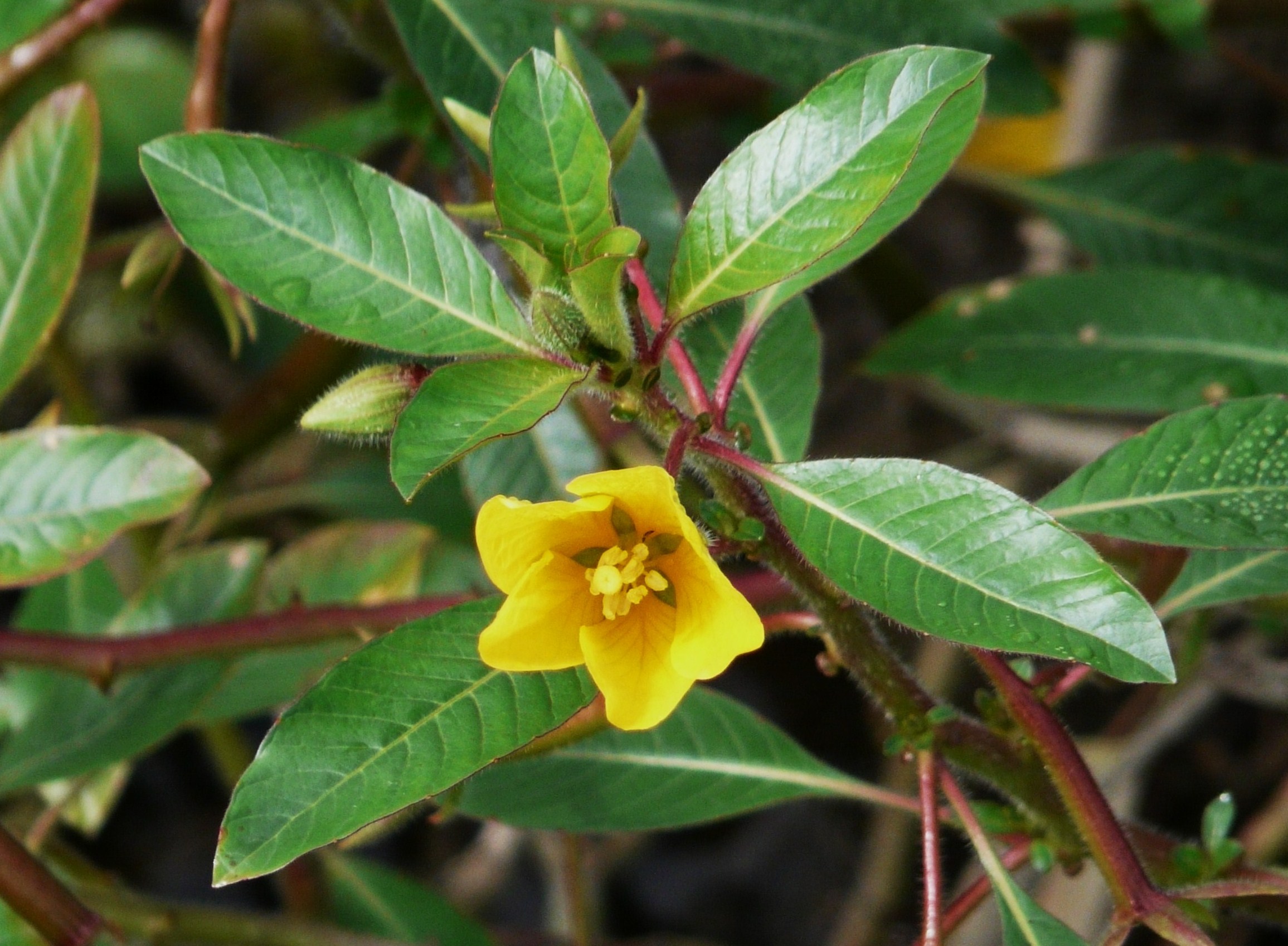
Père Igor (via Wikimedia Commons) · CC BY-SA
Family: Onagraceae · Type: Herb · Native
Conservation status: Cal-IPC Yes
Ludwigia peploides (Floating primrose willow) is a native California herb in the Onagraceae family, recognized by . Limited range data in eFlora.
Floating primrose willow is a naturalized perennial herb found in wetland and riparian habitats throughout California's central and coastal regions. Flowering from June to September, this plant produces bright yellow flowers with four to five petals approximately 2 to 3 centimeters wide. Growing in matted, floating, or creeping forms with stems that can be prostrate or erect, it spreads across water surfaces and shorelines. Its alternate leaves are oblong to round, clustered along the stem and ranging from 2 to 8 centimeters long, with smooth edges and occasional fine hairs near the stem's upper portions. The distinctive fruit is generally reflexed, with a hard body that can be nearly smooth or slightly hairy, containing small seeds embedded in a woody inner wall.
Identification and appearance
Key characters: Geographically isolated. Limited range data in eFlora.
Habitat and range
California counties: San Diego, Orange, Riverside, Kern, Sonoma, Los Angeles, San Bernardino, San Luis Obispo, Santa Barbara, Sutter, San Joaquin, Sacramento, Butte, Contra Costa, Ventura, Inyo, Fresno, Merced, Yolo, Tuolumne, Solano, Madera, Santa Cruz
Conservation status
Cal-IPC Yes
How to tell it apart
vs Veronica: Ludwigia flowers have 4-5 petals and persistent sepals; Veronica has 4 petals and sepals that fall off.; vs Pistia: Ludwigia has separate petals and normal leaves; Pistia is a free-floating rosette with a spathe-like flower.; vs Portulaca: Ludwigia grows in wet habitats with thin leaves; Portulaca has succulent, fleshy leaves in dry areas.; vs Alternanthera: Ludwigia has slender stems; Alternanthera stems are distinctly swollen at the nodes.; vs Epilobium: Ludwigia flowers have no floral tube; Epilobium has a distinct tubular hypanthium extending above the ovary.
Frequently asked questions
Is Ludwigia peploides native to California?
Yes. Ludwigia peploides is native to California (recorded as native).
Where in California does Ludwigia peploides grow?
Ludwigia peploides occurs in San Diego, Orange, Riverside, Kern, Sonoma, Los Angeles, San Bernardino, San Luis Obispo and other counties.
What plant family does Ludwigia peploides belong to?
Ludwigia peploides is in the Onagraceae family, genus Ludwigia.
Is Ludwigia peploides invasive in California?
Ludwigia peploides is listed by Cal-IPC with an invasiveness rating of Yes.
Related species
Other California species in the same genus, family, or bioregion.
Sources: Jepson eFlora · Index of California Plant Names · CalPhotos
Last updated 2026-10-07
Data from The California Species Project — 14,000+ California species with verified data from CNPS, CDFW, USFWS, Cal-IPC, and more.