Lupinus andersonii
Anderson's lupine
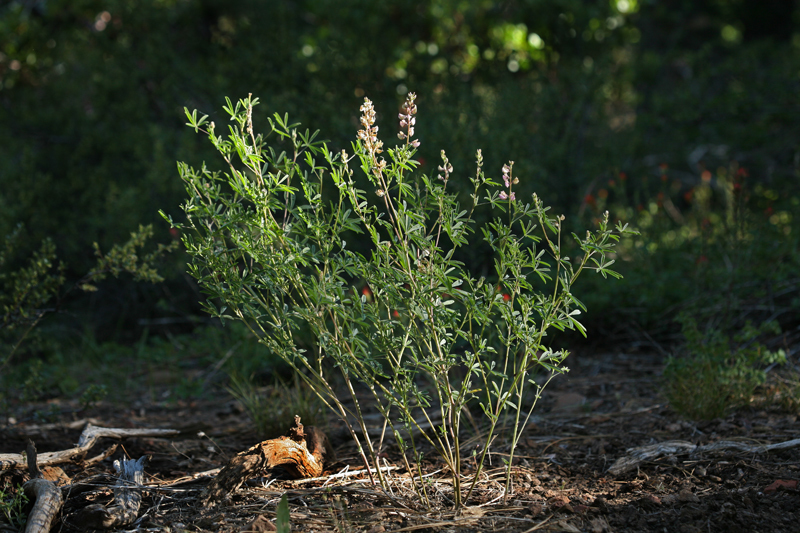
(c) Steve Matson, some rights reserved (CC BY), uploaded by Steve Matson · licence
Family: Fabaceae · Type: Herb · Native
Lupinus andersonii (Anderson's lupine) is a native California herb in the Fabaceae family, recognized by green foliage and glabrous keel are key.
Anderson's lupine is a California native perennial found in northwestern California, Sierra Nevada, western Transverse Ranges, San Bernardino Mountains, and eastern Sierra Nevada in dry slopes at elevations of 1,500 to 3,000 meters. Flowering from June to September, this plant produces light blue to lavender or purple flowers 9 to 12 millimeters long with a white spot that turns purple. Growing with erect green stems 20 to 90 centimeters tall and distinctly hairy, it develops a robust upright form. Its palmately compound leaves have 6 to 9 leaflets, each 20 to 60 millimeters long, arranged on petioles 2 to 6 centimeters in length. The fruit is a silky pod 2 to 4.5 centimeters long, containing 4 to 6 mottled tan and brown seeds.
Identification and appearance
Key characters: 87 sympatric species; green foliage and glabrous keel are key
Habitat and range
Habitat: dry slopes
Elevation: 1500-3000 m
California counties: San Bernardino, Mono, Kern, Los Angeles, Riverside, Ventura, Tulare, Inyo, Shasta, San Diego, Mariposa, Nevada, Alpine, Siskiyou, Orange, El Dorado, Plumas, Trinity, Butte, Lassen, Fresno, Placer, Tuolumne, Amador, Humboldt, Del Norte, Tehama, Sierra, Yuba, Calaveras, Santa Barbara
Outside California: southern Oregon, western Nevada
Bloom period
Lupinus andersonii blooms Jun-Sep.
How to tell it apart
vs Salvia: Lupine has pea flowers and palmate leaves; sage has tubular two-lipped flowers and opposite leaves.; vs Artemisia: Lupine has large showy flower spikes; sagebrush has tiny inconspicuous flowers and silvery aromatic foliage.; vs Thermopsis: Lupine typically has 7-11 leaflets; false lupine has exactly 3 leaflets and bright yellow flowers.; vs Delphinium: Lupine has pea flowers; larkspur has flowers with prominent backward-pointing spur.; vs Vicia: Lupine is upright with palmate leaves; vetch is climbing with pinnate leaves and tendrils.
Frequently asked questions
Is Lupinus andersonii native to California?
Yes. Lupinus andersonii is native to California (recorded as native).
When does Lupinus andersonii bloom?
Lupinus andersonii blooms Jun-Sep.
Where in California does Lupinus andersonii grow?
Lupinus andersonii occurs in San Bernardino, Mono, Kern, Los Angeles, Riverside, Ventura, Tulare, Inyo and other counties, at elevations of 1500-3000 m.
What plant family does Lupinus andersonii belong to?
Lupinus andersonii is in the Fabaceae family, genus Lupinus.
What habitat does Lupinus andersonii grow in?
Lupinus andersonii grows in dry slopes.
Related species
Other California species in the same genus, family, or bioregion.
Sources: Jepson eFlora · Index of California Plant Names · CalPhotos
Last updated 2026-10-07
Data from The California Species Project — 14,000+ California species with verified data from CNPS, CDFW, USFWS, Cal-IPC, and more.