Lupinus bicolor
Miniature lupine, Miniature Lupine
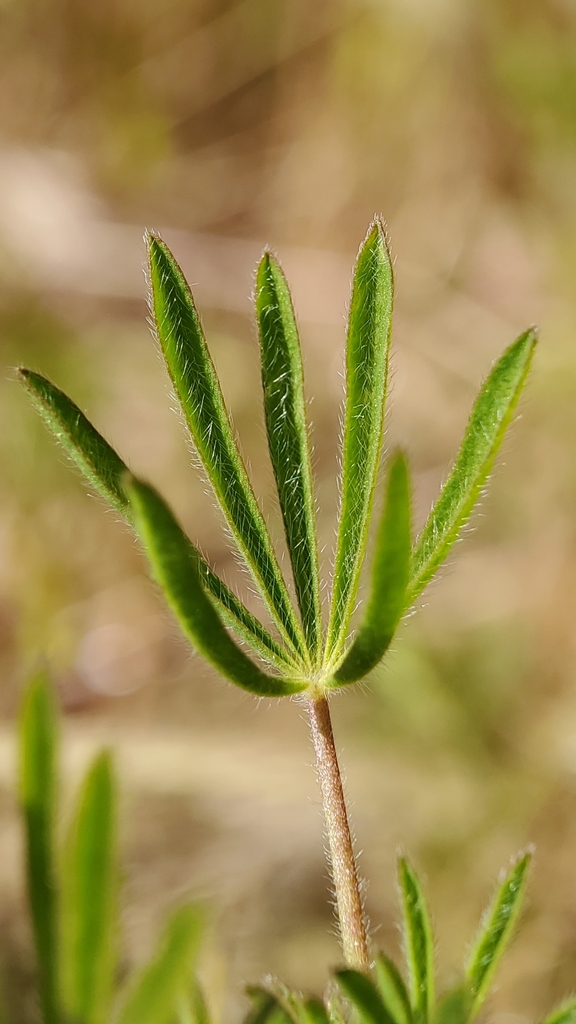
no rights reserved, uploaded by John Cowles · CC0
Family: Fabaceae · Type: Herb · Native
Lupinus bicolor (Miniature lupine) is a native California herb in the Fabaceae family, recognized by very small size.
Miniature lupine is a California native annual herb found in the California Floristic Province and Mojave Desert in open or disturbed areas at elevations below 1,600 meters. Flowering from March to June, this plant produces blue, pink, or white flowers with white banner spots that turn magenta with age, clustered in 2 to 5 whorled spirals. Growing 10 to 40 centimeters tall with hairy stems, it develops a compact and delicate form. Its palmate leaves consist of 5 to 7 slender leaflets 10 to 40 millimeters long, mostly smooth on the upper surface. The fruit is a small, hairy pod 1 to 3 centimeters long containing 5 to 8 seeds.
Identification and appearance
Key characters: 99 sympatric species; very small size is diagnostic
Habitat and range
Habitat: Abundant. Open or disturbed areas, many plant communities
Elevation: < 1600 m
California counties: Humboldt, Riverside, Placer, Calaveras, San Luis Obispo, Kern, San Diego, Los Angeles, Yolo, San Bernardino, Santa Barbara, Ventura, Tehama, Butte, Orange, Imperial, Inyo, Tulare, Monterey, Del Norte, San Benito, Lake, El Dorado, Fresno, Shasta, San Francisco, Solano, Alameda, Napa, San Mateo, San Joaquin, Sonoma, Mariposa, Contra Costa, Colusa, Merced, Santa Clara, Madera, Mendocino, Sacramento, Trinity, Amador, Sutter, Nevada, Yuba, Sierra, Stanislaus, Modoc, Marin, Santa Cruz, Glenn, Tuolumne, Siskiyou, Plumas
Outside California: to British Columbia, Baja California, naturalized in Arizona
Bloom period
Lupinus bicolor blooms Mar-Jun.
How to tell it apart
vs Salvia: Lupine has pea flowers and palmate leaves; sage has tubular two-lipped flowers and opposite leaves.; vs Artemisia: Lupine has large showy flower spikes; sagebrush has tiny inconspicuous flowers and silvery aromatic foliage.; vs Thermopsis: Lupine typically has 7-11 leaflets; false lupine has exactly 3 leaflets and bright yellow flowers.; vs Delphinium: Lupine has pea flowers; larkspur has flowers with prominent backward-pointing spur.; vs Vicia: Lupine is upright with palmate leaves; vetch is climbing with pinnate leaves and tendrils.
Frequently asked questions
Is Lupinus bicolor native to California?
Yes. Lupinus bicolor is native to California (recorded as native).
When does Lupinus bicolor bloom?
Lupinus bicolor blooms Mar-Jun.
Where in California does Lupinus bicolor grow?
Lupinus bicolor occurs in Humboldt, Riverside, Placer, Calaveras, San Luis Obispo, Kern, San Diego, Los Angeles and other counties, at elevations of < 1600 m.
What plant family does Lupinus bicolor belong to?
Lupinus bicolor is in the Fabaceae family, genus Lupinus.
What habitat does Lupinus bicolor grow in?
Lupinus bicolor grows in Abundant. Open or disturbed areas, many plant communities.
Related species
Other California species in the same genus, family, or bioregion.
Sources: Jepson eFlora · Index of California Plant Names · CalPhotos
Last updated 2026-10-07
Data from The California Species Project — 14,000+ California species with verified data from CNPS, CDFW, USFWS, Cal-IPC, and more.