Lupinus luteolus
Butter lupine, Butter Lupine
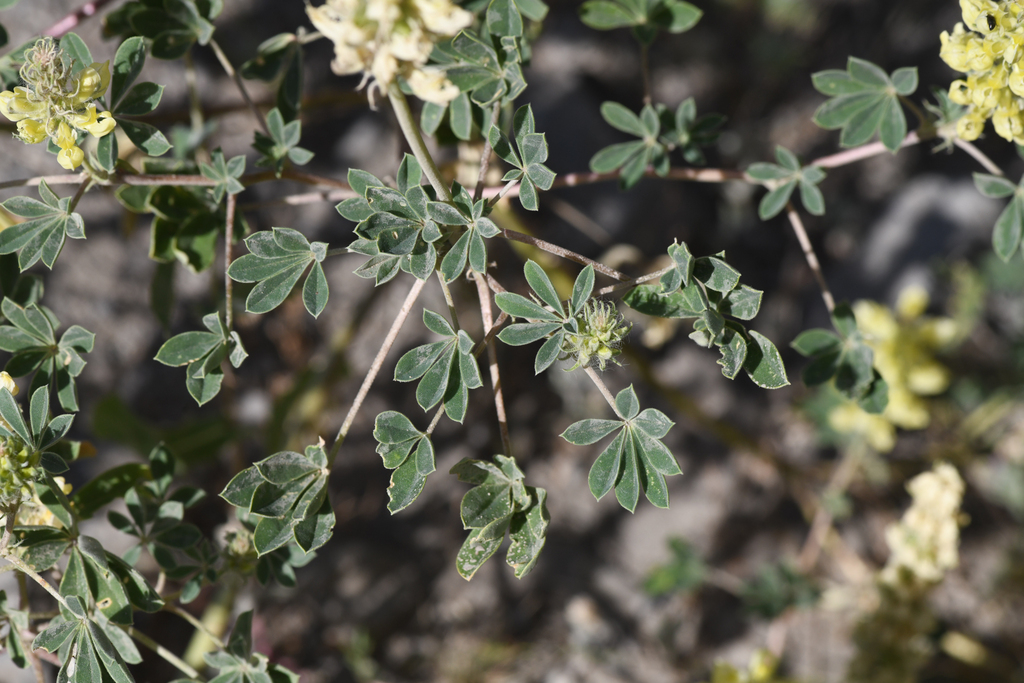
(c) Trevor Van Loon, some rights reserved (CC BY) · licence
Family: Fabaceae · Type: Herb · Native
Lupinus luteolus (Butter lupine) is a native California herb in the Fabaceae family, recognized by yellow flowers, persistent cotyledons, wide ovate fruits.
Butter lupine is a California native annual found in northwestern California, the California Ranges, eastern San Francisco Bay Area, and northern Santa Cruz Mountains in clearings and open areas within grasslands, oak woodlands, and conifer forests at elevations of 200 to 1,900 meters. Flowering from March to August, this plant produces pale yellow flowers occasionally tinged with pink or bright blue, arranged in crowded whorls on 5 to 22 centimeter inflorescences. Growing 30 to 100 centimeters tall with hard, rigid stems that appear glaucous and become less hairy with age, it develops a distinctive structure with persistent disk-like cotyledons. Its leaves feature 7 to 9 leaflets, each 10 to 30 millimeters long, typically hairy on the upper surface and arranged on petioles 2 to 5 centimeters in length. The spreading fruit is ovate, 1 to 1.5 centimeters long, and covered in fine hairs, containing two dark brown, tubercled seeds.
Identification and appearance
Key characters: 56 sympatric species; key features are yellow flowers, persistent cotyledons, wide ovate fruits
Habitat and range
Habitat: Clearings, open or disturbed areas in grasslands, oak woodlands, conifer forests
Elevation: 200-1900 m
Outside California: Oregon
Bloom period
Lupinus luteolus blooms Mar-Aug (generally later at higher elevations).
How to tell it apart
vs Salvia: Lupine has pea flowers and palmate leaves; sage has tubular two-lipped flowers and opposite leaves.; vs Artemisia: Lupine has large showy flower spikes; sagebrush has tiny inconspicuous flowers and silvery aromatic foliage.; vs Thermopsis: Lupine typically has 7-11 leaflets; false lupine has exactly 3 leaflets and bright yellow flowers.; vs Delphinium: Lupine has pea flowers; larkspur has flowers with prominent backward-pointing spur.; vs Vicia: Lupine is upright with palmate leaves; vetch is climbing with pinnate leaves and tendrils.
Frequently asked questions
Is Lupinus luteolus native to California?
Yes. Lupinus luteolus is native to California (recorded as native).
When does Lupinus luteolus bloom?
Lupinus luteolus blooms Mar-Aug (generally later at higher elevations).
What plant family does Lupinus luteolus belong to?
Lupinus luteolus is in the Fabaceae family, genus Lupinus.
What habitat does Lupinus luteolus grow in?
Lupinus luteolus grows in Clearings, open or disturbed areas in grasslands, oak woodlands, conifer forests.
Related species
Other California species in the same genus, family, or bioregion.
- Lupinus magnificus — Magnificent lupine
- Lupinus magnificus var. glarecola — Coso mountain lupine
- Lupinus magnificus var. hesperius — Mcgee meadow lupine
- Lupinus magnificus var. magnificus — Panamint mountain lupine
- Lupinus microcarpus — Chick lupine
- Lupinus microcarpus var. densiflorus — Secund chick lupine
Sources: Jepson eFlora · CalPhotos
Last updated 2026-10-07
Data from The California Species Project — 14,000+ California species with verified data from CNPS, CDFW, USFWS, Cal-IPC, and more.