Lupinus polyphyllus var. humicola
Holmgren's lupine
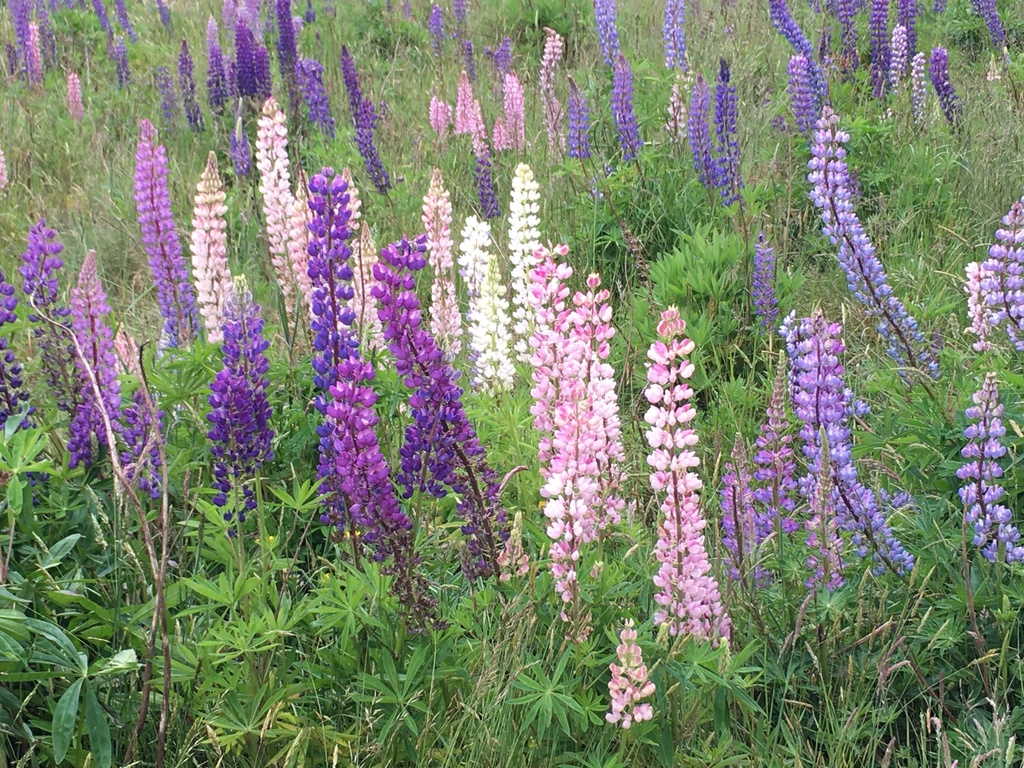
Photo: parent species Lupinus polyphyllus · (c) Henrik Kibak, some rights reserved (CC BY) · licence
Family: Fabaceae · Type: Perennial · Native
Conservation status: CNPS 2B.3
Lupinus polyphyllus var. humicola (Holmgren's lupine) is a native California perennial in the Fabaceae family, recognized by no sympatric species.
Holmgren's lupine is a rare (CNPS 2B.3) California native perennial found in the northeastern desert mountains including the Last Chance Range, Grapevine Mountains, and Inyo County in dry desert slopes, pinyon and juniper woodland, and grassy sites at elevations of 1,500 to 2,500 meters. Flowering from May to June, this plant produces violet flowers with a distinctive yellow banner spot, arranged in open to dense inflorescences 10 to 26 centimeters long. Growing 4 to 7 decimeters tall with long-hairy stems and a partially exposed caudex, it has an upright and somewhat robust form. Its leaves feature 7 to 12 silvery-gray leaflets that appear linear and are often folded, measuring 30 to 55 millimeters long with a silky, minutely strigose texture. The fruit develops as a long pod reaching 4 to 5 centimeters in length.
Identification and appearance
Key characters: Geographically isolated; no sympatric species
Habitat and range
Habitat: dry desert slopes, pinyon/juniper woodland, grassy and open wooded sites
Elevation: 1500-2500 m
Outside California: to British Columbia, Montana, Wyoming, Colorado, Arizona, Nevada, Utah
Bloom period
Lupinus polyphyllus var. humicola blooms May-Jun(Sep).
Conservation status
CNPS 2B.3
How to tell it apart
vs Salvia: Lupine has pea flowers and palmate leaves; sage has tubular two-lipped flowers and opposite leaves.; vs Artemisia: Lupine has large showy flower spikes; sagebrush has tiny inconspicuous flowers and silvery aromatic foliage.; vs Thermopsis: Lupine typically has 7-11 leaflets; false lupine has exactly 3 leaflets and bright yellow flowers.; vs Delphinium: Lupine has pea flowers; larkspur has flowers with prominent backward-pointing spur.; vs Vicia: Lupine is upright with palmate leaves; vetch is climbing with pinnate leaves and tendrils.
Frequently asked questions
Is Lupinus polyphyllus var. humicola native to California?
Yes. Lupinus polyphyllus var. humicola is native to California (recorded as native).
When does Lupinus polyphyllus var. humicola bloom?
Lupinus polyphyllus var. humicola blooms May-Jun(Sep).
What plant family does Lupinus polyphyllus var. humicola belong to?
Lupinus polyphyllus var. humicola is in the Fabaceae family, genus Lupinus.
Is Lupinus polyphyllus var. humicola rare or endangered?
Lupinus polyphyllus var. humicola carries California Rare Plant Rank 2B.3, state rank S2.
What habitat does Lupinus polyphyllus var. humicola grow in?
Lupinus polyphyllus var. humicola grows in dry desert slopes, pinyon/juniper woodland, grassy and open wooded sites.
Related species
Other California species in the same genus, family, or bioregion.
- Lupinus polyphyllus var. polyphyllus — Meadow lupine
- Lupinus polyphyllus var. saxosus — Rock lupine
- Lupinus pratensis — Inyo meadow lupine
- Lupinus pratensis var. eriostachyus — Hairy bannered inyo meadow lupine
- Lupinus pratensis var. pratensis — Inyo meadow lupine
- Lupinus pusillus var. intermontanus — Intermountain lupine
Sources: Jepson eFlora · CalPhotos · CDFW CNDDB
Last updated 2026-04-09
Data from The California Species Project — 14,000+ California species with verified data from CNPS, CDFW, USFWS, Cal-IPC, and more.