Lupinus sparsiflorus
Coulter's lupine
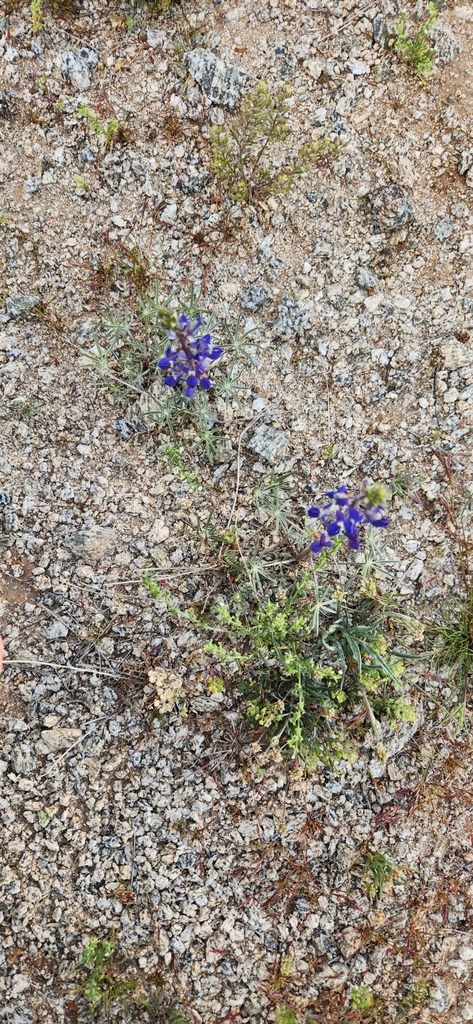
(c) Marci Howdyshell, some rights reserved (CC BY) · licence
Family: Fabaceae · Type: Herb · Native
Lupinus sparsiflorus (Coulter's lupine) is a native California herb in the Fabaceae family, recognized by spiraled flowers and color-changing banner spot.
Coulter's lupine is a California native annual found in southern coastal ranges, southwestern California, and the Mojave Desert in washes, sandy areas, coastal sage scrub, and creosote bush scrub at elevations below 1,300 meters. Flowering from February to May, this plant produces blue to pink flowers with yellow or white banner spots that darken with age, typically 10 to 12 millimeters long. Growing 15 to 40 centimeters tall with short-appressed and long-spreading hairs, the plant has an open, slender form. Its leaves feature 7 to 11 narrow leaflets 15 to 30 millimeters long, each 2 to 5 millimeters wide, with linear to oblanceolate shapes and hairy margins. The fruit is 1 to 2.5 centimeters long, covered in coarse hairs and containing 4 to 5 seeds.
Identification and appearance
Key characters: 61 sympatric species; key features are spiraled flowers and color-changing banner spot
Habitat and range
Habitat: Locally common. Washes, sandy areas, coastal sage scrub, creosote bush scrub, Joshua tree woodland
Elevation: < 1300 m
California counties: San Diego, San Bernardino, Los Angeles, Orange, Riverside, Imperial, Ventura, Kern, Santa Barbara, San Luis Obispo, Tulare, Monterey
Outside California: to Utah, Arizona, northern Mexico
Bloom period
Lupinus sparsiflorus blooms Feb-May.
How to tell it apart
vs Salvia: Lupine has pea flowers and palmate leaves; sage has tubular two-lipped flowers and opposite leaves.; vs Artemisia: Lupine has large showy flower spikes; sagebrush has tiny inconspicuous flowers and silvery aromatic foliage.; vs Thermopsis: Lupine typically has 7-11 leaflets; false lupine has exactly 3 leaflets and bright yellow flowers.; vs Delphinium: Lupine has pea flowers; larkspur has flowers with prominent backward-pointing spur.; vs Vicia: Lupine is upright with palmate leaves; vetch is climbing with pinnate leaves and tendrils.
Frequently asked questions
Is Lupinus sparsiflorus native to California?
Yes. Lupinus sparsiflorus is native to California (recorded as native).
When does Lupinus sparsiflorus bloom?
Lupinus sparsiflorus blooms Feb-May.
Where in California does Lupinus sparsiflorus grow?
Lupinus sparsiflorus occurs in San Diego, San Bernardino, Los Angeles, Orange, Riverside, Imperial, Ventura, Kern and other counties, at elevations of < 1300 m.
What plant family does Lupinus sparsiflorus belong to?
Lupinus sparsiflorus is in the Fabaceae family, genus Lupinus.
What habitat does Lupinus sparsiflorus grow in?
Lupinus sparsiflorus grows in Locally common. Washes, sandy areas, coastal sage scrub, creosote bush scrub, Joshua tree woodland.
Related species
Other California species in the same genus, family, or bioregion.
Sources: Jepson eFlora · Index of California Plant Names · CalPhotos
Last updated 2026-10-07
Data from The California Species Project — 14,000+ California species with verified data from CNPS, CDFW, USFWS, Cal-IPC, and more.