Lupinus spectabilis
Shaggy hair lupine
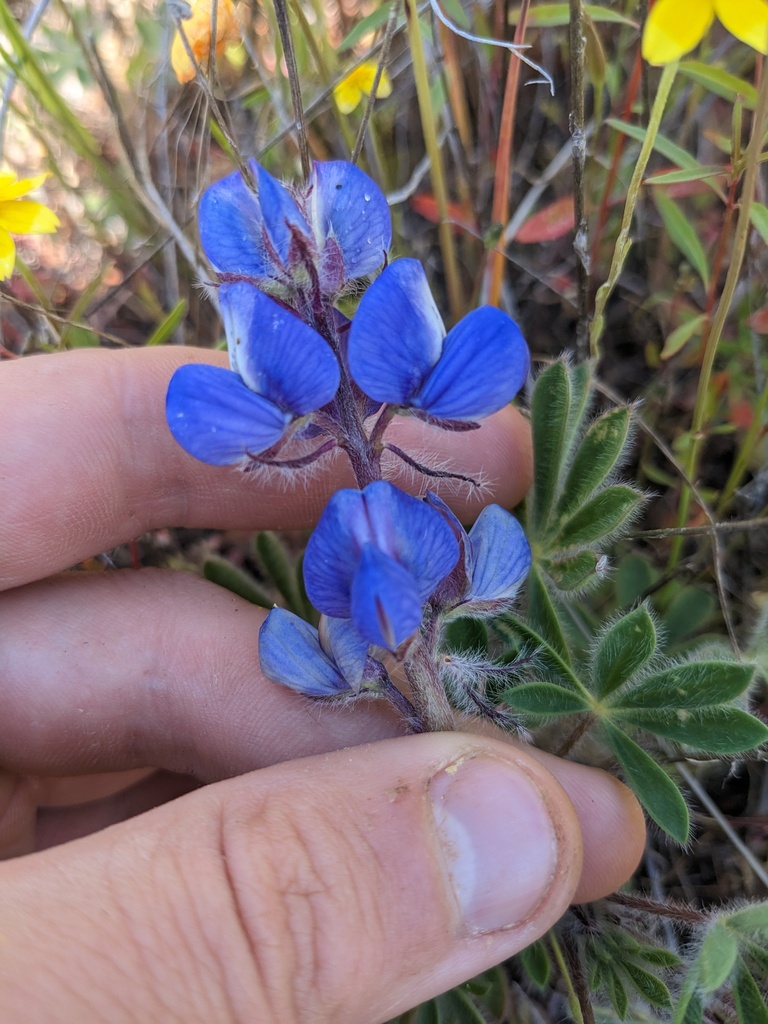
(c) Trevor Van Loon, some rights reserved (CC BY) · licence
Family: Fabaceae · Type: Herb · Native
Conservation status: CNPS 1B.2
Lupinus spectabilis (Shaggy hair lupine) is a native California herb in the Fabaceae family, recognized by in Sierra foothills; distinctive extremely long dense hairs throughout.
Shaggy hair lupine is a rare (CNPS 1B.2) California native annual found in central Sierra Nevada foothills of Mariposa and Tuolumne counties in serpentine chaparral and foothill woodland at elevations of 200 to 900 meters. Flowering from April to May, this plant produces distinctively blue flowers with white banner spots, typically 11 to 17 millimeters long, clustered in whorled arrangements. Growing with dense stems 20 to 60 centimeters tall, covered in short appressed and long spreading hairs up to 3.5 millimeters long, it presents a shaggy, textured appearance. Its compound leaves feature nine leaflets, each 10 to 40 millimeters long and 4 to 9 millimeters wide, supported by petioles 4 to 9 centimeters in length. The fruit is a densely hairy pod 3 to 5 centimeters long and 8 to 9 millimeters wide, containing 5 to 10 seeds.
Identification and appearance
Key characters: 24 sympatric species in Sierra foothills; distinctive extremely long dense hairs throughout
Habitat and range
Habitat: Serpentine, chaparral, foothill woodland
Elevation: 200-900 m
California counties: Mariposa, Tuolumne
Bloom period
Lupinus spectabilis blooms Apr-May.
Conservation status
CNPS 1B.2
How to tell it apart
vs Salvia: Lupine has pea flowers and palmate leaves; sage has tubular two-lipped flowers and opposite leaves.; vs Artemisia: Lupine has large showy flower spikes; sagebrush has tiny inconspicuous flowers and silvery aromatic foliage.; vs Thermopsis: Lupine typically has 7-11 leaflets; false lupine has exactly 3 leaflets and bright yellow flowers.; vs Delphinium: Lupine has pea flowers; larkspur has flowers with prominent backward-pointing spur.; vs Vicia: Lupine is upright with palmate leaves; vetch is climbing with pinnate leaves and tendrils.
Frequently asked questions
Is Lupinus spectabilis native to California?
Yes. Lupinus spectabilis is native to California (recorded as native).
When does Lupinus spectabilis bloom?
Lupinus spectabilis blooms Apr-May.
Where in California does Lupinus spectabilis grow?
Lupinus spectabilis occurs in Mariposa, Tuolumne, at elevations of 200-900 m.
What plant family does Lupinus spectabilis belong to?
Lupinus spectabilis is in the Fabaceae family, genus Lupinus.
Is Lupinus spectabilis rare or endangered?
Lupinus spectabilis carries California Rare Plant Rank 1B.2, state rank S2.
Related species
Other California species in the same genus, family, or bioregion.
Sources: Jepson eFlora · CNPS Rare Plant Inventory · Index of California Plant Names · CalPhotos · CDFW CNDDB
Last updated 2026-10-07
Data from The California Species Project — 14,000+ California species with verified data from CNPS, CDFW, USFWS, Cal-IPC, and more.