Lupinus uncialis
Lilliput lupine, Lilliput Lupine
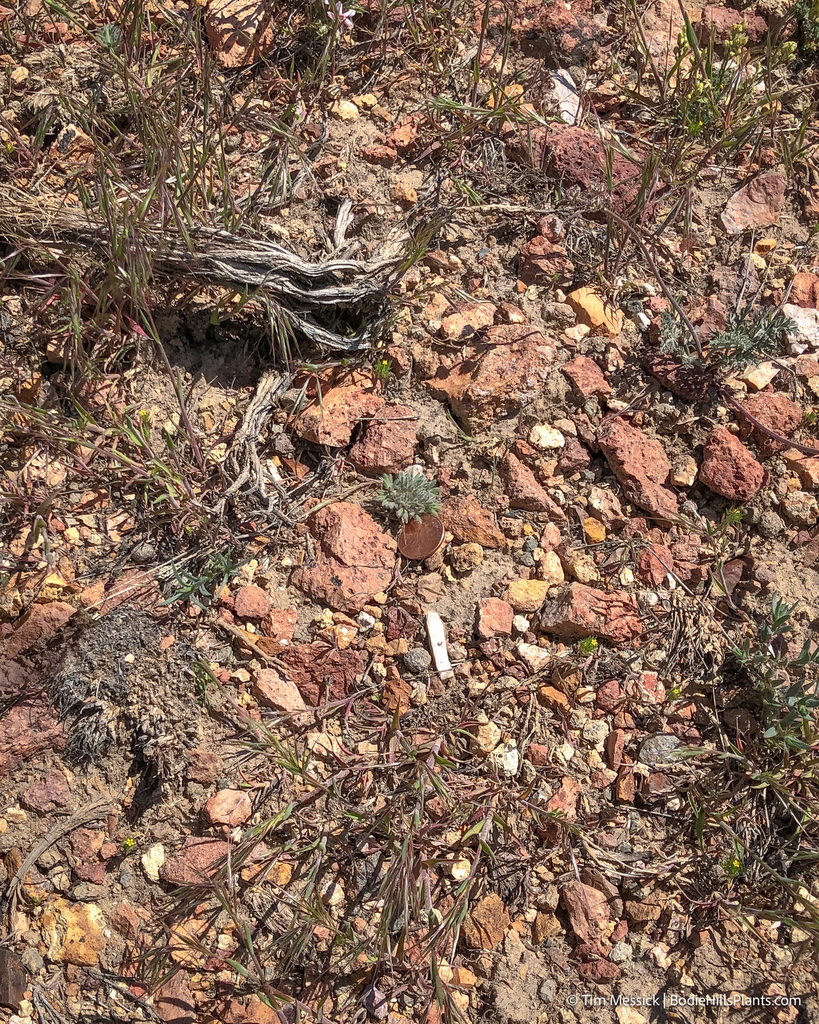
(c) Tim Messick, some rights reserved (CC BY) · licence
Family: Fabaceae · Type: Herb · Native
Conservation status: CNPS 2B.2
Lupinus uncialis (Lilliput lupine) is a native California herb in the Fabaceae family, recognized by on Modoc Plateau; unmistakable tiny size (1-3 cm) and two-toned flowers.
Lilliput lupine is a rare (CNPS 2B.2) California native annual found in the Modoc Plateau in open areas, barrens, and talus within sagebrush and pinyon/juniper woodland on limestone and volcanic substrates at elevations of 1,300 to 1,600 meters. Flowering from May to July, this diminutive plant produces delicately colored white and purple flowers with distinctive two-toned petals. Growing exceptionally small at just 1 to 2 centimeters tall, it forms densely tufted clusters with hairy stems and distinctive disk-like persistent cotyledons. Its leaves are composed of 3 to 5 tiny oblanceolate leaflets, each measuring 2 to 7 millimeters long and covered in fine hairs. The fruit is a small ovate pod 6 to 10 millimeters long, also covered in characteristic hairy indumentum.
Identification and appearance
Key characters: 25 sympatric species on Modoc Plateau; unmistakable tiny size (1-3 cm) and two-toned flowers
Habitat and range
Habitat: Open areas, barrens, talus in sagebrush and pinyon/juniper woodland, on limestone, rhyolite, volcanic gravels
Elevation: 1300-1600 m
California counties: Modoc
Outside California: Oregon, Idaho, Nevada
Bloom period
Lupinus uncialis blooms May-Jul.
Conservation status
CNPS 2B.2
How to tell it apart
vs Salvia: Lupine has pea flowers and palmate leaves; sage has tubular two-lipped flowers and opposite leaves.; vs Artemisia: Lupine has large showy flower spikes; sagebrush has tiny inconspicuous flowers and silvery aromatic foliage.; vs Thermopsis: Lupine typically has 7-11 leaflets; false lupine has exactly 3 leaflets and bright yellow flowers.; vs Delphinium: Lupine has pea flowers; larkspur has flowers with prominent backward-pointing spur.; vs Vicia: Lupine is upright with palmate leaves; vetch is climbing with pinnate leaves and tendrils.
Frequently asked questions
Is Lupinus uncialis native to California?
Yes. Lupinus uncialis is native to California (recorded as native).
When does Lupinus uncialis bloom?
Lupinus uncialis blooms May-Jul.
Where in California does Lupinus uncialis grow?
Lupinus uncialis occurs in Modoc, at elevations of 1300-1600 m.
What plant family does Lupinus uncialis belong to?
Lupinus uncialis is in the Fabaceae family, genus Lupinus.
Is Lupinus uncialis rare or endangered?
Lupinus uncialis carries California Rare Plant Rank 2B.2, state rank S2.
Related species
Other California species in the same genus, family, or bioregion.
- Lupinus adsurgens — Drew's silky lupine
- Lupinus affinis — Fleshy lupine
- Lupinus albicaulis — Sickle keeled lupine
- Lupinus albifrons — Silver bush lupine
- Lupinus albifrons var. abramsii — Abrams' lupine
- Lupinus albifrons var. albifrons — Silver bush lupine
- Marina orcuttii var. orcuttii — California marina
- Marina parryi — Parry dalea
- Marina sp.
- Medicago arabica — Burclover
Sources: Jepson eFlora · CNPS Rare Plant Inventory · Index of California Plant Names · CalPhotos · CDFW CNDDB
Last updated 2026-10-07
Data from The California Species Project — 14,000+ California species with verified data from CNPS, CDFW, USFWS, Cal-IPC, and more.