Luzula piperi
Piper's woodrush
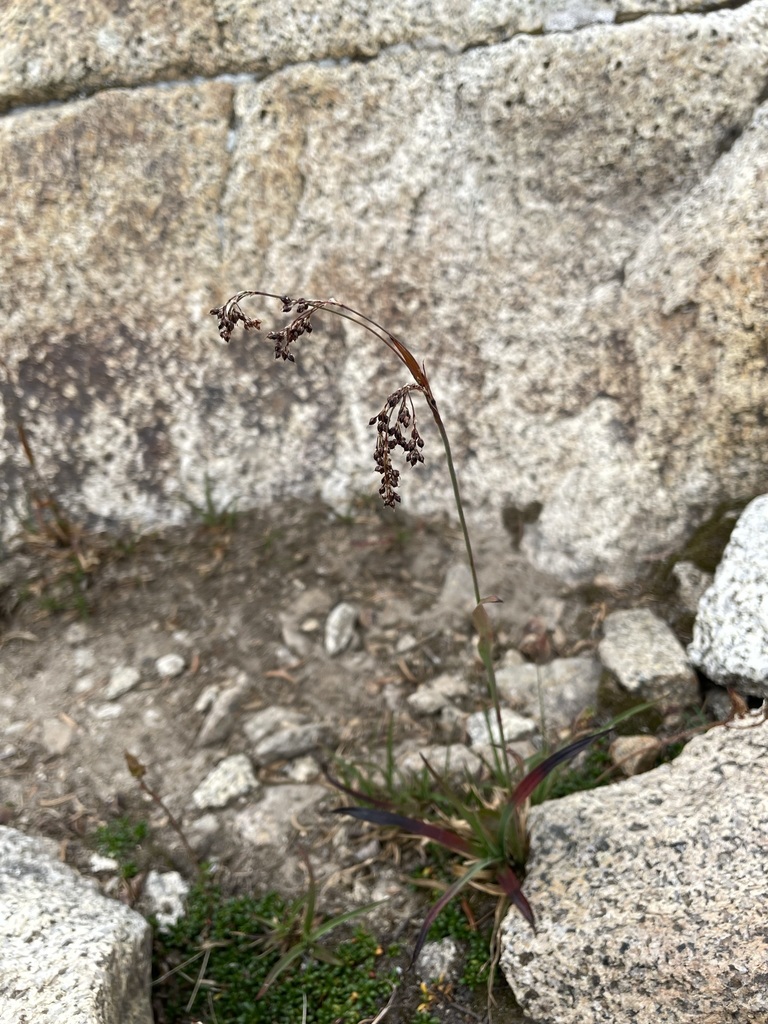
(c) Matt Berger, some rights reserved (CC BY) · licence
Family: Juncaceae · Type: Grass · Native
Luzula piperi (Piper's woodrush) is a native California grass in the Juncaceae family, recognized by blue-gray foliage and blackish flowers.
Piper's woodrush is a California native perennial found in the Klamath Ranges on subalpine and alpine slopes at elevations of 2,100 to 2,600 meters. Flowering in July, this plant produces small clusters of flowers with dark brown perianth parts in arching, nodding inflorescences 4 to 10 centimeters long. Growing in dense tufts 20 to 30 centimeters tall, it features blue- to gray-green leaves that turn purple in autumn. Its basal leaves are 5 to 10 centimeters long and 3 to 5 millimeters wide, with cauline leaves becoming progressively shorter up the stem. The plant produces shiny blackish to dark brown capsules that are slightly longer than the perianth, with small pale to dark brown seeds.
Identification and appearance
Key characters: 4 sympatric species; distinguished by blue-gray foliage and blackish flowers
Habitat and range
Habitat: Subalpine and alpine slopes, granitic or volcanic
Elevation: 2100-2600 m
Outside California: to Alaska, Alberta, Wyoming, eastern Asia
Bloom period
Luzula piperi blooms Jul.
How to tell it apart
vs Juncus: Run finger along leaf edge - hairy = Luzula, smooth = Juncus.; vs Carex: Luzula has hairy leaf margins; Carex has smooth margins and triangular stems.
Frequently asked questions
Is Luzula piperi native to California?
Yes. Luzula piperi is native to California (recorded as native).
When does Luzula piperi bloom?
Luzula piperi blooms Jul.
What plant family does Luzula piperi belong to?
Luzula piperi is in the Juncaceae family, genus Luzula.
What habitat does Luzula piperi grow in?
Luzula piperi grows in Subalpine and alpine slopes, granitic or volcanic.
Related species
Other California species in the same genus, family, or bioregion.
Sources: Jepson eFlora · CalPhotos
Last updated 2026-10-07
Data from The California Species Project — 14,000+ California species with verified data from CNPS, CDFW, USFWS, Cal-IPC, and more.