Lycopodium clavatum
Running-pine, Running-Pine
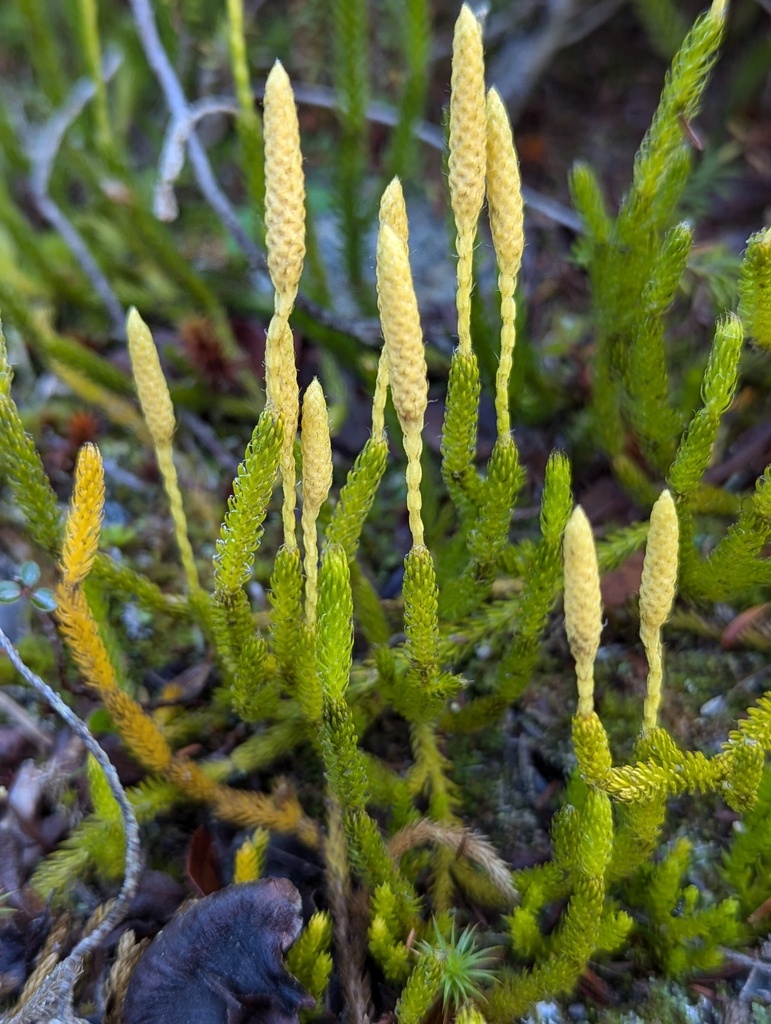
(c) Timothy McNitt, some rights reserved (CC BY) · licence
Family: Lycopodiaceae · Type: Subshrub · Native
Conservation status: CNPS 4.1
Lycopodium clavatum (Running-pine) is a native California subshrub in the Lycopodiaceae family, recognized by Range edge species; this circumpolar clubmoss reaches its southern Pacific limit in California's coastal fog belt.
Running-pine is a California native moss found in the North Coast bioregion in moist ground and swamps at elevations below 200 meters. With minimal flowering information available, this moss produces greenish-brown spore-bearing cones 1 to 3 centimeters long. Growing as a wide-creeping ground cover with vine-like stems up to 0.5 meters long and 0.5 to 1.5 centimeters wide, it spreads across forest floors and tree surfaces. Its leaves are small, approximately 4 to 7 millimeters long with distinctive narrow bristle tips, creating a delicate textured appearance. The moss produces 2 to 5 terminal reproductive cones on its fertile stems, characteristic of its sprawling growth habit.
Identification and appearance
Key characters: Range edge species; this circumpolar clubmoss reaches its southern Pacific limit in California's coastal fog belt
Habitat and range
Habitat: Moist ground, swamps (on trees)
Elevation: < 200 m
Outside California: to Alaska, Montana, New Mexico, eastern North America, Caribbean, South America, Europe, Africa, Asia
Conservation status
CNPS 4.1
How to tell it apart
vs Selaginella: Lycopodium has round stems with spirally arranged leaves; spike-moss has flattened branches with scale-like leaves in 4 rows.; vs Achillea: Lycopodium is a primitive club-moss with cones; yarrow is a flowering plant with flat-topped white flower clusters.; vs Euphorbia: Lycopodium is a low, moss-like plant with tiny leaves; spurge is a typical flowering plant with milky sap.; vs Lycopodiella: Lycopodium has branched fertile stems with multiple cones; bog club-moss has unbranched stems with single cones.
Frequently asked questions
Is Lycopodium clavatum native to California?
Yes. Lycopodium clavatum is native to California (recorded as native).
What plant family does Lycopodium clavatum belong to?
Lycopodium clavatum is in the Lycopodiaceae family, genus Lycopodium.
Is Lycopodium clavatum rare or endangered?
Lycopodium clavatum carries California Rare Plant Rank 4.1, state rank S3.
What habitat does Lycopodium clavatum grow in?
Lycopodium clavatum grows in Moist ground, swamps (on trees).
Related species
Other California species in the same genus, family, or bioregion.
Sources: Jepson eFlora · CNPS Rare Plant Inventory · Index of California Plant Names · CalPhotos · CDFW CNDDB
Last updated 2026-10-07
Data from The California Species Project — 14,000+ California species with verified data from CNPS, CDFW, USFWS, Cal-IPC, and more.