Lycopus uniflorus
Northern bugleweed
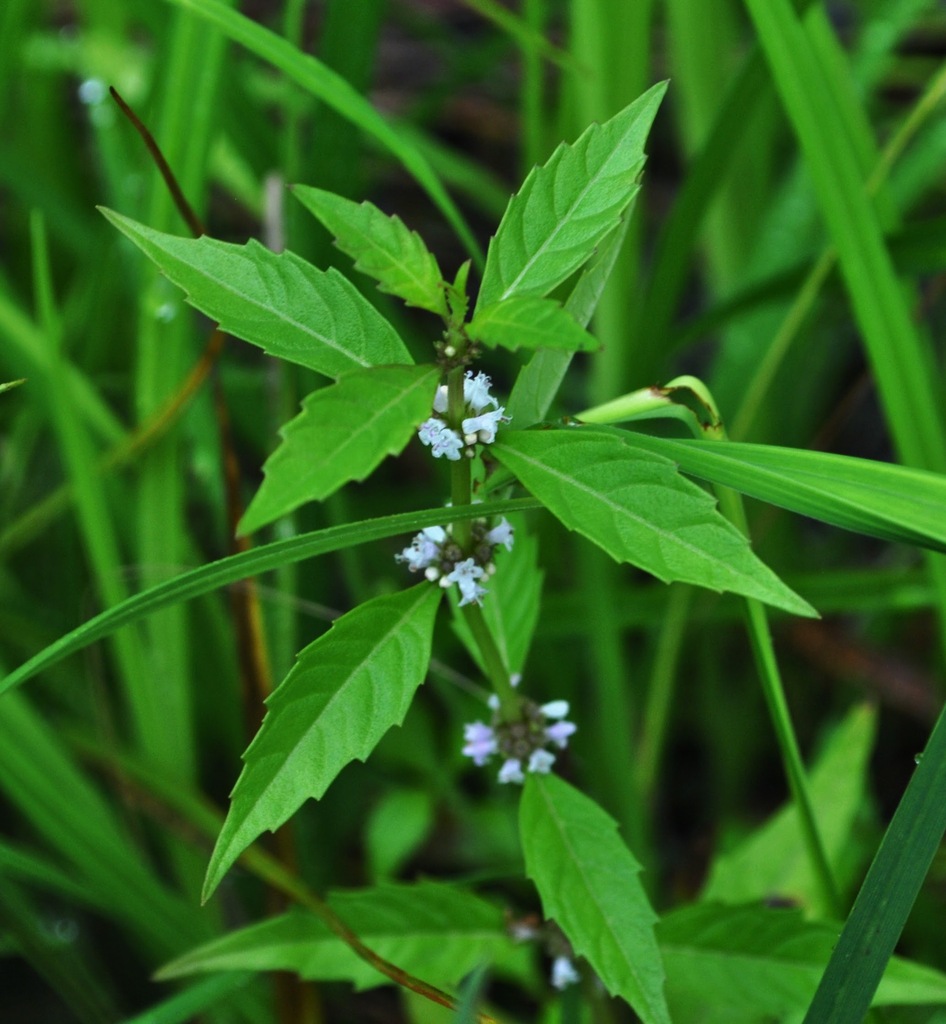
(c) aarongunnar, some rights reserved (CC BY), uploaded by aarongunnar · licence
Family: Lamiaceae · Type: Herb · Native
Conservation status: CNPS 4.3
Lycopus uniflorus (Northern bugleweed) is a native California herb in the Lamiaceae family, recognized by . Key features: highest elevation range, blunt calyx lobes, smaller stature.
Northern bugleweed is a California native perennial found in northwestern California, the Cascade Range, Sierra Nevada, and Modoc Plateau in moist areas, marshes, and near springs at elevations below 2,000 meters. Flowering from July to September, this plant produces small white flowers approximately 2.5 to 4 millimeters long. Growing with ascending to erect stems 10 to 50 centimeters tall that are finely hairy, it spreads through slender rhizomes with thickened, tuber-like tips. Its leaves are elliptic to lanceolate, generally 2 to 6 centimeters long with serrated edges and short petioles. The plant produces small nutlets 1 to 2 millimeters long with truncate tips.
Identification and appearance
Key characters: Co-occurs with 2 species. Key features: highest elevation range, blunt calyx lobes, smaller stature
Habitat and range
Habitat: Moist areas, marshes, near springs
Elevation: < 2000 m
California counties: Humboldt, Tuolumne, Plumas, Nevada, Lassen, Del Norte, Placer, Mariposa, Shasta, Siskiyou, Modoc
Outside California: to British Columbia, eastern United States
Bloom period
Lycopus uniflorus blooms Jul-Sep.
Conservation status
CNPS 4.3
How to tell it apart
vs Dysphania: Lycopus has opposite leaves and square stems (mint family), while Dysphania has alternate leaves and round stems.; vs Marrubium: Lycopus has 4-lobed flowers without an obvious lip, while Marrubium has strongly two-lipped hooded flowers.; vs Salvia: Lycopus has tiny 2-5mm white flowers with 4 equal lobes, while Salvia has larger two-lipped flowers.; vs Monarda: Lycopus grows in wetlands with tiny white flowers, while Monarda grows in desert mountains with larger radial flowers.; vs Acanthomintha: Lycopus lacks the spiny-edged bracts that make Acanthomintha look thorny beneath flower clusters.
Frequently asked questions
Is Lycopus uniflorus native to California?
Yes. Lycopus uniflorus is native to California (recorded as native).
When does Lycopus uniflorus bloom?
Lycopus uniflorus blooms Jul-Sep.
Where in California does Lycopus uniflorus grow?
Lycopus uniflorus occurs in Humboldt, Tuolumne, Plumas, Nevada, Lassen, Del Norte, Placer, Mariposa and other counties, at elevations of < 2000 m.
What plant family does Lycopus uniflorus belong to?
Lycopus uniflorus is in the Lamiaceae family, genus Lycopus.
Is Lycopus uniflorus rare or endangered?
Lycopus uniflorus carries California Rare Plant Rank 4.3, state rank S4.
Related species
Other California species in the same genus, family, or bioregion.
Sources: Jepson eFlora · CNPS Rare Plant Inventory · Index of California Plant Names · CalPhotos · CDFW CNDDB
Last updated 2026-10-07
Data from The California Species Project — 14,000+ California species with verified data from CNPS, CDFW, USFWS, Cal-IPC, and more.