Lythrum hyssopifolia
Hyssop loosestrife
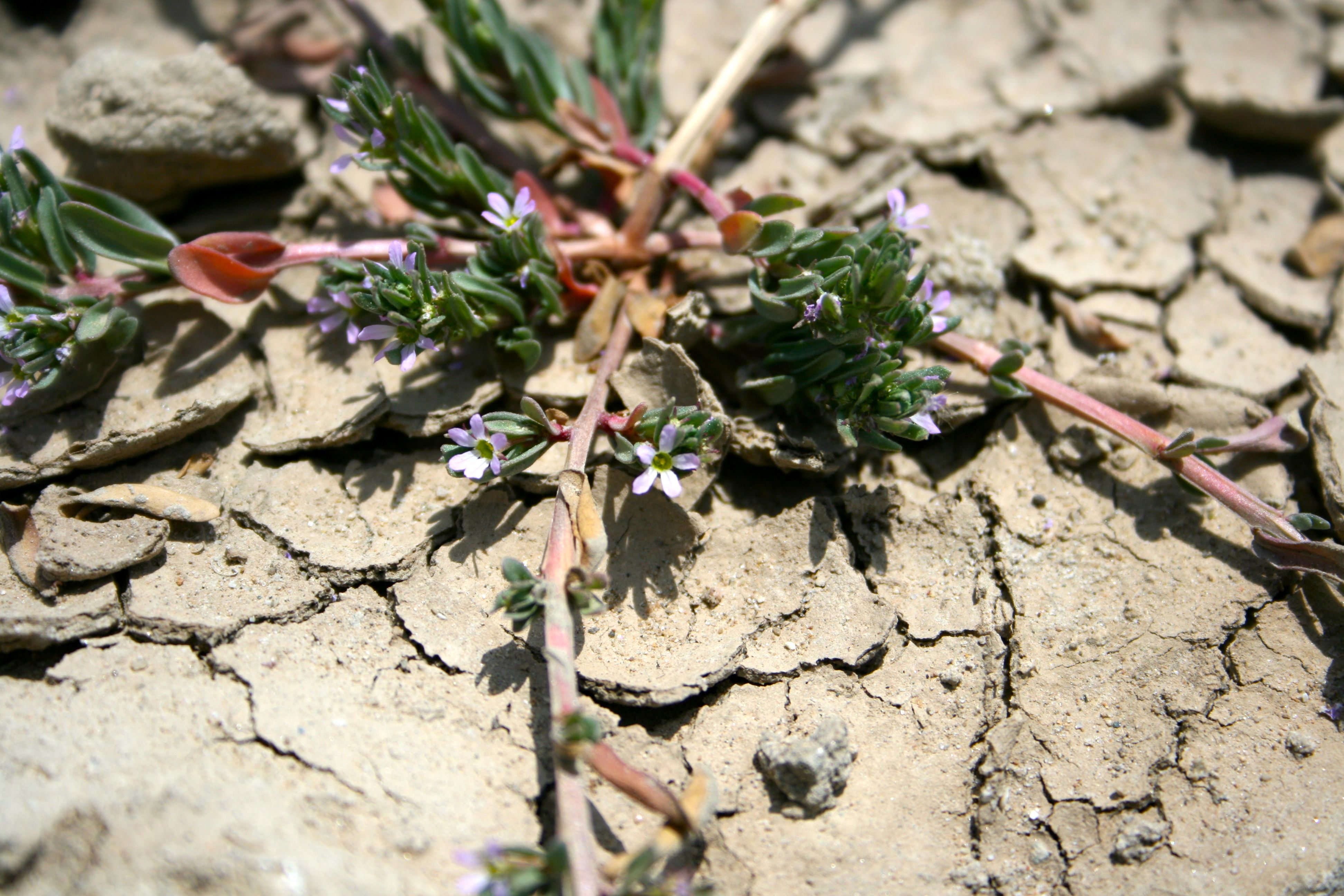
Photo by Chez Brungraber
Family: Lythraceae · Type: Herb · Not Native
Conservation status: Cal-IPC Yes
Lythrum hyssopifolia (Hyssop loosestrife) is a non-native California herb in the Lythraceae family, recognized by sessile flowers and leaf shape variation.
Hyssop loosestrife is a naturalized annual or short-lived perennial herb found in the California Floristic Province in marshes, drying pond margins, and disturbed ground at elevations below 1,600 meters. Flowering from April to October, this plant produces delicate pink to rose flowers 2 to 5 millimeters long, with each flower nestled individually in leaf axils. Growing with stems 10 to 60 centimeters tall, it has lower branches that are decumbent to ascending, with glabrous green stems. Its leaves are distinctive, with lower leaves opposite and oblong to elliptic, while upper leaves become alternate and linear, measuring 5 to 30 millimeters long and appearing slightly glaucous. The small flowers feature an elongated cylindric hypanthium and are characterized by 4 to 6 stamens nestled within the bloom.
Identification and appearance
Key characters: 4 sympatric species; distinguished by sessile flowers and leaf shape variation
Habitat and range
Habitat: Marshes, drying pond margins, disturbed ground
Elevation: < 1600 m
California counties: Santa Barbara, Calaveras, Tulare, San Diego, Lake, Fresno, Alameda, Tuolumne, Sonoma, Ventura, Orange, Humboldt, Siskiyou, Glenn, Contra Costa, Marin, El Dorado, Santa Cruz, Yolo, Colusa, Butte, Solano, Mendocino, Riverside, Kern, Los Angeles, Lassen, San Mateo, San Joaquin, Monterey, Placer, Santa Clara, Sacramento, San Luis Obispo, Merced, San Francisco, Madera, Nevada, Napa, Yuba, San Bernardino, Sutter, Amador, Tehama, Plumas, Shasta, Sierra, Del Norte, Trinity, Stanislaus, Mariposa, Modoc
Outside California: to Canada, eastern United States, native to Europe
Bloom period
Lythrum hyssopifolia blooms Apr-Oct.
Conservation status
Cal-IPC Yes
How to tell it apart
vs Coleonema: Lythrum has tubular flower bases and wetland habitat; Coleonema has open flowers and grows in dry upland areas.; vs Cuphea: Lythrum has symmetrical cylindrical flower tubes; Cuphea has asymmetrical, curved tubular flowers.; vs Epilobium: Lythrum has cylindrical flower tubes with leaves in pairs/whorls; Epilobium has cross-shaped flowers with inferior ovaries.; vs Salvia: Lythrum has cylindrical flower tubes and smooth leaf margins; Salvia has hooded, 2-lipped flowers and square stems.; vs Lysimachia: Lythrum has distinct tubular flower bases; Lysimachia has flat, wheel-shaped flowers without tubes.
Frequently asked questions
Is Lythrum hyssopifolia native to California?
No. Lythrum hyssopifolia is not native to California (recorded as not native).
When does Lythrum hyssopifolia bloom?
Lythrum hyssopifolia blooms Apr-Oct.
Where in California does Lythrum hyssopifolia grow?
Lythrum hyssopifolia occurs in Santa Barbara, Calaveras, Tulare, San Diego, Lake, Fresno, Alameda, Tuolumne and other counties, at elevations of < 1600 m.
What plant family does Lythrum hyssopifolia belong to?
Lythrum hyssopifolia is in the Lythraceae family, genus Lythrum.
Is Lythrum hyssopifolia invasive in California?
Lythrum hyssopifolia is listed by Cal-IPC with an invasiveness rating of Yes.
Related species
Other California species in the same genus, family, or bioregion.
Sources: Jepson eFlora · Index of California Plant Names · CalPhotos
Last updated 2026-10-07
Data from The California Species Project — 14,000+ California species with verified data from CNPS, CDFW, USFWS, Cal-IPC, and more.