Lythrum junceum
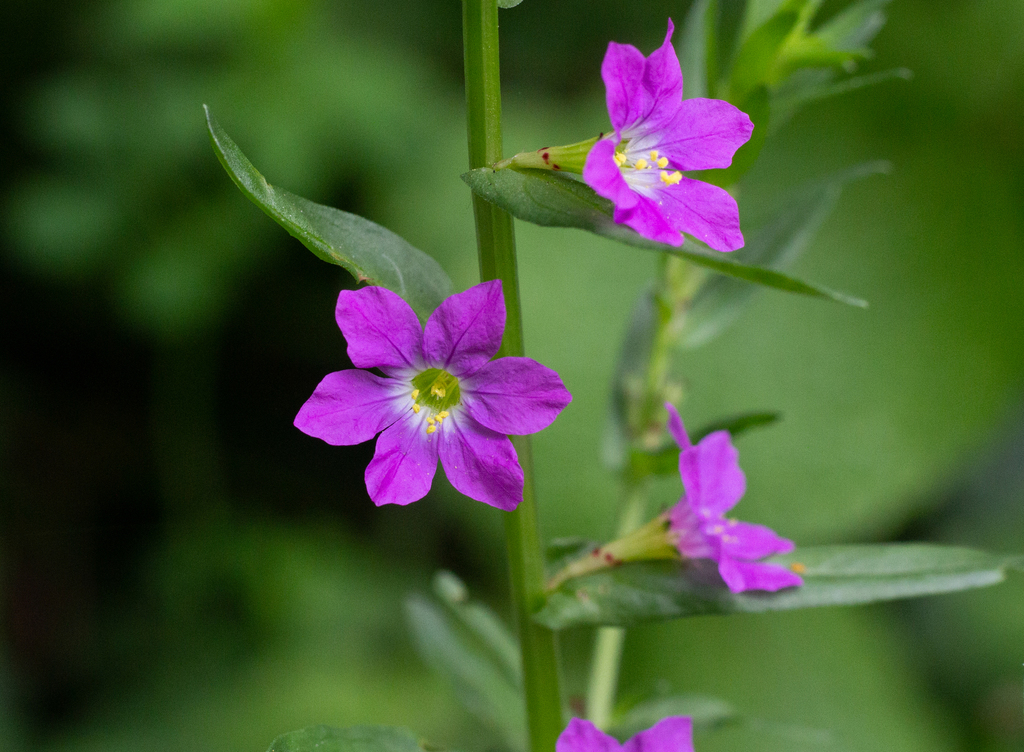
(c) Daniela Costa, some rights reserved (CC BY), uploaded by Daniela Costa · licence
Family: Lythraceae · Type: Perennial
Conservation status: Cal-IPC Yes
Lythrum junceum is a California perennial in the Lythraceae family, recognized by no sympatric species.
Lythrum junceum is a naturalized perennial herb found in freshwater wetlands, lake margins, and seasonal pools at elevations below 600 meters. Flowering from May to September, this plant produces bright purplish-red flowers with white bases, approximately 5 to 6 millimeters long, set against a backdrop of glaucous leaves. Growing 2 to 7 decimeters tall with sprawling, laxly ascending stems that often branch from the base, it develops a distinctive appearance in wetland environments. Its leaves are mostly alternate, ranging from 8 to 40 millimeters long, with lower leaves oblong and upper leaves linear, positioned almost erectly and overlapping. The plant features an unusual floral structure with red-dotted hypanthium and 12 stamens that may be either included or exserted, creating an intriguing botanical profile.
Identification and appearance
Key characters: Geographically isolated; no sympatric species
Habitat and range
Habitat: Freshwater wetlands, margins lakes and seasonal pools, riparian
Elevation: < 600 m
Outside California: native to southern Europe, southwestern Asia, northern Africa, globally introduced
Bloom period
Lythrum junceum blooms May-Sep(Nov).
Conservation status
Cal-IPC Yes
How to tell it apart
vs Coleonema: Lythrum has tubular flower bases and wetland habitat; Coleonema has open flowers and grows in dry upland areas.; vs Cuphea: Lythrum has symmetrical cylindrical flower tubes; Cuphea has asymmetrical, curved tubular flowers.; vs Epilobium: Lythrum has cylindrical flower tubes with leaves in pairs/whorls; Epilobium has cross-shaped flowers with inferior ovaries.; vs Salvia: Lythrum has cylindrical flower tubes and smooth leaf margins; Salvia has hooded, 2-lipped flowers and square stems.; vs Lysimachia: Lythrum has distinct tubular flower bases; Lysimachia has flat, wheel-shaped flowers without tubes.
Frequently asked questions
When does Lythrum junceum bloom?
Lythrum junceum blooms May-Sep(Nov).
What plant family does Lythrum junceum belong to?
Lythrum junceum is in the Lythraceae family, genus Lythrum.
Is Lythrum junceum invasive in California?
Lythrum junceum is listed by Cal-IPC with an invasiveness rating of Yes.
What habitat does Lythrum junceum grow in?
Lythrum junceum grows in Freshwater wetlands, margins lakes and seasonal pools, riparian.
Related species
Other California species in the same genus, family, or bioregion.
Sources: Jepson eFlora · CalPhotos
Last updated 2026-09-30
Data from The California Species Project — 14,000+ California species with verified data from CNPS, CDFW, USFWS, Cal-IPC, and more.