Lythrum salicaria
Purple loosestrife
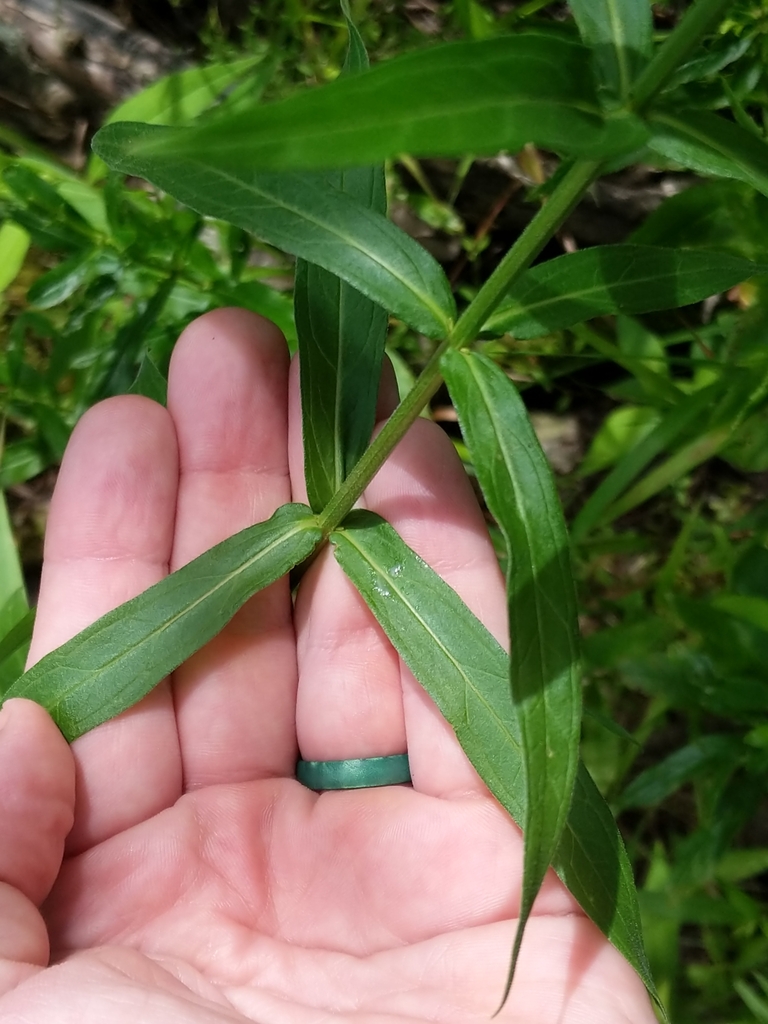
(c) Paul Roots, some rights reserved (CC BY), uploaded by Paul Roots · licence
Family: Lythraceae · Type: Subshrub · Not Native
Conservation status: Cal-IPC Yes
Lythrum salicaria (Purple loosestrife) is a non-native California subshrub in the Lythraceae family, recognized by large size and dense flower clusters.
Purple loosestrife is a naturalized perennial herb found in southern North Coast, North Coast Ranges, northern Sierra Nevada Foothills, Sacramento Valley, Central Coast, and northwestern Modoc Plateau in marshes, ponds, and streambanks at elevations below 1,000 meters. Flowering from May to October, this invasive plant produces red-purple flowers 7 to 14 millimeters long in dense clusters along the stem. Growing 50 to 150 centimeters tall with erect stems that are glabrous or slightly gray-puberulent, it forms few-branched clumps. Its leaves are sessile, 5 to 14 centimeters long, lanceolate to nearly ovate, and truncate at the base. The plant produces distinctive flowers with three different style forms and 12 stamens, making it a notable wetland species.
Identification and appearance
Key characters: 4 sympatric species; distinguished by large size and dense flower clusters
Habitat and range
Habitat: Marshes, ponds, streambanks
Elevation: < 1000 m
California counties: Nevada, Butte, Shasta, Kern, Alameda, San Bernardino, Yolo, San Joaquin, Marin, Sutter, El Dorado, Sonoma, Fresno, Merced, Stanislaus, San Mateo, San Diego, Contra Costa, Solano, Mendocino, Siskiyou, Placer, Humboldt, San Luis Obispo, Monterey, Colusa
Outside California: worldwide, native to Europe, cultivated for ornament
Bloom period
Lythrum salicaria blooms May-Oct.
Conservation status
Cal-IPC Yes
How to tell it apart
vs Coleonema: Lythrum has tubular flower bases and wetland habitat; Coleonema has open flowers and grows in dry upland areas.; vs Cuphea: Lythrum has symmetrical cylindrical flower tubes; Cuphea has asymmetrical, curved tubular flowers.; vs Epilobium: Lythrum has cylindrical flower tubes with leaves in pairs/whorls; Epilobium has cross-shaped flowers with inferior ovaries.; vs Salvia: Lythrum has cylindrical flower tubes and smooth leaf margins; Salvia has hooded, 2-lipped flowers and square stems.; vs Lysimachia: Lythrum has distinct tubular flower bases; Lysimachia has flat, wheel-shaped flowers without tubes.
Frequently asked questions
Is Lythrum salicaria native to California?
No. Lythrum salicaria is not native to California (recorded as not native).
When does Lythrum salicaria bloom?
Lythrum salicaria blooms May-Oct.
Where in California does Lythrum salicaria grow?
Lythrum salicaria occurs in Nevada, Butte, Shasta, Kern, Alameda, San Bernardino, Yolo, San Joaquin and other counties, at elevations of < 1000 m.
What plant family does Lythrum salicaria belong to?
Lythrum salicaria is in the Lythraceae family, genus Lythrum.
Is Lythrum salicaria invasive in California?
Lythrum salicaria is listed by Cal-IPC with an invasiveness rating of Yes.
Related species
Other California species in the same genus, family, or bioregion.
Sources: Jepson eFlora · Index of California Plant Names · CalPhotos
Last updated 2026-10-07
Data from The California Species Project — 14,000+ California species with verified data from CNPS, CDFW, USFWS, Cal-IPC, and more.