Maclura pomifera
Osage orange
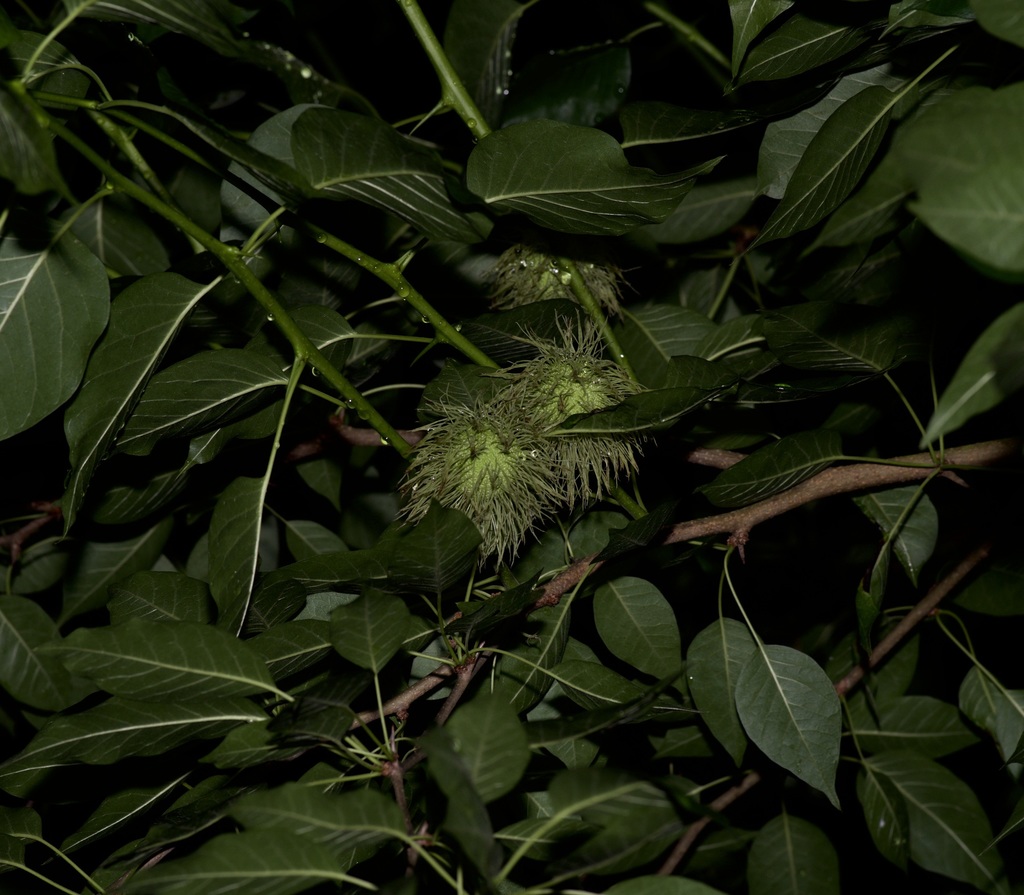
(c) Michelle W. (鍾偉瑋), some rights reserved (CC BY) · licence
Family: Moraceae · Type: Shrub / Tree · Not Native
Maclura pomifera (Osage orange) is a non-native California shrub / tree in the Moraceae family, recognized by Naturalized species from Great Plains; unique fruit morphology within California mulberry family.
Osage orange is a naturalized tree found in the Great Valley, southern California coastal areas, and western Transverse Ranges in streambanks and disturbed areas at elevations below 440 meters. Flowering from April to June, this tree produces yellow-green flowers in clusters with distinctive warty, spherical fruits 9 to 15 centimeters in diameter. Growing to 20 meters tall with sharp thorns up to 3 centimeters long, it develops a spreading, dense canopy. Its leaves are dark green, ovate to lance-oblong, 3 to 14 centimeters long, attached by 1 to 4 centimeter petioles and sparsely covered with soft hairs. The remarkable yellow-green, bumpy fruit makes this tree instantly recognizable in its adopted landscapes.
Identification and appearance
Key characters: Naturalized species from Great Plains; unique fruit morphology within California mulberry family
Habitat and range
Habitat: Streambanks, disturbed areas
Elevation: < 440 m
California counties: Los Angeles, Riverside, Sutter, Ventura, Butte, Kern, Nevada, Kings, Calaveras, Sacramento, Contra Costa, Yolo, San Diego, Solano, Stanislaus, Yuba
Outside California: native to south-central United States
Bloom period
Maclura pomifera blooms Apr-Jun.
How to tell it apart
vs Citrus: Maclura has massive bumpy softball fruits and long single thorns; Citrus has smooth round fruits and shorter paired thorns.; vs Platanus: Maclura has thorns and massive warty fruits; Platanus has peeling bark and dangling ball-like seed clusters.; vs Morus: Maclura has fearsome thorns and huge warty fruits; Morus lacks thorns and has blackberry-like segmented fruits.; vs Ficus: Maclura has thorns, simple entire leaves, and huge warty fruits; Ficus lacks thorns and has hollow fig fruits.; vs Castela: Maclura has single stout thorns and massive fruits; Castela has paired short thorns and small capsule fruits.
Frequently asked questions
Is Maclura pomifera native to California?
No. Maclura pomifera is not native to California (recorded as not native).
When does Maclura pomifera bloom?
Maclura pomifera blooms Apr-Jun.
Where in California does Maclura pomifera grow?
Maclura pomifera occurs in Los Angeles, Riverside, Sutter, Ventura, Butte, Kern, Nevada, Kings and other counties, at elevations of < 440 m.
What plant family does Maclura pomifera belong to?
Maclura pomifera is in the Moraceae family, genus Maclura.
What habitat does Maclura pomifera grow in?
Maclura pomifera grows in Streambanks, disturbed areas.
Related species
Other California species in the same genus, family, or bioregion.
Sources: Jepson eFlora · Index of California Plant Names · CalPhotos
Last updated 2026-10-07
Data from The California Species Project — 14,000+ California species with verified data from CNPS, CDFW, USFWS, Cal-IPC, and more.