Madia anomala
Plump seeded madia
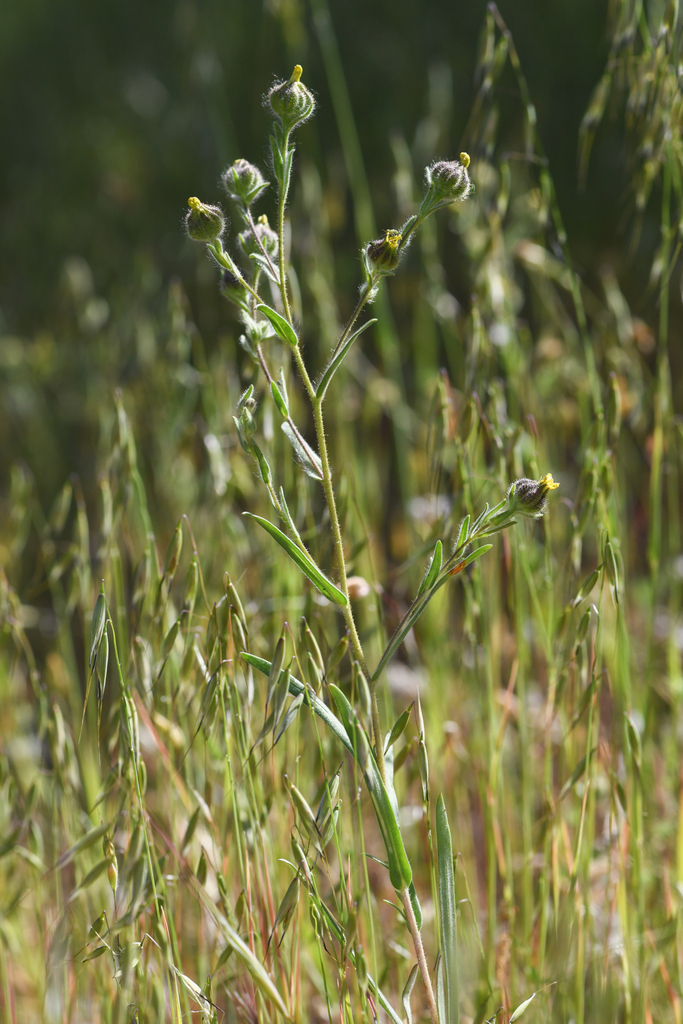
(c) Trevor Van Loon, some rights reserved (CC BY) · licence
Family: Asteraceae · Type: Herb · Native
Madia anomala (Plump seeded madia) is a native California herb in the Asteraceae family, recognized by spherical involucre, round fruits in cross-section, and low elevation coastal distribution.
Plump seeded madia is a California native annual found in northern coastal regions, Sutter Buttes, coastal central California, and San Francisco Bay Area in woodland or chaparral openings at elevations below 500 meters. Flowering from April to June, this plant produces green-yellow ray flowers with 3 to 8 rays, accompanied by disk flowers with dark purple anthers. Growing 20 to 55 centimeters tall with coarse and glandular-hairy stems featuring yellow, purple, or black glands, it develops lateral branches rarely exceeding the main stem. Its leaves are slender linear blades 2 to 10 centimeters long and 2 to 7 millimeters wide, arranged with a sparse, open structure. The fruit is distinctively round in cross-section, appearing black or purple and beakless.
Identification and appearance
Key characters: 6 sympatric species; distinguished by spherical involucre, round fruits in cross-section, and low elevation coastal distribution
Habitat and range
Habitat: Openings in woodland or chaparral
Elevation: < 500 m
Bloom period
Madia anomala blooms Apr-Jun.
How to tell it apart
vs Anisocarpus: Madia has absolutely no pappus on disk flowers; Anisocarpus has 5-21 scales forming a pappus on disk flowers.; vs Deinandra: Madia has ray fruits completely hidden by bracts and no disk pappus; Deinandra has exposed ray fruits and disk pappus present.; vs Layia: Madia has bright yellow rays and no disk pappus; Layia often has white or bicolored rays and hairy disk pappus.; vs Hemizonia: Madia has fruits completely wrapped by bracts; Hemizonia has fruits only partly enclosed by bracts.; vs Lagophylla: Madia has yellow rays and no pappus; Lagophylla has white rays and scale-like pappus on disk flowers.
Frequently asked questions
Is Madia anomala native to California?
Yes. Madia anomala is native to California (recorded as native).
When does Madia anomala bloom?
Madia anomala blooms Apr-Jun.
What plant family does Madia anomala belong to?
Madia anomala is in the Asteraceae family, genus Madia.
What habitat does Madia anomala grow in?
Madia anomala grows in Openings in woodland or chaparral.
Related species
Other California species in the same genus, family, or bioregion.
Sources: Jepson eFlora · CalPhotos
Last updated 2026-10-07
Data from The California Species Project — 14,000+ California species with verified data from CNPS, CDFW, USFWS, Cal-IPC, and more.