Madia radiata
Showy golden madia, Showy Golden Madia
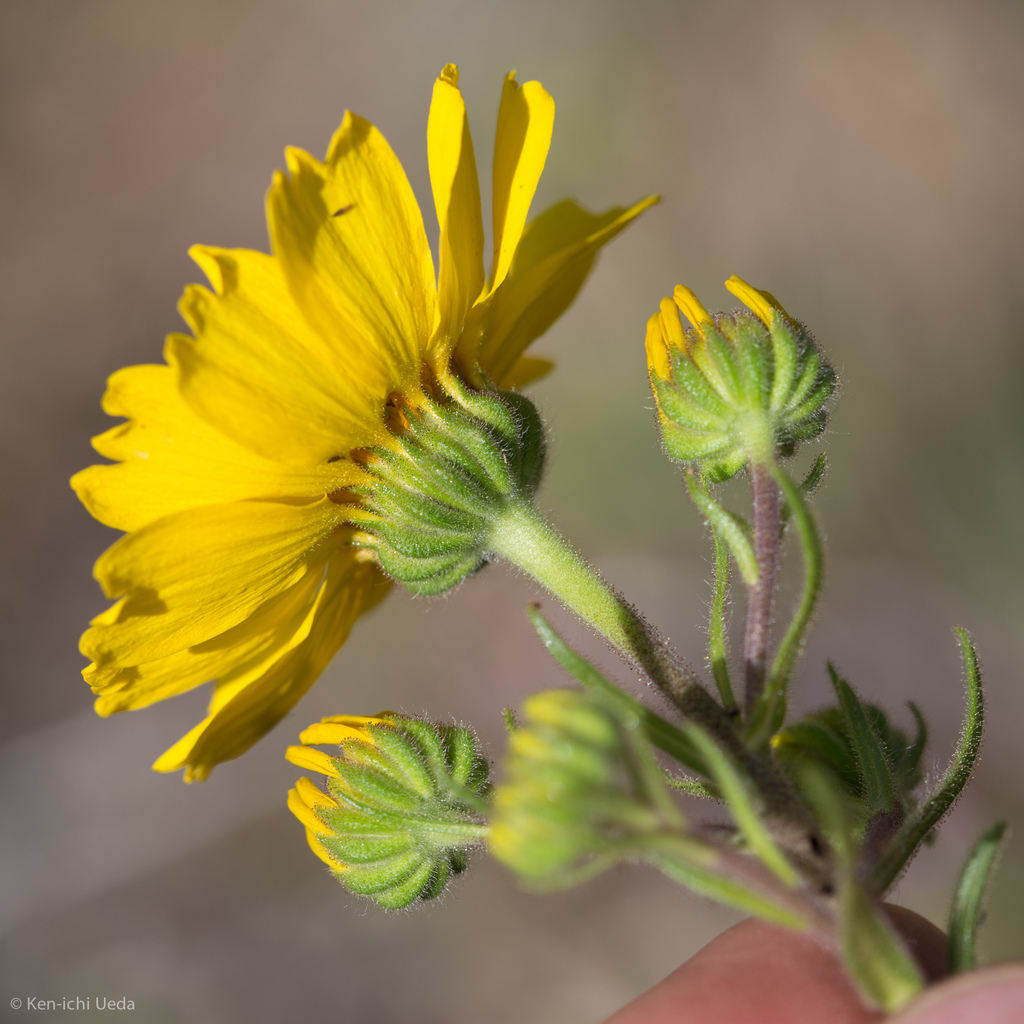
(c) Ken-ichi Ueda, some rights reserved (CC BY), uploaded by Ken-ichi Ueda · licence
Family: Asteraceae · Type: Herb · Native
Conservation status: CNPS 1B.1
Madia radiata (Showy golden madia) is a native California herb in the Asteraceae family, recognized by showy golden rays 6-19mm, curved-beaked fruits, hooked involucral hairs, and limited clay soil distribution.
Showy golden madia is a rare (CNPS 1B.1) California native annual found in the San Joaquin Valley, San Francisco Bay Area, and southern coastal ranges in grassy or open slopes at elevations of 20 to 1,200 meters. Flowering from March to May, this plant produces golden yellow ray flowers up to 19 millimeters long with showy heads arranged in open, flat-topped clusters. Growing 10 to 90 centimeters tall with glandular-hairy stems that often have lateral branches exceeding the main stem, it displays a distinctive branching pattern. Its leaves are narrow and lance-shaped, measuring 2 to 10 centimeters long and 4 to 15 millimeters wide, with soft glandular hairs bearing yellow or purple glands. The fruits are uniquely compressed and strongly arched, ranging from black to purple or mottled, with curved beaks that are offset along the ray flowers.
Identification and appearance
Key characters: 4 sympatric species; distinguished by showy golden rays 6-19mm, curved-beaked fruits, hooked involucral hairs, and limited clay soil distribution
Habitat and range
Habitat: Grassy or open slopes, vertic clay, rarely serpentine
Elevation: 20-1200 m
Bloom period
Madia radiata blooms Mar-May.
Conservation status
CNPS 1B.1
How to tell it apart
vs Anisocarpus: Madia has absolutely no pappus on disk flowers; Anisocarpus has 5-21 scales forming a pappus on disk flowers.; vs Deinandra: Madia has ray fruits completely hidden by bracts and no disk pappus; Deinandra has exposed ray fruits and disk pappus present.; vs Layia: Madia has bright yellow rays and no disk pappus; Layia often has white or bicolored rays and hairy disk pappus.; vs Hemizonia: Madia has fruits completely wrapped by bracts; Hemizonia has fruits only partly enclosed by bracts.; vs Lagophylla: Madia has yellow rays and no pappus; Lagophylla has white rays and scale-like pappus on disk flowers.
Frequently asked questions
Is Madia radiata native to California?
Yes. Madia radiata is native to California (recorded as native).
When does Madia radiata bloom?
Madia radiata blooms Mar-May.
What plant family does Madia radiata belong to?
Madia radiata is in the Asteraceae family, genus Madia.
Is Madia radiata rare or endangered?
Madia radiata carries California Rare Plant Rank 1B.1, state rank S3.
What habitat does Madia radiata grow in?
Madia radiata grows in Grassy or open slopes, vertic clay, rarely serpentine.
Related species
Other California species in the same genus, family, or bioregion.
Sources: Jepson eFlora · CNPS Rare Plant Inventory · Index of California Plant Names · CalPhotos · CDFW CNDDB
Last updated 2026-10-07
Data from The California Species Project — 14,000+ California species with verified data from CNPS, CDFW, USFWS, Cal-IPC, and more.