Malacothamnus fremontii var. exfibulosus
Short-haired unfurled bushmallow, heller's bushmallow
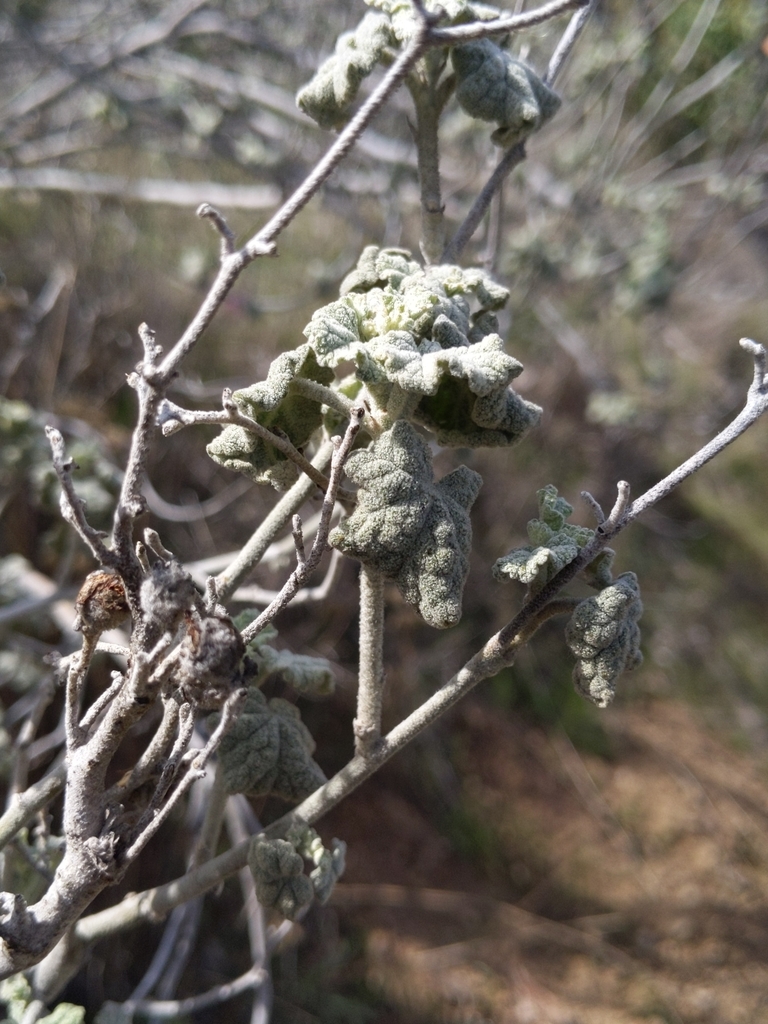
Photo: parent species Malacothamnus fremontii · (c) Ken-ichi Ueda, some rights reserved (CC BY) · licence
Family: Malvaceae · Type: Shrub · Native
Conservation status: CNPS 3.3
Malacothamnus fremontii var. exfibulosus (Short-haired unfurled bushmallow) is a native California shrub in the Malvaceae family, recognized by short, mostly unstalked stellate hairs.
Short-haired unfurled bushmallow is a California native shrub found in early-recovering post-burn woody vegetation at elevations of 45 to 640 meters. Flowering from May to June, this plant produces pale pink to white flowers clustered in delicate inflorescences. Growing as a compact shrub up to 2.5 meters tall, it features densely stellate-hairy stems that are entirely covered with fine, intricate hairs. Its leaves are roughly round to widely ovate, often with subtle 3 to 5 lobes, featuring an ashy to light-green surface with dense stellate hair coverage. The plant's distinctive hairy texture and ability to persist in recovering burn areas make it an important component of regenerating woodland landscapes.
Identification and appearance
Key characters: 18 sympatric species; key feature is short, mostly unstalked stellate hairs
Habitat and range
Habitat: Early-recovering post-burn woody vegetation, edges of openings, some plants occasionally persisting into more mature vegetation stages
Elevation: 45-640 m
Bloom period
Malacothamnus fremontii var. exfibulosus blooms May-Jun(Aug).
Conservation status
CNPS 3.3
How to tell it apart
vs Sphaeralcea: Malacothamnus has flowers clustered in leaf axils; Sphaeralcea has flowers in an elongated spike-like arrangement.; vs Sidalcea: Malacothamnus is a woody shrub in chaparral; Sidalcea is herbaceous in meadows and moist areas.; vs Malva: Malacothamnus is a native chaparral shrub with axillary clusters; Malva is a weedy herb with flowers along stems.; vs Ribes: Malacothamnus has mallow flowers with fused stamens; Ribes has tubular flowers and produces berries.; vs Brickellia: Malacothamnus has 5-petaled mallow flowers; Brickellia has fuzzy composite flower heads without petals.
Frequently asked questions
Is Malacothamnus fremontii var. exfibulosus native to California?
Yes. Malacothamnus fremontii var. exfibulosus is native to California (recorded as native).
When does Malacothamnus fremontii var. exfibulosus bloom?
Malacothamnus fremontii var. exfibulosus blooms May-Jun(Aug).
What plant family does Malacothamnus fremontii var. exfibulosus belong to?
Malacothamnus fremontii var. exfibulosus is in the Malvaceae family, genus Malacothamnus.
Is Malacothamnus fremontii var. exfibulosus rare or endangered?
Malacothamnus fremontii var. exfibulosus carries California Rare Plant Rank 3.3, state rank S2.
What habitat does Malacothamnus fremontii var. exfibulosus grow in?
Malacothamnus fremontii var. exfibulosus grows in Early-recovering post-burn woody vegetation, edges of openings, some plants occasionally persisting into more mature vegetation stages.
Related species
Other California species in the same genus, family, or bioregion.
- Malacothamnus fremontii var. fremontii — Long-haired unfurled bushmallow
- Malacothamnus involucratus — Carmel valley bushmallow
- Malacothamnus jonesii — Jones's bush mallow
- Malacothamnus jonesii var. gracilis — Huasna bushmallow
- Malacothamnus jonesii var. jonesii — Jones's bushmallow
- Malacothamnus jonesii var. niveus — Fragrant-snow bushmallow
Sources: Jepson eFlora · CNPS Rare Plant Inventory · Index of California Plant Names · CalPhotos
Last updated 2026-09-30
Data from The California Species Project — 14,000+ California species with verified data from CNPS, CDFW, USFWS, Cal-IPC, and more.