Malacothrix coulteri
Snake's-head
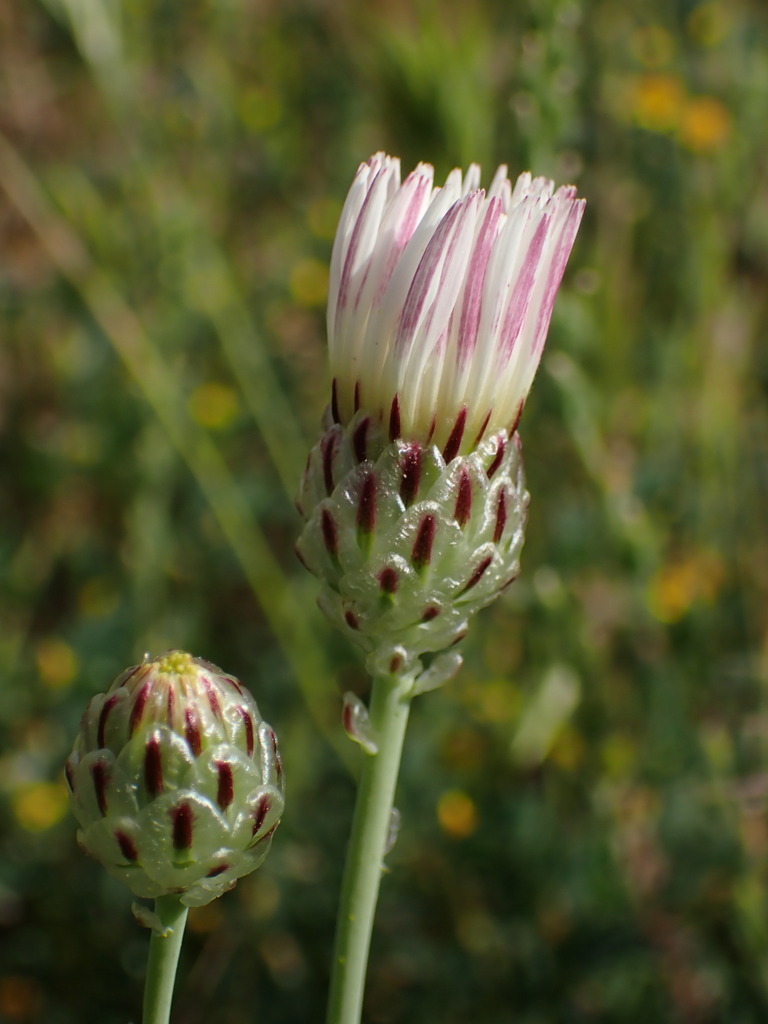
(c) Cricket Raspet, some rights reserved (CC BY), uploaded by Cricket Raspet · licence
Family: Asteraceae · Type: Herb · Native
Malacothrix coulteri (Snake's-head) is a native California herb in the Asteraceae family, recognized by distinctive spherical involucre and glaucous stems.
Snake's-head is a California native annual found in the San Joaquin Valley, central western California, northern Channel Islands, western Transverse Ranges, Peninsular Ranges, Southeastern Sierra Nevada, eastern Mojave Desert, and northern Sonoran Desert in sandy, open areas of coastal sage scrub, grassland, and desert habitats at elevations below 1,500 meters. Flowering from March to May, this plant produces pale yellow to white flowers in heads 10 to 22 millimeters wide, with ligules extending 2 to 12 millimeters from the spheric involucre. Growing with ascending or erect stems up to 75 centimeters tall, the plant can be simple or slightly branched with a glaucous appearance. Its leaves are distinctive, with basal leaves that are fleshy and lance-linear to ovate, featuring wavy lobes, while lower leaves are often lanceolate and toothed or deeply divided. The fruit is small, 1.6 to 3.2 millimeters long, with prominent ribs and uneven outer pappus teeth.
Identification and appearance
Key characters: 23 sympatric species; distinctive spherical involucre and glaucous stems
Habitat and range
Habitat: Sandy, open areas, in coastal-sage scrub, grassland, desert
Elevation: < 1500 m
Outside California: to Utah, Arizona, South America
Bloom period
Malacothrix coulteri blooms Mar-May.
How to tell it apart
vs Rafinesquia: Rafinesquia has persistent pappus that stays attached; Malacothrix pappus falls off easily when disturbed.; vs Pinaropappus: Pinaropappus pappus remains attached to seeds; Malacothrix pappus falls away easily.; vs Anisocoma: Anisocoma has scale-like pappus; Malacothrix has bristly pappus that falls off easily.; vs Calycoseris: Calycoseris leaves have glandular-sticky stems; Malacothrix lacks the sticky glandular feel.; vs Agoseris: Agoseris pappus stays firmly attached; Malacothrix pappus falls off at the slightest touch.
Frequently asked questions
Is Malacothrix coulteri native to California?
Yes. Malacothrix coulteri is native to California (recorded as native).
When does Malacothrix coulteri bloom?
Malacothrix coulteri blooms Mar-May.
What plant family does Malacothrix coulteri belong to?
Malacothrix coulteri is in the Asteraceae family, genus Malacothrix.
What habitat does Malacothrix coulteri grow in?
Malacothrix coulteri grows in Sandy, open areas, in coastal-sage scrub, grassland, desert.
Related species
Other California species in the same genus, family, or bioregion.
- Malacothrix floccifera — Woolly dandelion
- Malacothrix foliosa — Leafy desertdandelion
- Malacothrix foliosa subsp. crispifolia — Wavy-leaved malacothrix
- Malacothrix foliosa subsp. foliosa — Leafy malacothrix
- Malacothrix foliosa subsp. philbrickii — Philbrick's malacothrix
- Malacothrix foliosa subsp. polycephala — Many-headed malacothrix
Sources: Jepson eFlora · Index of California Plant Names · CalPhotos
Last updated 2026-10-07
Data from The California Species Project — 14,000+ California species with verified data from CNPS, CDFW, USFWS, Cal-IPC, and more.