Malva parviflora
Cheeseweed, little mallow, Little Mallow
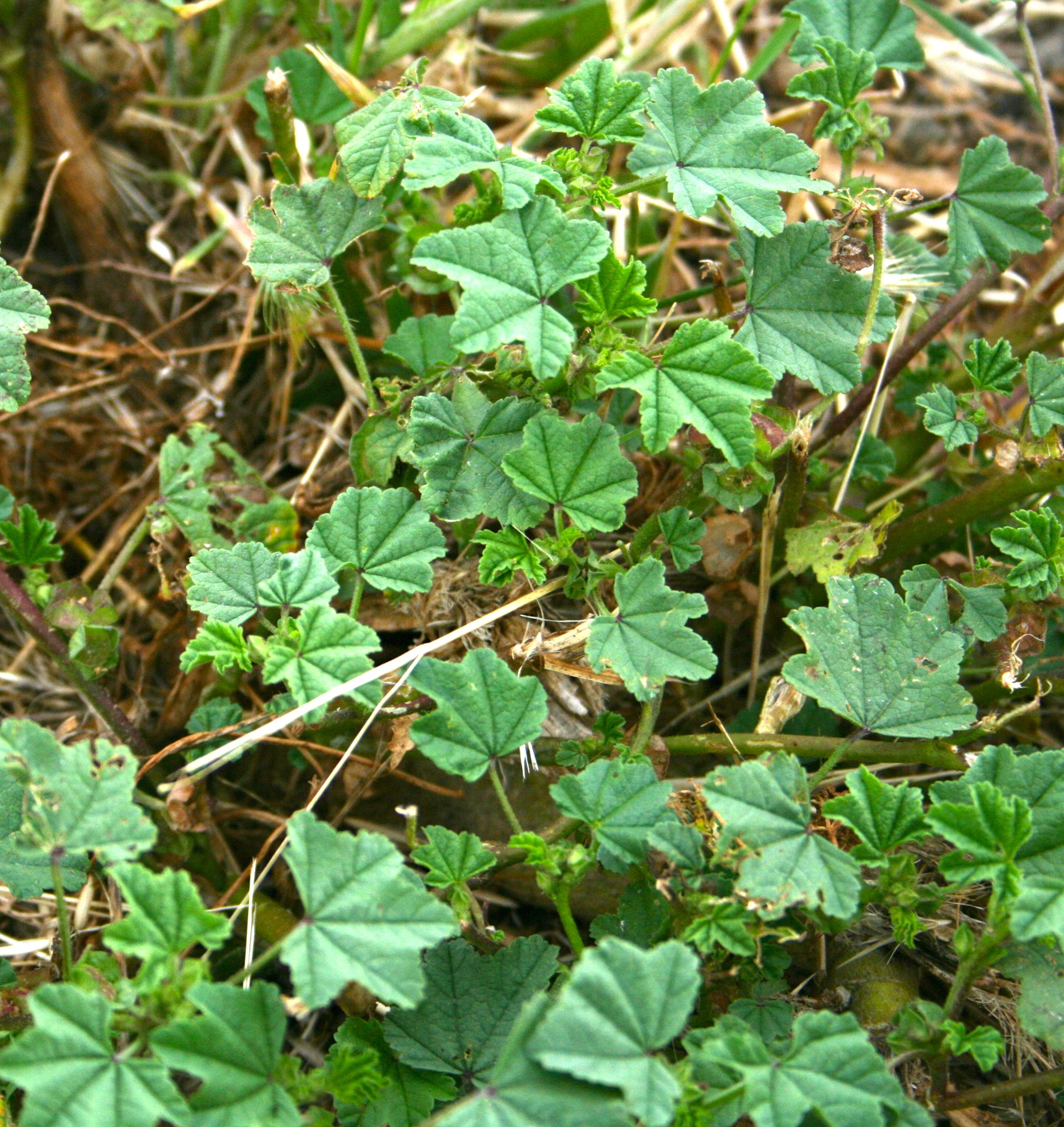
Photo by Chez Brungraber
Family: Malvaceae · Type: Herb · Not Native
Malva parviflora (Cheeseweed) is a non-native California herb in the Malvaceae family, recognized by small flowers and thin-winged fruit segments.
Cheeseweed is a naturalized annual herb found in the California Floristic Province and desert regions in disturbed places at elevations below 2,500 meters. Flowering from March to August, this plant produces white to pink flowers small and delicate, typically 3 to 5 millimeters long, clustered 2 to 4 in leaf axils. Growing with prostrate to erect stems 20 to 80 centimeters tall that are widely branched and stellate-hairy near the tips, it spreads easily across disturbed landscapes. Its leaves are broadly rounded to kidney-shaped, 2 to 8 centimeters wide, with 5 to 7 rounded lobes and distinctive stipules 4 to 5 millimeters long. The fruit is a distinctive wheel-like structure 6 to 7 millimeters in diameter, with approximately 10 to 11 segments that are wrinkled and net-veined with thin, toothed outer edges.
Identification and appearance
Key characters: Co-occurs with 8 species; distinguished by small flowers and thin-winged fruit segments
Habitat and range
Habitat: Common. Disturbed places
Elevation: < 2500 m
California counties: Kern, San Bernardino, San Diego, Los Angeles, Riverside, San Luis Obispo, Imperial, Ventura, Orange, San Francisco, Santa Cruz, Plumas, Fresno, Alameda, San Benito, Santa Barbara, Tulare, San Mateo, Yolo, Santa Clara, Stanislaus, Monterey, Colusa, Contra Costa, Inyo, San Joaquin, Kings, Sutter, Placer, Merced, Sacramento, Butte, Yuba, Napa, Humboldt, Lake, Nevada, Solano, Mendocino, Tuolumne
Outside California: native to Europe, Mediterranean, India, widespread weed
Bloom period
Malva parviflora blooms Mar-Aug.
How to tell it apart
vs Pelargonium: Malva has symmetrical bowl-shaped flowers; Pelargonium has irregular flowers with two upper petals distinct from three lower.; vs Sidalcea: Malva has 3 bracts forming collar below flower; Sidalcea has no bract ring (or just 1-3 tiny bracts).; vs Hibiscus: Malva has small flowers with 3 bracts; Hibiscus has large showy flowers with many fused bracts.; vs Alcea: Malva has smaller flowers (<6 cm) with 3 bracts; Alcea has huge flowers (>6 cm) with 5-11 bracts.; vs Malvella: Malva is upright and green; Malvella is prostrate forming gray-fuzzy ground mats.
Frequently asked questions
Is Malva parviflora native to California?
No. Malva parviflora is not native to California (recorded as not native).
When does Malva parviflora bloom?
Malva parviflora blooms Mar-Aug.
Where in California does Malva parviflora grow?
Malva parviflora occurs in Kern, San Bernardino, San Diego, Los Angeles, Riverside, San Luis Obispo, Imperial, Ventura and other counties, at elevations of < 2500 m.
What plant family does Malva parviflora belong to?
Malva parviflora is in the Malvaceae family, genus Malva.
What habitat does Malva parviflora grow in?
Malva parviflora grows in Common. Disturbed places.
Related species
Other California species in the same genus, family, or bioregion.
Sources: Jepson eFlora · Index of California Plant Names · CalPhotos
Last updated 2026-10-07
Data from The California Species Project — 14,000+ California species with verified data from CNPS, CDFW, USFWS, Cal-IPC, and more.