Marrubium vulgare
White horehound
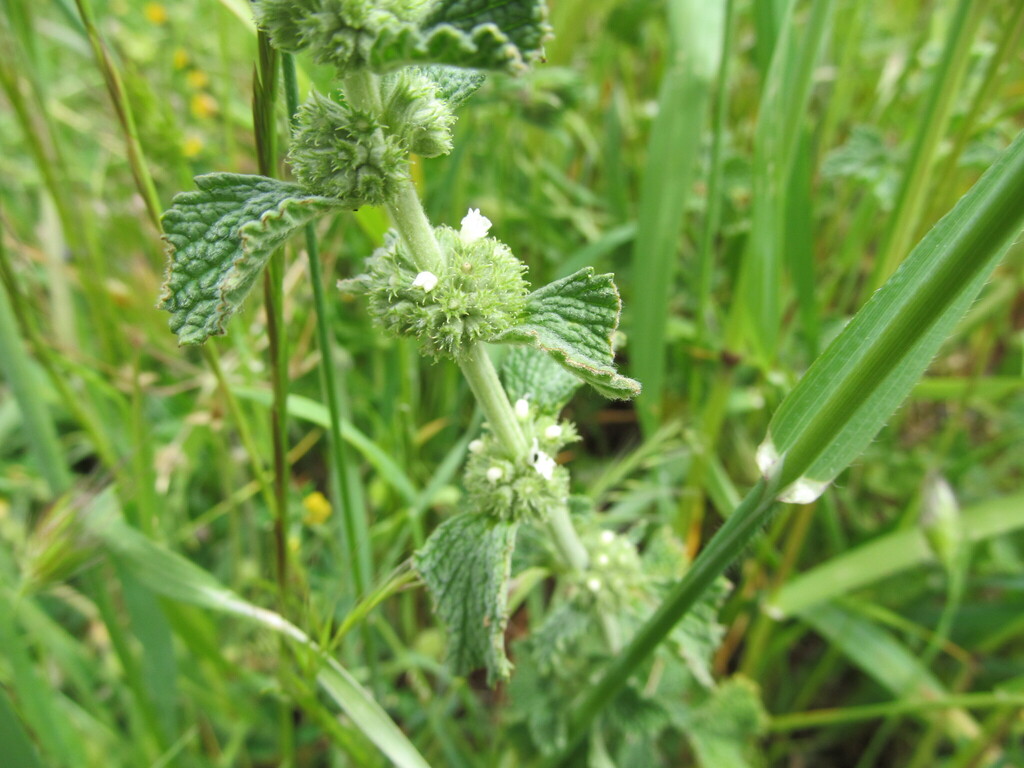
(c) zebedeugalinha, some rights reserved (CC BY) · licence
Family: Lamiaceae · Type: Subshrub · Not Native
Conservation status: Cal-IPC Yes
Marrubium vulgare (White horehound) is a non-native California subshrub in the Lamiaceae family, recognized by Widespread naturalized European species; distinctive hooked calyx morphology within mint family.
White horehound is a naturalized perennial herb found throughout California (excluding Western and Inyo regions) in disturbed sites and overgrazed pastures at elevations below 600 meters. Flowering from March to November, this plant produces small white flowers in clustered whorls along its stems. Growing with ascending to erect stems 10 to 60 centimeters tall, it forms a robust and spreading habit with multiple branches. Its leaves are wide-ovate to nearly round, 1.5 to 5.5 centimeters long, with rounded bases and crenate (scalloped) margins that give the foliage a soft, textured appearance. The plant's distinctive calyx has short, soft hairs and supports a corolla that extends slightly beyond the calyx lobes.
Identification and appearance
Key characters: Widespread naturalized European species; distinctive hooked calyx morphology within mint family
Habitat and range
Habitat: Disturbed sites, generally overgrazed pastures
Elevation: < 600 m
California counties: Los Angeles, Placer, Riverside, Santa Barbara, San Diego, San Bernardino, Orange, San Luis Obispo, Kern, Ventura, Lake, Fresno, Tuolumne, Santa Cruz, San Mateo, Santa Clara, Shasta, Inyo, Tulare, Alameda, Yolo, Mendocino, Plumas, Siskiyou, Monterey, Solano, El Dorado, Colusa, Nevada, Amador, Mono, San Joaquin, Modoc, Sacramento, Butte, Calaveras, Lassen, Sutter, Yuba, Glenn, Tehama, Merced, Contra Costa, Napa, Humboldt, San Benito, Stanislaus, Alpine, Del Norte, Madera, Sonoma, Mariposa
Outside California: widespread worldwide
Bloom period
Marrubium vulgare blooms Mar-Nov.
Conservation status
Cal-IPC Yes
How to tell it apart
vs Stachys: Stachys (hedge-nettles) have soft-hairy but green leaves and larger pink-purple flowers in open whorls; Marrubium is densely white-woolly with wrinkled round leaves and small white flowers in tight axillary balls.; vs Leonurus: Leonurus (motherwort) has palmately lobed or cut leaves and pink flowers; Marrubium has rounded, crenate, unlobed wrinkled leaves and white flowers.; vs Mentha: Mentha (mints) smell strongly minty and have spike-like clusters of nearly equal small lilac flowers; Marrubium smells musty-bitter and has globe-like white flower whorls with hooked calyx teeth.; vs Nepeta: Nepeta (catnip) has gray-green triangular toothed leaves and violet spotted flowers; Marrubium has round white-woolly leaves and white flowers.; vs Ballota: Ballota (black horehound) is greener and ill-scented with purple flowers and non-hooked calyx lobes; Marrubium is white-woolly with white flowers and about 10 recurved, hooked calyx teeth that cling like burrs.
Frequently asked questions
Is Marrubium vulgare native to California?
No. Marrubium vulgare is not native to California (recorded as not native).
When does Marrubium vulgare bloom?
Marrubium vulgare blooms Mar-Nov.
Where in California does Marrubium vulgare grow?
Marrubium vulgare occurs in Los Angeles, Placer, Riverside, Santa Barbara, San Diego, San Bernardino, Orange, San Luis Obispo and other counties, at elevations of < 600 m.
What plant family does Marrubium vulgare belong to?
Marrubium vulgare is in the Lamiaceae family, genus Marrubium.
Is Marrubium vulgare invasive in California?
Marrubium vulgare is listed by Cal-IPC with an invasiveness rating of Yes.
Related species
Other California species in the same genus, family, or bioregion.
Sources: Jepson eFlora · Index of California Plant Names · CalPhotos
Last updated 2026-10-07
Data from The California Species Project — 14,000+ California species with verified data from CNPS, CDFW, USFWS, Cal-IPC, and more.