Matricaria chamomilla
German chamomile
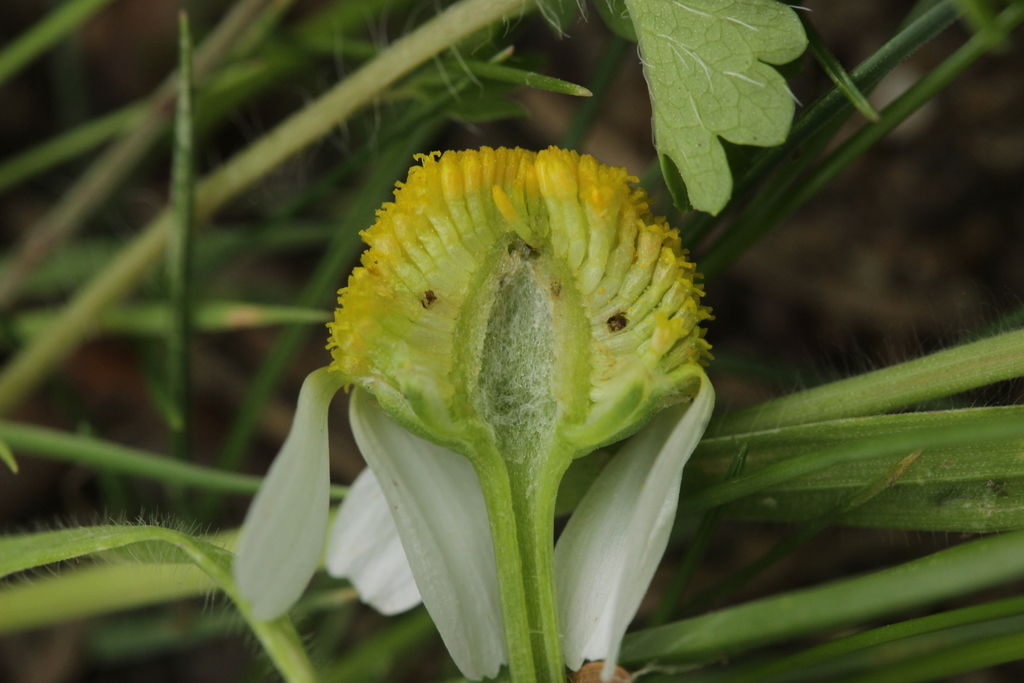
(c) Björn Sothmann, some rights reserved (CC BY-SA), uploaded by Björn Sothmann · licence
Family: Asteraceae · Type: Annual · Not Native
Matricaria chamomilla (German chamomile) is a non-native California annual in the Asteraceae family, recognized by radiate heads vs rayless heads.
German chamomile is a naturalized annual herb found in the Sierra Nevada foothills along disturbed roadsides at elevations around 100 meters. Flowering from April to May, this plant produces white ray flowers 7 to 8.5 millimeters long with a white center, creating delicate daisy-like heads 5 to 9 millimeters in diameter. Growing 10 to 60 centimeters tall with often branched stems near the top, it is strongly aromatic with a distinctive scent. Its leaves are sessile, glabrous, and up to 8 centimeters long, divided into fine, feathery segments. The plant forms spherical flower heads that shatter at maturity, leaving behind small ribbed fruits.
Identification and appearance
Key characters: 1 sympatric species; distinguished by radiate heads vs rayless heads
Habitat and range
Habitat: Disturbed roadsides
Elevation: +- 100 m.
California counties: San Luis Obispo, Madera, Sonoma, San Mateo, Yolo
Outside California: to eastern North America, native to Europe, introduced worldwide
Bloom period
Matricaria chamomilla blooms Apr-May.
How to tell it apart
vs Oncosiphon: Matricaria smells sweet and has egg-shaped heads; Oncosiphon smells intensely foul and has spherical heads.; vs Anthemis: Matricaria has egg-shaped heads that become hollow inside; Anthemis has rounded heads with solid, chaffy receptacles.; vs Chamaemelum: Matricaria has egg-shaped mature heads; Chamaemelum has conical or dome-shaped receptacles at maturity.; vs Cotula: Matricaria has sweet scent and egg-shaped heads; Cotula lacks strong scent and has flattened button-like heads.; vs Glebionis: Matricaria often lacks ray petals and has egg-shaped heads; Glebionis has showy yellow or white rays.
Frequently asked questions
Is Matricaria chamomilla native to California?
No. Matricaria chamomilla is not native to California (recorded as not native).
When does Matricaria chamomilla bloom?
Matricaria chamomilla blooms Apr-May.
Where in California does Matricaria chamomilla grow?
Matricaria chamomilla occurs in San Luis Obispo, Madera, Sonoma, San Mateo, Yolo, at elevations of +- 100 m..
What plant family does Matricaria chamomilla belong to?
Matricaria chamomilla is in the Asteraceae family, genus Matricaria.
What habitat does Matricaria chamomilla grow in?
Matricaria chamomilla grows in Disturbed roadsides.
Related species
Other California species in the same genus, family, or bioregion.
Sources: Jepson eFlora · Index of California Plant Names · CalPhotos
Last updated 2026-09-30
Data from The California Species Project — 14,000+ California species with verified data from CNPS, CDFW, USFWS, Cal-IPC, and more.