Medicago arabica
Burclover, spotted burclover, Spotted Burclover
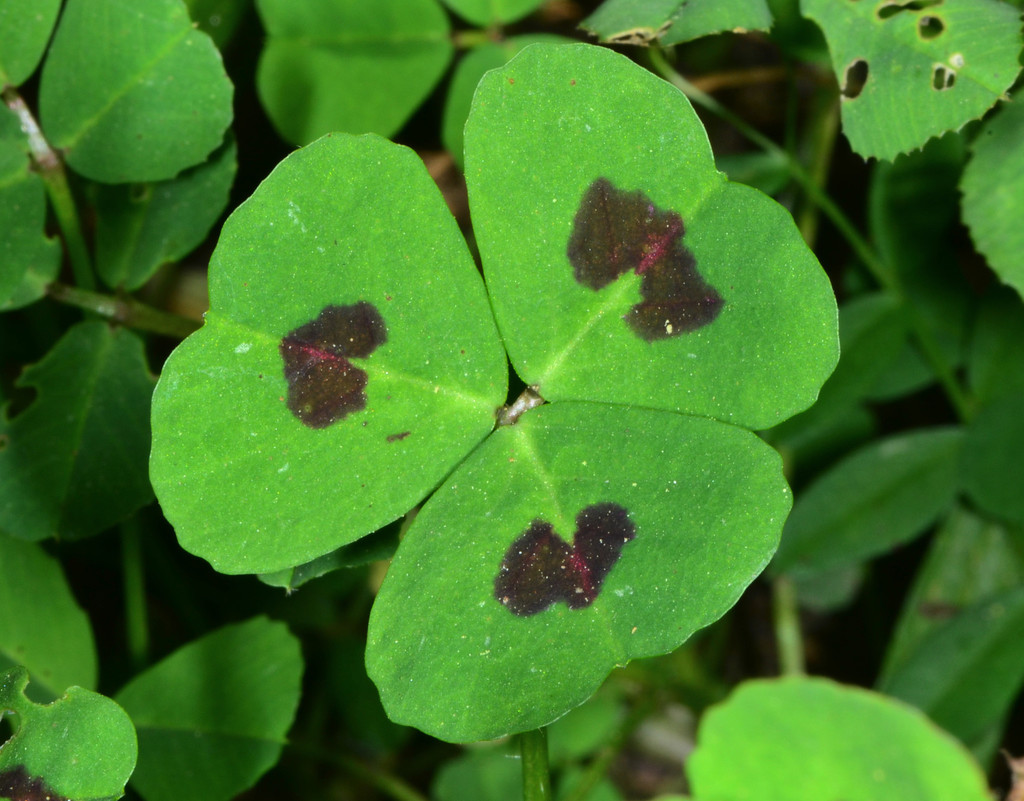
(c) Don Loarie, some rights reserved (CC BY) · licence
Family: Fabaceae · Type: Herb · Not Native
Medicago arabica (Burclover) is a non-native California herb in the Fabaceae family, recognized by dark spots on leaflets and fruit characteristics are key.
Burclover is a naturalized annual found in northern California coastal, central California, and central valley regions in disturbed agricultural areas, fields, and woodland habitats at elevations below 2,000 meters. Flowering from March to June, this plant produces small yellow flowers in compact clusters of 2 to 4 blooms. Growing with sprawling stems 10 to 40 centimeters long, it has a low-spreading growth habit with sparse hairs. Its compound leaves feature distinctive leaflets 1 to 2.5 centimeters long, each with a characteristic dark central spot and an obcordate (heart-shaped) form. The fruit develops as a loosely coiled spiral with curved, hooked prickles that turn tan to brown when mature.
Identification and appearance
Key characters: 8 sympatric species; dark spots on leaflets and fruit characteristics are key
Habitat and range
Habitat: Disturbed and agricultural areas, fields, woodland
Elevation: < 2000 m
California counties: Napa, Contra Costa, Alameda, Sonoma, Santa Clara, Mendocino, Butte, Marin, San Francisco, Humboldt, San Diego, Del Norte, Yolo, Sutter, Tehama, Sacramento, San Mateo, San Luis Obispo, Placer, Yuba, Solano, Stanislaus, El Dorado, Santa Cruz, Monterey
Outside California: abundant especially in southeastern United States, elsewhere, native to Mediterranean
Bloom period
Medicago arabica blooms Mar-Jun.
How to tell it apart
vs Melilotus: Medicago fruits are spirally coiled; Melilotus fruits are small egg-shaped pods with transverse ridges.; vs Trifolium: Medicago flowers fall off; Trifolium flowers persist and enclose the fruit in papery covering.; vs Oxalis: Medicago has pea-shaped flowers and coiled fruits; wood-sorrels (Oxalis) have 5-petaled flowers and upright capsules.; vs Acmispon: Medicago has toothed leaflets and coiled fruits; Acmispon has smooth-edged leaflets and straight pods.; vs Vicia: Medicago has coiled prickly fruits; vetches (Vicia) have flat straight pods and tendrils.
Frequently asked questions
Is Medicago arabica native to California?
No. Medicago arabica is not native to California (recorded as not native).
When does Medicago arabica bloom?
Medicago arabica blooms Mar-Jun.
Where in California does Medicago arabica grow?
Medicago arabica occurs in Napa, Contra Costa, Alameda, Sonoma, Santa Clara, Mendocino, Butte, Marin and other counties, at elevations of < 2000 m.
What plant family does Medicago arabica belong to?
Medicago arabica is in the Fabaceae family, genus Medicago.
What habitat does Medicago arabica grow in?
Medicago arabica grows in Disturbed and agricultural areas, fields, woodland.
Related species
Other California species in the same genus, family, or bioregion.
Sources: Jepson eFlora · Index of California Plant Names · CalPhotos
Last updated 2026-10-07
Data from The California Species Project — 14,000+ California species with verified data from CNPS, CDFW, USFWS, Cal-IPC, and more.