Medicago lupulina
Black medick
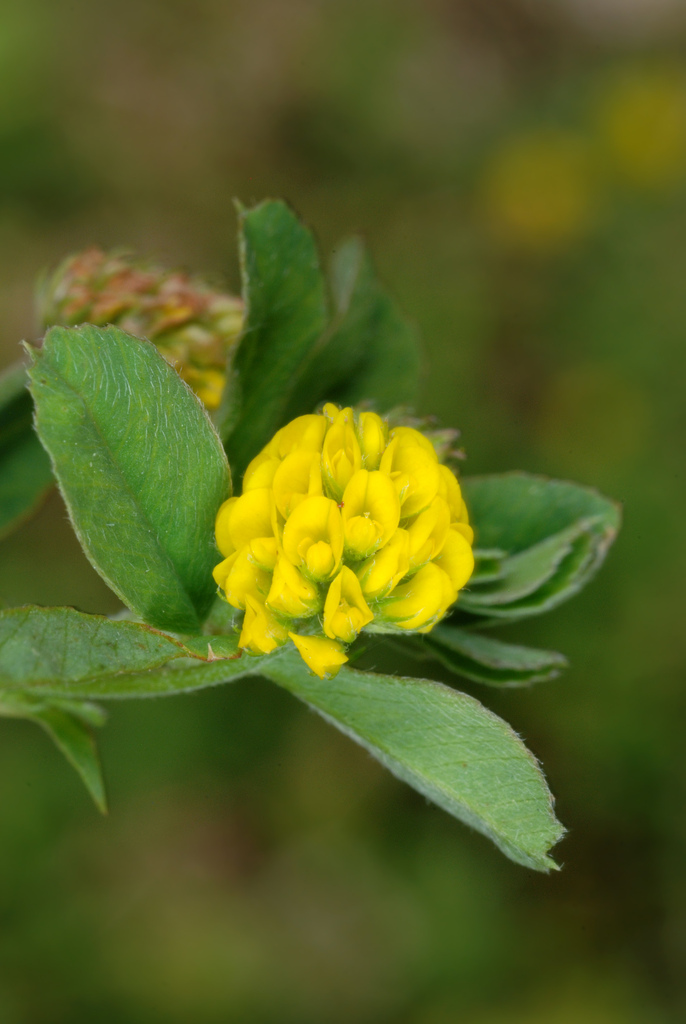
(c) Douglas Goldman, some rights reserved (CC BY-SA), uploaded by Douglas Goldman · licence
Family: Fabaceae · Type: Herb · Not Native
Medicago lupulina (Black medick) is a non-native California herb in the Fabaceae family, recognized by black, kidney-shaped, spineless fruits.
Black medick is a naturalized annual found in California's Foothill Woodlands, Great Basin, and Panamint Mountains in disturbed and agricultural areas, forest, and mountain habitats at elevations up to 2,500 meters. Flowering from April to July, this plant produces small yellow flowers in compact clusters of 10 to 20 blooms. Growing with prostrate to ascending stems 10 to 40 centimeters long that are distinctly angled and hairy, it spreads low across the ground. Its leaves have three obovate to oblong leaflets typically 1 to 1.5 centimeters long, with entire or slightly toothed stipules. The small black, kidney-shaped fruits are 2 to 2.5 millimeters long with prominent concentric veins.
Identification and appearance
Key characters: 9 sympatric species; black, kidney-shaped, spineless fruits are diagnostic
Habitat and range
Habitat: Disturbed and agricultural areas, forest, mountains
Elevation: < 2500 m
California counties: San Bernardino, El Dorado, San Francisco, Butte, Calaveras, Kern, Los Angeles, San Diego, Riverside, Imperial, Orange, Siskiyou, Inyo, Monterey, Sonoma, Mendocino, Lake, Santa Clara, Lassen, Fresno, Plumas, Ventura, Glenn, Tehama, San Mateo, Trinity, Placer, Nevada, Mono, Modoc, Marin, Shasta, Sacramento, Contra Costa, Alameda, Yuba, Colusa, San Luis Obispo, Napa, Humboldt, Del Norte, Mariposa, Tuolumne, Amador, Madera, Tulare, Santa Barbara, Alpine, Sierra, Stanislaus, San Benito, Yolo, Santa Cruz
Outside California: most of United States, widespread elsewhere, native to Europe
Bloom period
Medicago lupulina blooms Apr-Jul.
How to tell it apart
vs Melilotus: Medicago fruits are spirally coiled; Melilotus fruits are small egg-shaped pods with transverse ridges.; vs Trifolium: Medicago flowers fall off; Trifolium flowers persist and enclose the fruit in papery covering.; vs Oxalis: Medicago has pea-shaped flowers and coiled fruits; wood-sorrels (Oxalis) have 5-petaled flowers and upright capsules.; vs Acmispon: Medicago has toothed leaflets and coiled fruits; Acmispon has smooth-edged leaflets and straight pods.; vs Vicia: Medicago has coiled prickly fruits; vetches (Vicia) have flat straight pods and tendrils.
Frequently asked questions
Is Medicago lupulina native to California?
No. Medicago lupulina is not native to California (recorded as not native).
When does Medicago lupulina bloom?
Medicago lupulina blooms Apr-Jul.
Where in California does Medicago lupulina grow?
Medicago lupulina occurs in San Bernardino, El Dorado, San Francisco, Butte, Calaveras, Kern, Los Angeles, San Diego and other counties, at elevations of < 2500 m.
What plant family does Medicago lupulina belong to?
Medicago lupulina is in the Fabaceae family, genus Medicago.
What habitat does Medicago lupulina grow in?
Medicago lupulina grows in Disturbed and agricultural areas, forest, mountains.
Related species
Other California species in the same genus, family, or bioregion.
Sources: Jepson eFlora · Index of California Plant Names · CalPhotos
Last updated 2026-10-07
Data from The California Species Project — 14,000+ California species with verified data from CNPS, CDFW, USFWS, Cal-IPC, and more.