Melia azedarach
China berry, persian lilac, Persian Lilac
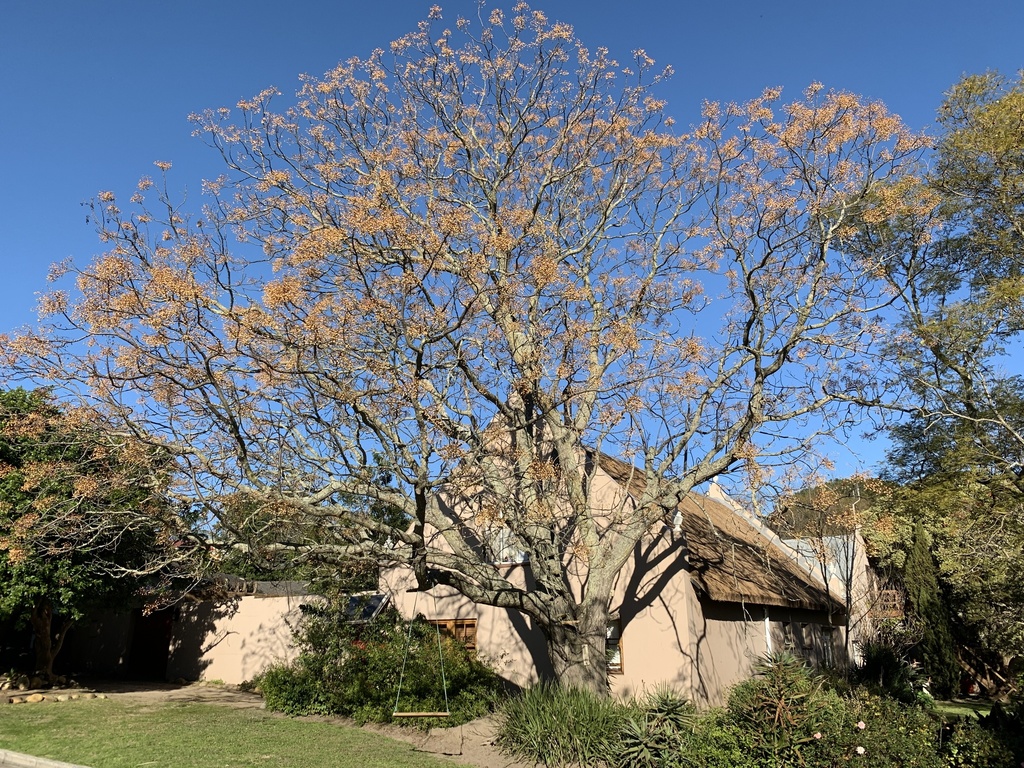
(c) Dave Richardson, some rights reserved (CC BY), uploaded by Dave Richardson · licence
Family: Meliaceae · Type: Shrub / Tree · Not Native
Conservation status: Cal-IPC Yes
Melia azedarach (China berry) is a non-native California shrub / tree in the Meliaceae family, recognized by Naturalized Asian species; only mahogany family representative in California.
China berry is a naturalized tree found in southern California bioregions including San Francisco Bay, Southern California Coast, San Gabriel Mountains, San Bernardino Mountains, and Peninsular Ranges in washes, riparian areas, and coastal scrub at elevations below 1,280 meters. Flowering from March to July, this tree produces white to lilac fragrant flowers with purple filament tubes that age to black. Growing to 10 meters tall with broadly spreading branches and furrowed bark, it develops a distinctive canopy structure. Its large compound leaves reach 20 to 40 centimeters long, featuring 5 to 9 primary leaflets with 5 to 7 secondary leaflets that are ovate to lanceolate and toothed. The fruit is a small spherical yellow structure approximately 10 to 15 millimeters in diameter, containing a single hard seed.
Identification and appearance
Key characters: Naturalized Asian species; only mahogany family representative in California
Habitat and range
Habitat: Washes, riparian areas, coastal scrub, or persisting near old habitations
Elevation: < 1280 m
California counties: Los Angeles, Riverside, San Bernardino, Orange, Kern, Ventura, San Luis Obispo, Butte, Fresno, Kings, Colusa, Alameda, Stanislaus, San Joaquin, Yolo, Santa Barbara, Tulare, Monterey, San Diego, Santa Clara
Outside California: native to southeastern Asia, northern Australia
Bloom period
Melia azedarach blooms Mar-Jul.
Conservation status
Cal-IPC Yes
How to tell it apart
vs Ailanthus: Tree-of-heaven has once-pinnate leaves with gland-tipped basal teeth and dry winged samaras; chinaberry has twice-pinnate leaves and fleshy yellow marble-like drupes.; vs Sambucus: Elderberry leaves are once-pinnate and opposite with flat-topped white flower clusters; Melia leaves are bipinnate and alternate with loose lilac flower panicles.; vs Jacaranda: Jacaranda is also bipinnate but bears large trumpet-shaped blue-purple flowers; Melia flowers are small and star-like with a dark purple staminal tube.; vs Koelreuteria: Goldenrain-tree has inflated papery capsules and yellow flowers; chinaberry has round fleshy yellow drupes and lilac flowers.; vs Fraxinus: Ash leaves are once-pinnate, opposite, and fruit is a single winged samara; Melia leaves are twice-pinnate, alternate, and fruit is a fleshy drupe.
Frequently asked questions
Is Melia azedarach native to California?
No. Melia azedarach is not native to California (recorded as not native).
When does Melia azedarach bloom?
Melia azedarach blooms Mar-Jul.
Where in California does Melia azedarach grow?
Melia azedarach occurs in Los Angeles, Riverside, San Bernardino, Orange, Kern, Ventura, San Luis Obispo, Butte and other counties, at elevations of < 1280 m.
What plant family does Melia azedarach belong to?
Melia azedarach is in the Meliaceae family, genus Melia.
Is Melia azedarach invasive in California?
Melia azedarach is listed by Cal-IPC with an invasiveness rating of Yes.
Related species
Other California species in the same genus, family, or bioregion.
Sources: Jepson eFlora · Index of California Plant Names · CalPhotos
Last updated 2026-10-07
Data from The California Species Project — 14,000+ California species with verified data from CNPS, CDFW, USFWS, Cal-IPC, and more.