Melica californica
California melic, California Melic
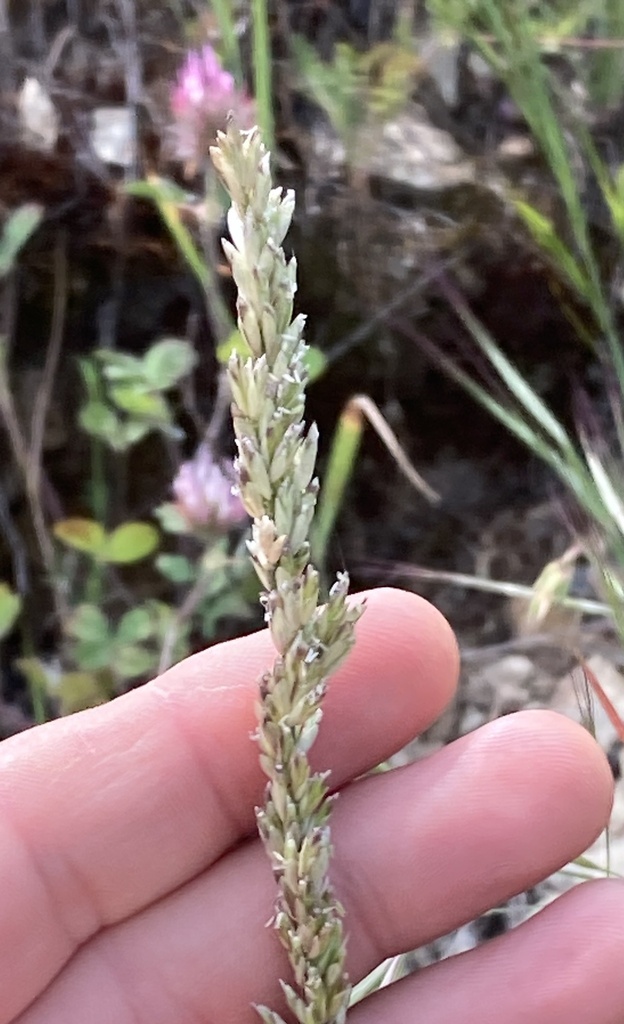
(c) Adam J. Searcy, some rights reserved (CC BY) · licence
Family: Poaceae · Type: Grass · Native
Melica californica (California melic) is a native California grass in the Poaceae family, recognized by habitat breadth and non-floret-like sterile clusters diagnostic.
California melic is a California native perennial found in northwestern California, Cascade Range, Sierra Nevada, Central Valley, Central Western California, Western Transverse Ranges, and Peninsular Ranges in open or rocky hillsides, oak woodland, and conifer forest at elevations below 2,200 meters. Flowering from April to May, this plant produces delicate pale green to brown spikelets in compact clusters with branches held close to the main stem. Growing with slender stems 40 to 140 centimeters tall and slightly swollen lower internodes, it develops without a prominent underground corm. Its leaf blades are narrow, measuring 1.5 to 5 millimeters wide, with a ligule 1.5 to 4 millimeters long. Each spikelet contains 2 to 5 bisexual florets with lemmas 5 to 9 millimeters long, typically glabrous or slightly rough-textured.
Identification and appearance
Key characters: Co-occurs with 11 species; habitat breadth and non-floret-like sterile clusters diagnostic
Habitat and range
Habitat: Open or rocky hillsides, oak woodland, conifer forest
Elevation: < 2200 m
California counties: Humboldt, Fresno, San Luis Obispo, Santa Clara, Lake, Alameda, Tuolumne, Tulare, San Benito, Solano, El Dorado, Santa Barbara, Trinity, Monterey, Siskiyou, Glenn, Riverside, Santa Cruz, Stanislaus, Sonoma, Mendocino, Marin, San Mateo, Kern, Ventura, Mariposa, Butte, Contra Costa, Los Angeles, Madera, San Francisco, Sutter, Colusa, Napa, Sacramento, San Bernardino, Placer, Amador, Calaveras, Lassen, Sierra, Yuba, Nevada, Shasta, Tehama, Merced, San Joaquin, Alpine, Mono, Modoc, Yolo, San Diego, Plumas, Inyo
Outside California: Oregon
Bloom period
Melica californica blooms Apr-May.
How to tell it apart
vs Oloptum: Melica has club-shaped sterile floret tips; Oloptum has normal pointed spikelets and needle-like rolled leaves.; vs Poa: Melica has club-shaped sterile florets at tips; Poa has all fertile florets and boat-shaped lemmas with cobwebby hairs.; vs Lolium: Melica has club-shaped floret tips and closed leaf sheaths; Lolium has edgewise spikelets and split leaf sheaths.; vs Festuca: Melica has club-shaped sterile florets; Festuca has all fertile florets and open (split) leaf sheaths.; vs Ehrharta: Melica has club-shaped sterile florets at top; Ehrharta has hardened sterile florets at bottom of spikelet.
Frequently asked questions
Is Melica californica native to California?
Yes. Melica californica is native to California (recorded as native).
When does Melica californica bloom?
Melica californica blooms Apr-May.
Where in California does Melica californica grow?
Melica californica occurs in Humboldt, Fresno, San Luis Obispo, Santa Clara, Lake, Alameda, Tuolumne, Tulare and other counties, at elevations of < 2200 m.
What plant family does Melica californica belong to?
Melica californica is in the Poaceae family, genus Melica.
What habitat does Melica californica grow in?
Melica californica grows in Open or rocky hillsides, oak woodland, conifer forest.
Related species
Other California species in the same genus, family, or bioregion.
Sources: Jepson eFlora · Index of California Plant Names · CalPhotos
Last updated 2026-10-07
Data from The California Species Project — 14,000+ California species with verified data from CNPS, CDFW, USFWS, Cal-IPC, and more.