Melica subulata
Alaskan oniongrass
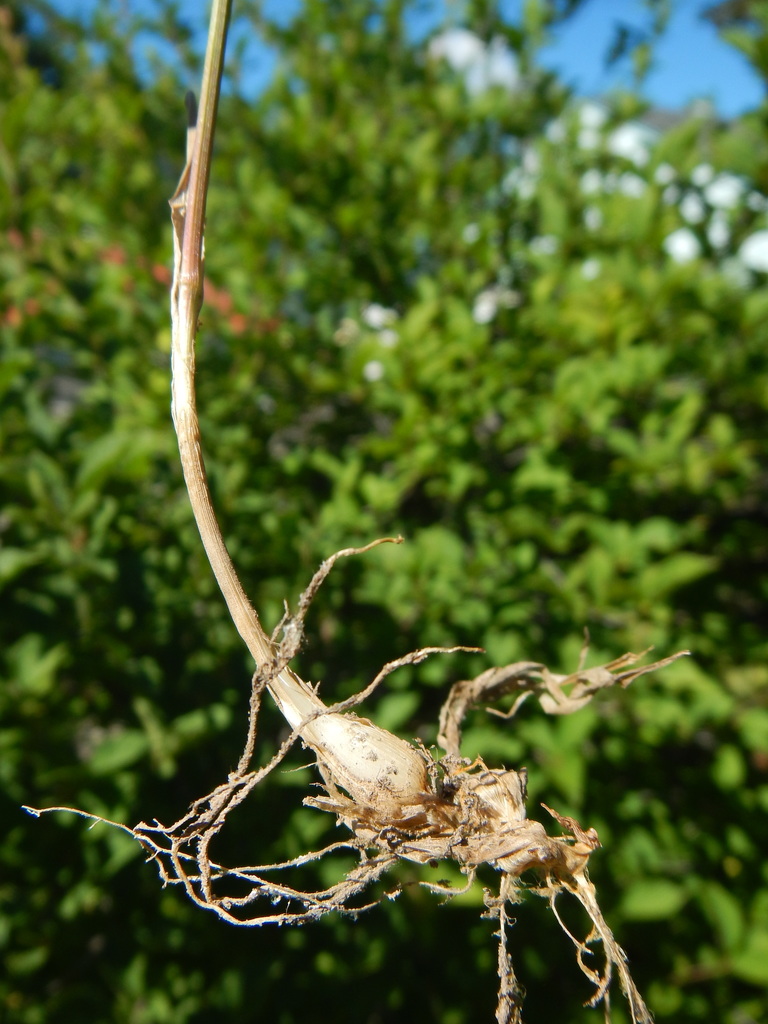
(c) Matt Lavin, some rights reserved (CC BY) · licence
Family: Poaceae · Type: Grass · Native
Melica subulata (Alaskan oniongrass) is a native California grass in the Poaceae family, recognized by moist habitat and acuminate lemma tips diagnostic.
Alaskan oniongrass is a California native perennial found in the Klamath Ranges, northern Coast Ranges, high Cascade Range, northern and central Sierra Nevada, Central Coast, San Francisco Bay Area, and Warner Mountains in moist sites, streambanks, and conifer forests at elevations below 2,300 meters. Flowering from April to July, this grass produces delicate spikelets 10 to 28 millimeters long with persistent glumes. Growing with stems 50 to 130 centimeters tall, it forms clustered sessile corms and develops short rhizomes. Its leaves are 2 to 10 millimeters wide with very short ligules measuring 0.4 to 5 millimeters. The grass produces 2 to 5 bisexual florets with lemmas that are generally hairy, particularly near the base, and have strongly tapered, acuminate tips.
Identification and appearance
Key characters: Co-occurs with 10 species; moist habitat and acuminate lemma tips diagnostic
Habitat and range
Habitat: Moist sites, streambanks, conifer forest
Elevation: < 2300 m
California counties: Humboldt, Del Norte, Plumas, Nevada, Napa, Butte, Mariposa, Siskiyou, Mendocino, Trinity, Santa Clara, El Dorado, Amador, Alpine, Modoc, Glenn, Lassen, Placer, Shasta, Sonoma, Marin, San Mateo, Santa Cruz, Tuolumne, Tehama, Yuba, Monterey, Lake
Outside California: Alaska, Rocky Mountains, also in South America
Bloom period
Melica subulata blooms Apr-Jul.
How to tell it apart
vs Oloptum: Melica has club-shaped sterile floret tips; Oloptum has normal pointed spikelets and needle-like rolled leaves.; vs Poa: Melica has club-shaped sterile florets at tips; Poa has all fertile florets and boat-shaped lemmas with cobwebby hairs.; vs Lolium: Melica has club-shaped floret tips and closed leaf sheaths; Lolium has edgewise spikelets and split leaf sheaths.; vs Festuca: Melica has club-shaped sterile florets; Festuca has all fertile florets and open (split) leaf sheaths.; vs Ehrharta: Melica has club-shaped sterile florets at top; Ehrharta has hardened sterile florets at bottom of spikelet.
Frequently asked questions
Is Melica subulata native to California?
Yes. Melica subulata is native to California (recorded as native).
When does Melica subulata bloom?
Melica subulata blooms Apr-Jul.
Where in California does Melica subulata grow?
Melica subulata occurs in Humboldt, Del Norte, Plumas, Nevada, Napa, Butte, Mariposa, Siskiyou and other counties, at elevations of < 2300 m.
What plant family does Melica subulata belong to?
Melica subulata is in the Poaceae family, genus Melica.
What habitat does Melica subulata grow in?
Melica subulata grows in Moist sites, streambanks, conifer forest.
Related species
Other California species in the same genus, family, or bioregion.
Sources: Jepson eFlora · Index of California Plant Names · CalPhotos
Last updated 2026-10-07
Data from The California Species Project — 14,000+ California species with verified data from CNPS, CDFW, USFWS, Cal-IPC, and more.