Melissa officinalis
Lemon balm, Lemon Balm
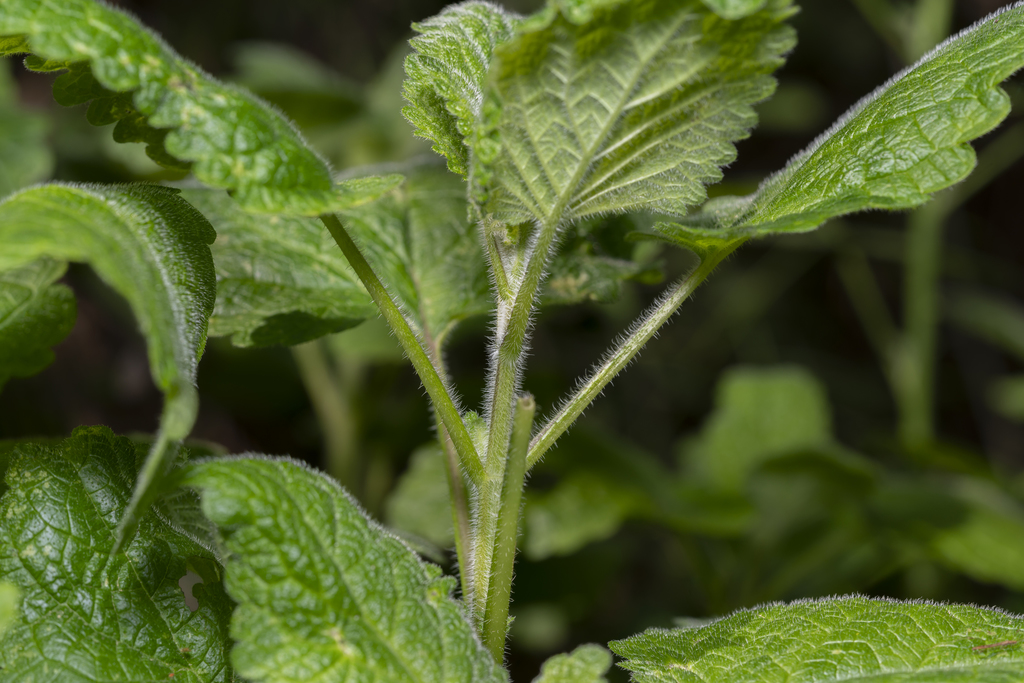
(c) Eleftherios Katsillis, some rights reserved (CC BY), uploaded by Eleftherios Katsillis · licence
Family: Lamiaceae · Type: Herb · Not Native
Melissa officinalis (Lemon balm) is a non-native California herb in the Lamiaceae family, recognized by Naturalized European culinary herb; distinctive lemon fragrance unique among California mint family.
Lemon balm is a naturalized perennial found in northwestern California, the northern Sierra Nevada foothills, and central western areas in moist meadows and fields at elevations below 800 meters. Flowering from June to September, this plant produces white to cream-colored flowers occasionally tinged with lavender, clustered in small groups of 4 to 12 blooms. Growing with branched stems 20 to 150 centimeters tall that are finely glandular hairy, it spreads with multiple erect stems. Its leaves are broadly ovate, 2 to 14 centimeters long and 1.5 to 7 centimeters wide, with softly scalloped edges. The plant's delicate glandular stems and softly textured leaves make it a distinctive herb in moist habitats.
Identification and appearance
Key characters: Naturalized European culinary herb; distinctive lemon fragrance unique among California mint family
Habitat and range
Habitat: Moist sites, meadows, fields
Elevation: < 800 m
California counties: Butte, Siskiyou, Humboldt, Santa Cruz, Alameda, Santa Clara, Tuolumne, Sonoma, San Mateo, Mendocino, San Bernardino, Inyo, San Diego, Shasta, Los Angeles, Amador, El Dorado, Contra Costa, San Luis Obispo, Sutter, Monterey, Napa, Tulare, Marin, Nevada, Trinity, Orange
Outside California: native to southern Europe
Bloom period
Melissa officinalis blooms Jun-Sep.
How to tell it apart
vs Stachys: Melissa has full-sized leaves beneath all flower clusters; Stachys upper flowers have only small bracts.; vs Mentha: Melissa flowers have upward-curved tubes; Mentha flowers are nearly radial with short tubes.; vs Nepeta: Melissa has 7-9mm calyces; Nepeta calyces are larger with 15 distinct veins.; vs Marrubium: Melissa has white curved-tube flowers; Marrubium has tiny white radial flowers in dense leaf axils.; vs Urtica: Melissa has showy tubular mint flowers; Urtica has tiny green dangling flower clusters and stinging hairs.
Frequently asked questions
Is Melissa officinalis native to California?
No. Melissa officinalis is not native to California (recorded as not native).
When does Melissa officinalis bloom?
Melissa officinalis blooms Jun-Sep.
Where in California does Melissa officinalis grow?
Melissa officinalis occurs in Butte, Siskiyou, Humboldt, Santa Cruz, Alameda, Santa Clara, Tuolumne, Sonoma and other counties, at elevations of < 800 m.
What plant family does Melissa officinalis belong to?
Melissa officinalis is in the Lamiaceae family, genus Melissa.
What habitat does Melissa officinalis grow in?
Melissa officinalis grows in Moist sites, meadows, fields.
Related species
Other California species in the same genus, family, or bioregion.
Sources: Jepson eFlora · Index of California Plant Names · CalPhotos
Last updated 2026-10-07
Data from The California Species Project — 14,000+ California species with verified data from CNPS, CDFW, USFWS, Cal-IPC, and more.