Mentha canadensis
American cornmint, japanese peppermint, Japanese Peppermint
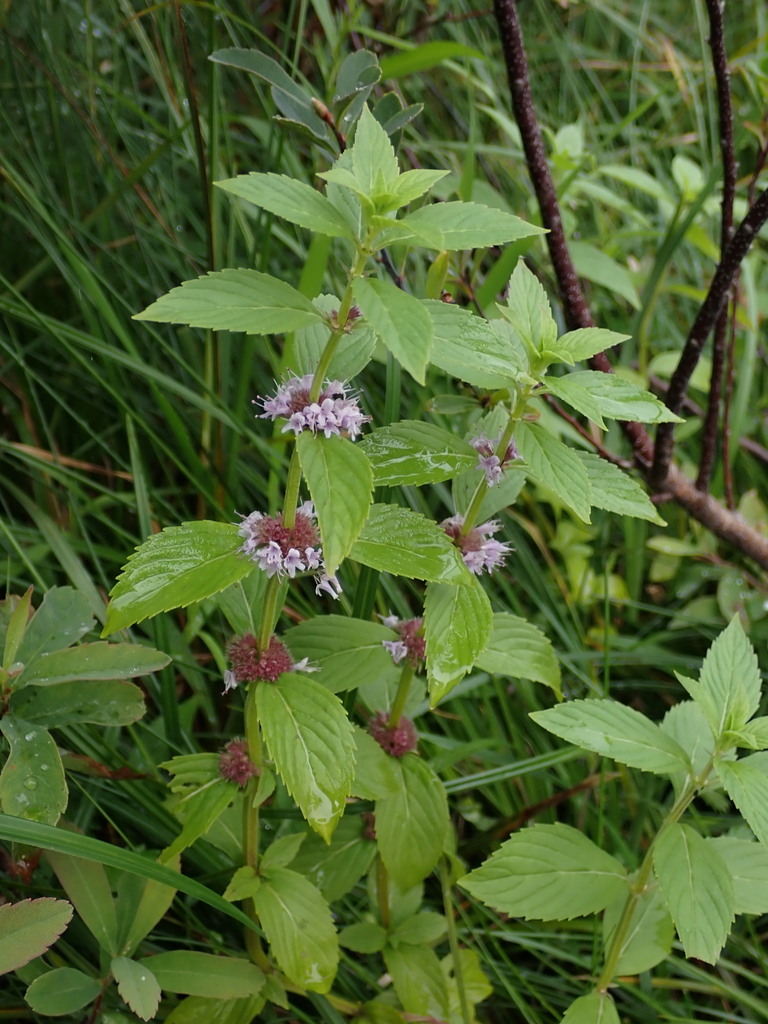
(c) elik03, some rights reserved (CC BY) · licence
Family: Lamiaceae · Type: Perennial · Native
Mentha canadensis (American cornmint) is a native California perennial in the Lamiaceae family, recognized by Co-occurs with 11 other mint species; only native species with distinctive hairiness pattern.
American cornmint is a native perennial found in northwestern California, the Cascade Range, Sierra Nevada, Great Valley, central western California, southern California, Transverse Ranges, Peninsular Ranges, Modoc Plateau, and desert mountains in moist areas, streambanks, and lakeshores at elevations below 2,400 meters. Flowering from July to October, this plant produces white to pink or violet flowers 4 to 7 millimeters long in delicate axillary clusters. Growing with stems 10 to 50 centimeters tall that are softly hairy, it spreads with a distinctive branching habit. Its leaves are linear to lanceolate, 1.5 to 5 centimeters long, with serrated edges and a tapered base, covered in short hairs especially along the veins. The plant thrives in wet habitats, creating dense, aromatic patches that attract pollinators.
Identification and appearance
Key characters: Co-occurs with 11 other mint species; only native species with distinctive hairiness pattern
Habitat and range
Habitat: Moist areas, streambanks, lakeshores, fields
Elevation: < 2400 m
California counties: Nevada, Alpine, Solano, San Bernardino, Mono, Riverside, Humboldt, Siskiyou, Del Norte, Plumas, Colusa, Tulare, Fresno, Modoc, Kern, Inyo, Santa Clara, Monterey, Napa, Shasta, Los Angeles, San Luis Obispo, San Joaquin, San Benito, Ventura, Marin, Tuolumne, Lake, Mendocino, San Diego, El Dorado, Placer, San Mateo, Santa Barbara, Lassen, Sacramento, Glenn, Sonoma, Butte, Yuba, Tehama, Yolo, Santa Cruz, Mariposa, Stanislaus, Alameda, Contra Costa, Madera
Outside California: eastern Asia
Bloom period
Mentha canadensis blooms Jul-Oct.
How to tell it apart
vs Monardella: Monardella has one pom-pom head per stem; Mentha has multiple clusters stacked at intervals up the stem.; vs Salvia: Sage has flowers in an elongated terminal spike; Mentha has clusters distributed along the stem at leaf joints.; vs Stachys: Hedge-nettle has larger flowers and lacks the classic mint smell; Mentha is aromatic with smaller flowers.; vs Melissa: Lemon balm has flowers all on one side of the stem; Mentha's clusters encircle the stem evenly.; vs Clinopodium: Clinopodium has tiny flowers (pencil-eraser size); Mentha's flowers are noticeably larger and more visible.
Frequently asked questions
Is Mentha canadensis native to California?
Yes. Mentha canadensis is native to California (recorded as native).
When does Mentha canadensis bloom?
Mentha canadensis blooms Jul-Oct.
Where in California does Mentha canadensis grow?
Mentha canadensis occurs in Nevada, Alpine, Solano, San Bernardino, Mono, Riverside, Humboldt, Siskiyou and other counties, at elevations of < 2400 m.
What plant family does Mentha canadensis belong to?
Mentha canadensis is in the Lamiaceae family, genus Mentha.
What habitat does Mentha canadensis grow in?
Mentha canadensis grows in Moist areas, streambanks, lakeshores, fields.
Related species
Other California species in the same genus, family, or bioregion.
Sources: Jepson eFlora · Index of California Plant Names · CalPhotos
Last updated 2026-10-06
Data from The California Species Project — 14,000+ California species with verified data from CNPS, CDFW, USFWS, Cal-IPC, and more.