Micranthes odontoloma
Brook saxifrage
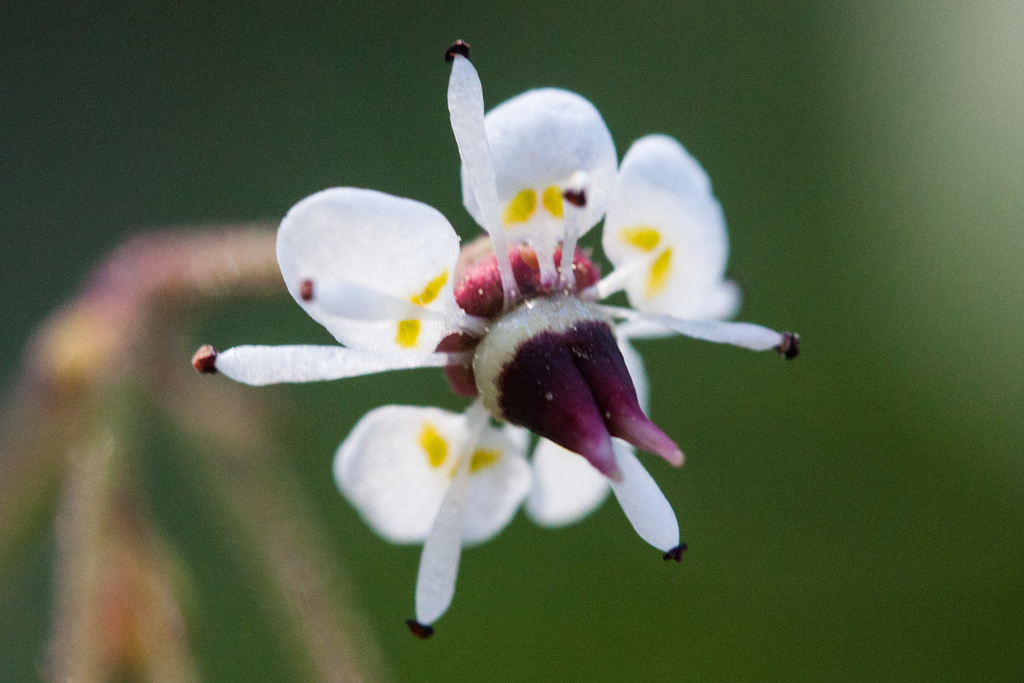
(c) Ken-ichi Ueda, some rights reserved (CC BY) · licence
Family: Saxifragaceae · Type: Herb · Native
Micranthes odontoloma (Brook saxifrage) is a native California herb in the Saxifragaceae family, recognized by distinctive round cordate leaves and sheathing petiole bases.
Brook saxifrage is a California native perennial found in the Klamath Ranges, northern Coast Ranges, California Ranges, Sierra Nevada High, and San Bernardino Mountains in wet meadows and rocky ledges at elevations above 1,500 meters. Flowering from July to August, this plant produces white flowers with distinctive two-spotted petals that are round to elliptic, measuring 3 to 4.5 millimeters long. Growing with stems 20 to 50 centimeters tall and developing a caudex with rhizomes, it has an open flowering structure. Its leaves are broadly round with heart-shaped bases, featuring coarse and sharp teeth, measuring 4 to 40 centimeters long with petioles 2 to 30 centimeters in length that have expanded, membranous bases. The fruit develops as a capsule-like structure with unique placental characteristics in its ovary lobes.
Identification and appearance
Key characters: 11 sympatric species; distinctive round cordate leaves and sheathing petiole bases
Habitat and range
Habitat: Wet meadows, ledges
Elevation: > 1500 m
California counties: San Bernardino, Inyo, Butte, El Dorado, Lassen, Madera, Mono, Shasta, Sierra, Trinity, Tehama, Tuolumne, Alpine, Fresno, Mariposa, Nevada, Plumas, Siskiyou, Tulare, Placer, Amador
Outside California: to British Columbia, Montana, New Mexico
Bloom period
Micranthes odontoloma blooms Jul-Aug.
How to tell it apart
vs Saxifraga: Micranthes has all leaves unlobed/entire; Saxifraga has at least some leaves lobed or divided.; vs Romanzoffia: Micranthes has basal rosettes and 2 pistils; Romanzoffia has trailing stems and funnel-shaped flowers.; vs Boykinia: Micranthes has 2 separate pistils forming follicles; Boykinia has 1 pistil forming a capsule.; vs Calyptridium: Micranthes has 2 pistils and 5 petals; Calyptridium has 1 pistil and 2 petals.; vs Verbascum: Micranthes has basal rosettes with small flowers; Verbascum has tall spikes with large fuzzy flowers.
Frequently asked questions
Is Micranthes odontoloma native to California?
Yes. Micranthes odontoloma is native to California (recorded as native).
When does Micranthes odontoloma bloom?
Micranthes odontoloma blooms Jul-Aug.
Where in California does Micranthes odontoloma grow?
Micranthes odontoloma occurs in San Bernardino, Inyo, Butte, El Dorado, Lassen, Madera, Mono, Shasta and other counties, at elevations of > 1500 m.
What plant family does Micranthes odontoloma belong to?
Micranthes odontoloma is in the Saxifragaceae family, genus Micranthes.
What habitat does Micranthes odontoloma grow in?
Micranthes odontoloma grows in Wet meadows, ledges.
Related species
Other California species in the same genus, family, or bioregion.
Sources: Jepson eFlora · Index of California Plant Names · CalPhotos
Last updated 2026-10-07
Data from The California Species Project — 14,000+ California species with verified data from CNPS, CDFW, USFWS, Cal-IPC, and more.