Microsteris gracilis
Slender phlox
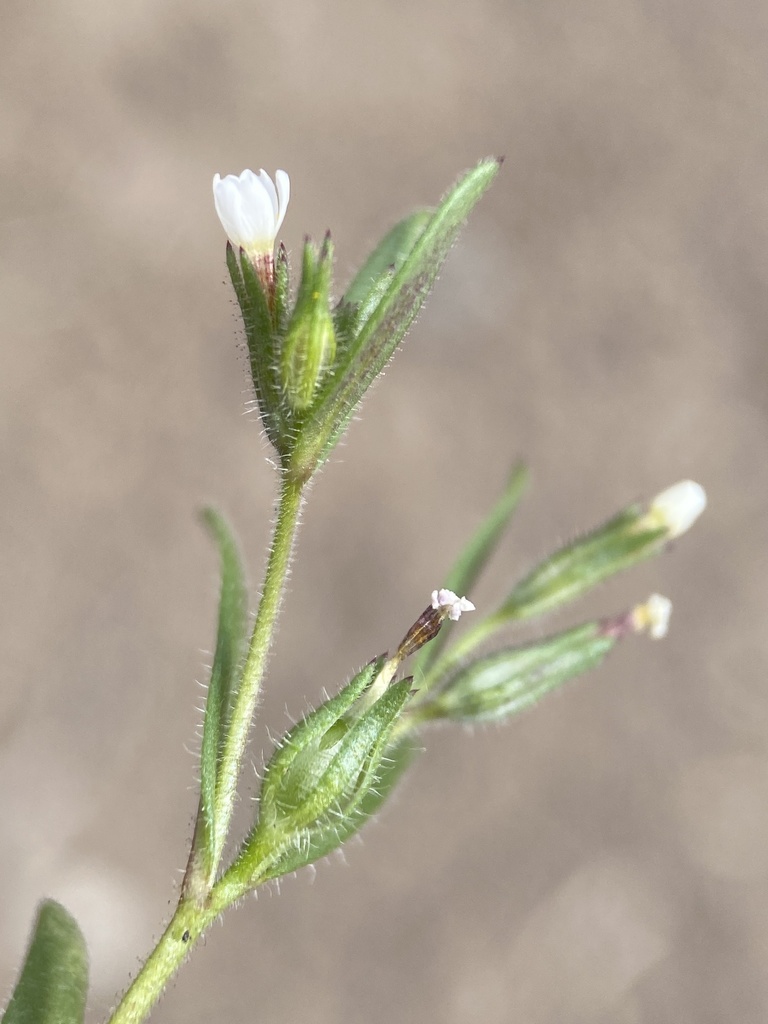
(c) Matt Berger, some rights reserved (CC BY), uploaded by Matt Berger · licence
Family: Polemoniaceae · Type: Herb · Native
Microsteris gracilis (Slender phlox) is a native California herb in the Polemoniaceae family, recognized by Range edge species extending into California from Rocky Mountain distribution.
Slender phlox is a California native annual found in dry to moist areas across the state at elevations up to 3,300 meters. Flowering from March to August, this delicate plant produces bright pink or white flowers with small lobes and a yellowish tube, typically 1 to 2 millimeters across. Growing with erect or decumbent stems less than 20 centimeters tall, it has a glandular-hairy appearance that becomes more pronounced toward the upper portions of the plant. Its leaves are opposite near the base and often alternate higher up the stem, ranging 10 to 30 millimeters long and shaped oblanceolate to lanceolate. When wet, the plant's seeds develop a unique gelatinous coating, adding to its distinctive botanical character.
Identification and appearance
Key characters: Range edge species extending into California from Rocky Mountain distribution
Habitat and range
Habitat: dry to moist areas
Elevation: < 3300 m
California counties: Kern, San Bernardino, Tulare, San Diego, Riverside, Los Angeles, Ventura, San Luis Obispo, Monterey, Mono, Alameda, El Dorado, Butte, Plumas, Modoc, Alpine, Fresno, Lake, Marin, Lassen, Shasta, Nevada, Sonoma, Mendocino, Merced, Glenn, Sutter, Tehama, Humboldt, Sierra, Trinity, Placer, Colusa, Siskiyou, Calaveras, Del Norte, San Mateo, Santa Barbara, Contra Costa, Inyo, Tuolumne, Amador, San Benito, Solano, Santa Clara, Napa, Yolo, Mariposa, San Joaquin, Yuba, Kings, Santa Cruz, Madera
Outside California: to British Columbia, Montana, Colorado, Mexico, also in South America
Bloom period
Microsteris gracilis blooms Mar-Aug.
How to tell it apart
vs Collomia: Microsteris has tiny flowers with barely-visible petals; Collomia has showy tubular flowers with flared lobes.; vs Leptosiphon: Microsteris has simple undivided leaves; Leptosiphon has deeply divided finger-like leaves.; vs Epilobium: Microsteris has opposite leaves and 5-petaled flowers; Epilobium has 4-petaled flowers and long seed capsules.; vs Allophyllum: Microsteris has simple unlobed leaves; Allophyllum has deeply pinnately-divided leaves.; vs Navarretia: Microsteris has soft simple leaves; Navarretia has spine-tipped divided leaves.
Frequently asked questions
Is Microsteris gracilis native to California?
Yes. Microsteris gracilis is native to California (recorded as native).
When does Microsteris gracilis bloom?
Microsteris gracilis blooms Mar-Aug.
Where in California does Microsteris gracilis grow?
Microsteris gracilis occurs in Kern, San Bernardino, Tulare, San Diego, Riverside, Los Angeles, Ventura, San Luis Obispo and other counties, at elevations of < 3300 m.
What plant family does Microsteris gracilis belong to?
Microsteris gracilis is in the Polemoniaceae family, genus Microsteris.
What habitat does Microsteris gracilis grow in?
Microsteris gracilis grows in dry to moist areas.
Related species
Other California species in the same genus, family, or bioregion.
Sources: Jepson eFlora · Index of California Plant Names · CalPhotos
Last updated 2026-10-07
Data from The California Species Project — 14,000+ California species with verified data from CNPS, CDFW, USFWS, Cal-IPC, and more.