Mirabilis laevis var. villosa
Wishbone bush
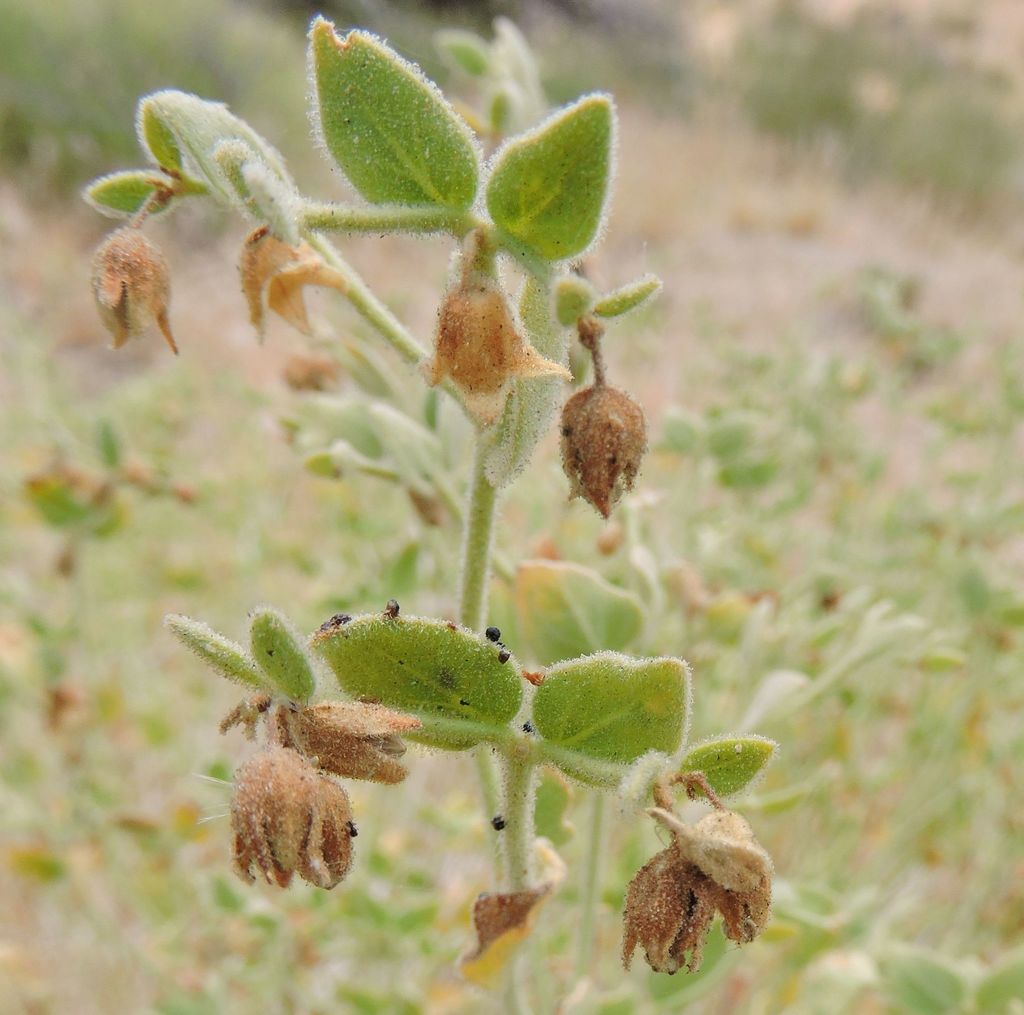
(c) cwwood, some rights reserved (CC BY-SA) · licence
Family: Nyctaginaceae · Type: Subshrub · Native
Mirabilis laevis var. villosa (Wishbone bush) is a native California subshrub in the Nyctaginaceae family, recognized by glandular-only hairs and fruit characteristics.
Wishbone bush is a California native perennial found in the White and Inyo Mountains and eastern Desert regions in rocky places at elevations below 2,000 meters. Flowering throughout the year, this plant produces white to pale pink flowers in bell-shaped involucres 5 to 6 millimeters long with widely funnel-shaped perianths 8 to 12 millimeters across. Growing with branched stems that are generously covered in glandular hairs, it forms a distinctive shrubby structure. Its leaves are small, ranging from 0.5 to 4 centimeters in blade length, and also covered in glandular hairs. The fruit is generally ovoid, lightly dotted and often mottled, with rarely visible surface lines.
Identification and appearance
Key characters: 9 sympatric species; distinguished by glandular-only hairs and fruit characteristics
Habitat and range
Habitat: Rocky places
Elevation: < 2000 m
California counties: San Bernardino, Inyo, Kern, Riverside, Los Angeles, Fresno, Imperial, San Diego, Mono, Lassen, San Luis Obispo, Tulare, Monterey, Ventura
Outside California: to Utah, Arizona, northwestern Mexico
Bloom period
Mirabilis laevis var. villosa blooms +- all year.
How to tell it apart
vs Nicotiana: Mirabilis flowers sit in a cup of 5 green bracts; Nicotiana has true tubular flowers with 5-lobed petals.; vs Allionia: Mirabilis has 5 bracts and symmetrical flowers; Allionia has 3 bracts and 3 lopsided flowers.; vs Phacelia: Mirabilis flowers sit in green bract cups; Phacelia has coiled clusters with 5 separate petals and hairy leaves.; vs Petunia: Mirabilis has colorful sepals in bract cups; Petunia has fused true petals forming a funnel with capsule fruits.; vs Pelargonium: Mirabilis has opposite leaves and flowers in bract cups; Pelargonium has alternate leaves and 5 separate petals.
Frequently asked questions
Is Mirabilis laevis var. villosa native to California?
Yes. Mirabilis laevis var. villosa is native to California (recorded as native).
When does Mirabilis laevis var. villosa bloom?
Mirabilis laevis var. villosa blooms +- all year.
Where in California does Mirabilis laevis var. villosa grow?
Mirabilis laevis var. villosa occurs in San Bernardino, Inyo, Kern, Riverside, Los Angeles, Fresno, Imperial, San Diego and other counties, at elevations of < 2000 m.
What plant family does Mirabilis laevis var. villosa belong to?
Mirabilis laevis var. villosa is in the Nyctaginaceae family, genus Mirabilis.
What habitat does Mirabilis laevis var. villosa grow in?
Mirabilis laevis var. villosa grows in Rocky places.
Related species
Other California species in the same genus, family, or bioregion.
Sources: Jepson eFlora · Index of California Plant Names · CalPhotos
Last updated 2026-10-07
Data from The California Species Project — 14,000+ California species with verified data from CNPS, CDFW, USFWS, Cal-IPC, and more.