Mirabilis tenuiloba
Slender-lobed four o'clock, Slender-Lobed Four O'Clock
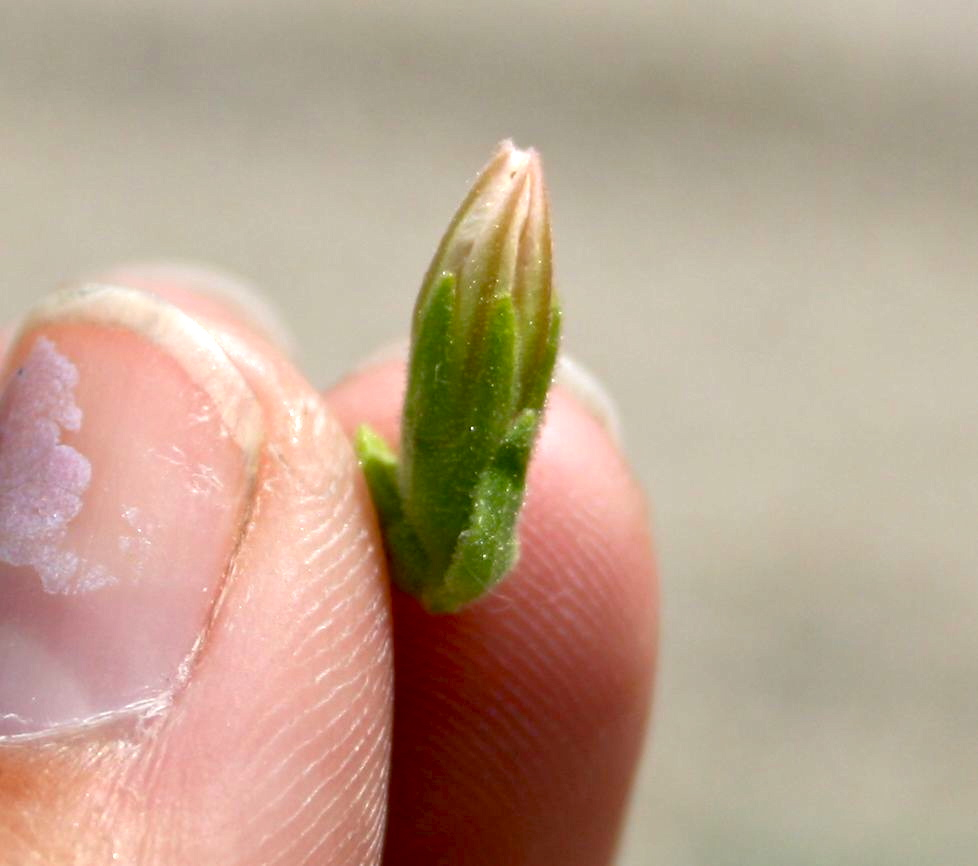
Photo by Chez Brungraber
Family: Nyctaginaceae · Type: Subshrub · Native
Conservation status: CNPS 4.3
Mirabilis tenuiloba (Slender-lobed four o'clock) is a native California subshrub in the Nyctaginaceae family, recognized by triangular leaves and distinctive bract lobe structure.
Slender-lobed four o'clock is a California native perennial found in western Sonoran Desert regions on rocky slopes in desert scrub at elevations below 500 meters. Flowering from March to May, this plant produces white flowers 12 to 15 millimeters long with a delicate funnel-shaped perianth. Growing with trailing to erect stems less than 50 centimeters tall and covered in glandular hairs, it has an open, spreading growth habit. Its leaves are ascending with triangular blades 2.5 to 5 centimeters long, also glandular-hairy and varying from narrow to broadly triangular. The fruit is a small, smooth ovoid seed approximately 5 millimeters long, dark black-brown in color.
Identification and appearance
Key characters: 5 sympatric species; distinguished by triangular leaves and distinctive bract lobe structure
Habitat and range
Habitat: Rocky slopes in desert scrub
Elevation: < 500 m
California counties: Riverside, Imperial, San Diego, San Bernardino
Outside California: Baja California
Bloom period
Mirabilis tenuiloba blooms Mar-May.
Conservation status
CNPS 4.3
How to tell it apart
vs Nicotiana: Mirabilis flowers sit in a cup of 5 green bracts; Nicotiana has true tubular flowers with 5-lobed petals.; vs Allionia: Mirabilis has 5 bracts and symmetrical flowers; Allionia has 3 bracts and 3 lopsided flowers.; vs Phacelia: Mirabilis flowers sit in green bract cups; Phacelia has coiled clusters with 5 separate petals and hairy leaves.; vs Petunia: Mirabilis has colorful sepals in bract cups; Petunia has fused true petals forming a funnel with capsule fruits.; vs Pelargonium: Mirabilis has opposite leaves and flowers in bract cups; Pelargonium has alternate leaves and 5 separate petals.
Frequently asked questions
Is Mirabilis tenuiloba native to California?
Yes. Mirabilis tenuiloba is native to California (recorded as native).
When does Mirabilis tenuiloba bloom?
Mirabilis tenuiloba blooms Mar-May.
Where in California does Mirabilis tenuiloba grow?
Mirabilis tenuiloba occurs in Riverside, Imperial, San Diego, San Bernardino, at elevations of < 500 m.
What plant family does Mirabilis tenuiloba belong to?
Mirabilis tenuiloba is in the Nyctaginaceae family, genus Mirabilis.
Is Mirabilis tenuiloba rare or endangered?
Mirabilis tenuiloba carries California Rare Plant Rank 4.3, state rank S4.
Related species
Other California species in the same genus, family, or bioregion.
- Mirabilis albida — Dwarf four o'clock
- Mirabilis alipes — Winged four o'clock
- Mirabilis coccinea — Red four o'clock
- Mirabilis greenei — Greene's four o'clock
- Mirabilis jalapa var. jalapa — Wishbone bush
- Mirabilis laevis — Desert wishbone bush
- Nyctaginaceae sp. — Four o'clock family
- Tripterocalyx crux-maltae — Kellogg's sand-verbena
- Tripterocalyx micranthus — Small-flowered sand-verbena
- Tripterocalyx sp.
Sources: Jepson eFlora · CNPS Rare Plant Inventory · Index of California Plant Names · CalPhotos · CDFW CNDDB
Last updated 2026-10-07
Data from The California Species Project — 14,000+ California species with verified data from CNPS, CDFW, USFWS, Cal-IPC, and more.