Moehringia macrophylla
Large-leaved sandwort
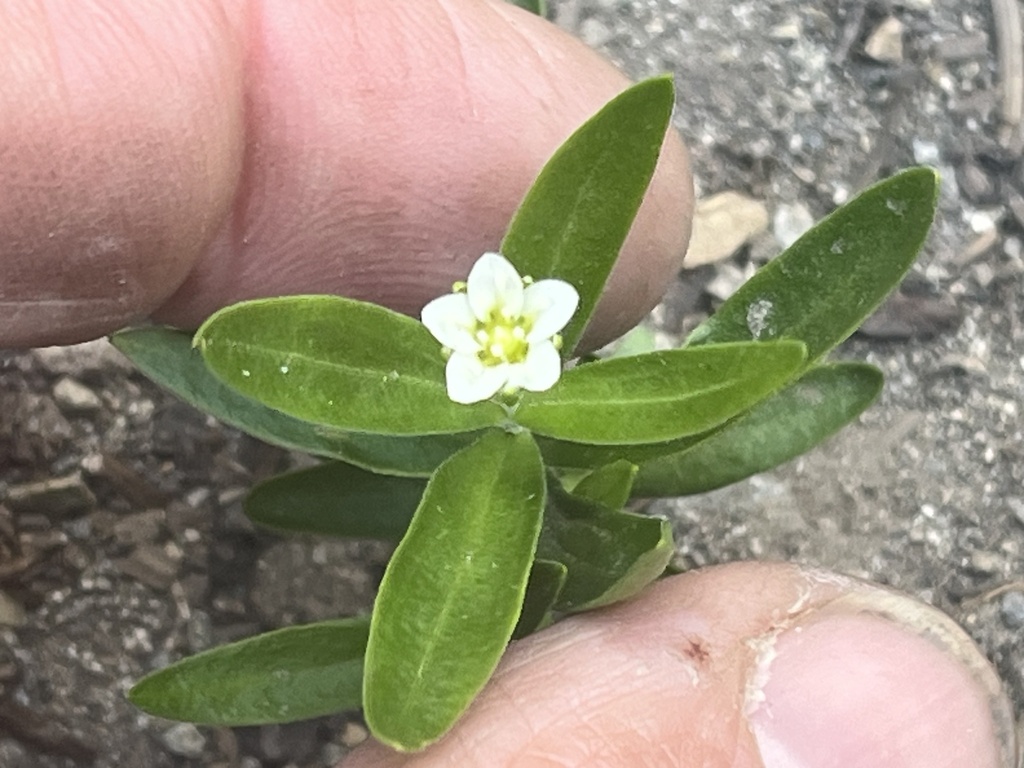
(c) Brian Finzel, some rights reserved (CC BY-SA) · licence
Family: Caryophyllaceae · Type: Herb · Native
Moehringia macrophylla (Large-leaved sandwort) is a native California herb in the Caryophyllaceae family, recognized by Disjunct populations representing southern extent of circumboreal species.
Large-leaved sandwort is a California native perennial found in northwestern California, northern Sierra Nevada, San Francisco Bay Area, southern Coast Ranges, and Peninsular Ranges in moist, shaded slopes, rocky ridges, pine and oak forests at elevations of 300 to 1,800 meters. Flowering from late spring to summer, this plant produces white flowers with round petals and delicate sepals. Growing with slender, branched stems 2 to 18 millimeters tall that have minute peg-like hairs, it spreads through a thin, branching rhizome. Its leaves are 1.5 to 5 centimeters long, spaced evenly along the stem, with smooth to minutely granular margins and ciliate edges near the base. The fruit develops as a small black seed approximately 1.5 to 2.2 millimeters long with low, rounded tubercles.
Identification and appearance
Key characters: Disjunct populations representing southern extent of circumboreal species
Habitat and range
Habitat: Moist, shaded slopes, rocky ridges, summits, pine, oak forests, serpentine
Elevation: 300-1800 m
California counties: Humboldt, Monterey, Trinity, Placer, San Diego, Siskiyou, Tulare, Plumas, Contra Costa, Butte, San Mateo, Alameda, Sonoma, San Benito, Del Norte, Santa Clara, Marin, Yuba, Shasta, Fresno, Mendocino, El Dorado
Outside California: to British Columbia, Montana, Colorado, New Mexico, also +- northern Canada, northeastern North America, Asia
Bloom period
Moehringia macrophylla blooms Late spring-summer.
How to tell it apart
vs Stellaria: Moehringia has broader oval leaves and seeds with appendages; Stellaria has narrower leaves and plain seeds.; vs Holosteum: Moehringia has scattered flowers and smooth petals; Holosteum has umbrella clusters and jagged petals.; vs Sagina: Moehringia has broad oval leaves; Sagina has thread-like leaves forming moss-like mats.; vs Eremogone: Moehringia has broad oval leaves scattered on stems; Eremogone has sharp needle leaves clustered in cushions.; vs Arenaria: Moehringia has underground rhizomes and seeds with spongy appendages; Arenaria lacks both features.
Frequently asked questions
Is Moehringia macrophylla native to California?
Yes. Moehringia macrophylla is native to California (recorded as native).
When does Moehringia macrophylla bloom?
Moehringia macrophylla blooms Late spring-summer.
Where in California does Moehringia macrophylla grow?
Moehringia macrophylla occurs in Humboldt, Monterey, Trinity, Placer, San Diego, Siskiyou, Tulare, Plumas and other counties, at elevations of 300-1800 m.
What plant family does Moehringia macrophylla belong to?
Moehringia macrophylla is in the Caryophyllaceae family, genus Moehringia.
What habitat does Moehringia macrophylla grow in?
Moehringia macrophylla grows in Moist, shaded slopes, rocky ridges, summits, pine, oak forests, serpentine.
Related species
Other California species in the same genus, family, or bioregion.
Sources: Jepson eFlora · Index of California Plant Names · CalPhotos
Last updated 2026-10-07
Data from The California Species Project — 14,000+ California species with verified data from CNPS, CDFW, USFWS, Cal-IPC, and more.