Moluccella laevis
Shell flower
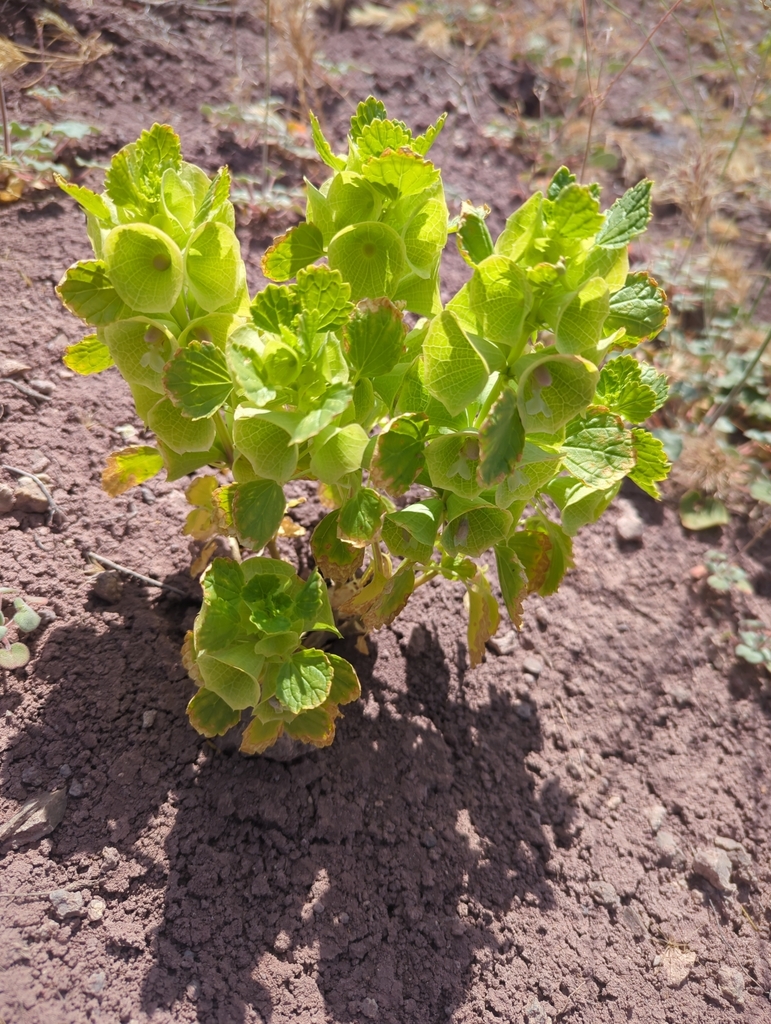
no rights reserved · CC0
Family: Lamiaceae · Type: Herb · Not Native
Moluccella laevis (Shell flower) is a non-native California herb in the Lamiaceae family, recognized by Historical waif from cultivation, distinctive enlarged calyx structure unique among California Lamiaceae.
Shell flower is a naturalized annual found in northern Coast Ranges, Sacramento Valley, and San Francisco Bay Area in disturbed areas and roadsides at elevations below 750 meters. Flowering from April to July, this plant produces white or pink flowers with a distinctive light green to tan calyx spanning 2 to 3 centimeters wide. Growing with stems up to 60 centimeters tall that sometimes branch at the base, it develops an upright and occasionally spreading form. Its leaves are roughly circular, palmately veined, with blade sizes between 1.5 to 4 centimeters, typically shorter than their supporting leaf stalks. The flower's lower lip is uniquely structured with four lobes, where the lateral lobes are smaller than the central two lobes.
Identification and appearance
Key characters: Historical waif from cultivation, distinctive enlarged calyx structure unique among California Lamiaceae
Habitat and range
Habitat: Disturbed areas, roadsides
Elevation: < 750 m
Outside California: north to British Columbia, east to eastern Nevada, southwestern Utah, Rocky Mountains, native to southern Europe
Bloom period
Moluccella laevis blooms Apr-Jul.
How to tell it apart
vs Marrubium: Horehound is densely white-woolly with small calyces bearing 10 hooked teeth in tight clusters; bells-of-Ireland has a large (2--3 cm), smooth, pale-green cup-shaped calyx.; vs Lamium: Dead-nettles have small tubular 5-toothed calyces and showy 2-lipped colored corollas; Moluccella has a hugely inflated shell-like calyx nearly hiding the small white or pink corolla.; vs Prunella: Self-heal packs its flowers into a dense terminal spike with bristly bracts; Moluccella spaces its bell-like calyces in whorls up the stem.; vs Nepeta: Catmint's showy part is a blue 2-lipped corolla above a small calyx; in Moluccella the showy part is the enlarged green calyx, not the corolla.; vs Melissa: Lemon balm has toothed ovate scented leaves and small white flowers in loose clusters; Moluccella has rounded, palmately veined leaves and conspicuous bell-shaped calyces.
Frequently asked questions
Is Moluccella laevis native to California?
No. Moluccella laevis is not native to California (recorded as not native).
When does Moluccella laevis bloom?
Moluccella laevis blooms Apr-Jul.
What plant family does Moluccella laevis belong to?
Moluccella laevis is in the Lamiaceae family, genus Moluccella.
What habitat does Moluccella laevis grow in?
Moluccella laevis grows in Disturbed areas, roadsides.
Related species
Other California species in the same genus, family, or bioregion.
Sources: Jepson eFlora · CalPhotos
Last updated 2026-10-07
Data from The California Species Project — 14,000+ California species with verified data from CNPS, CDFW, USFWS, Cal-IPC, and more.