Monarda pectinata
Plains bee balm, Plains Bee Balm
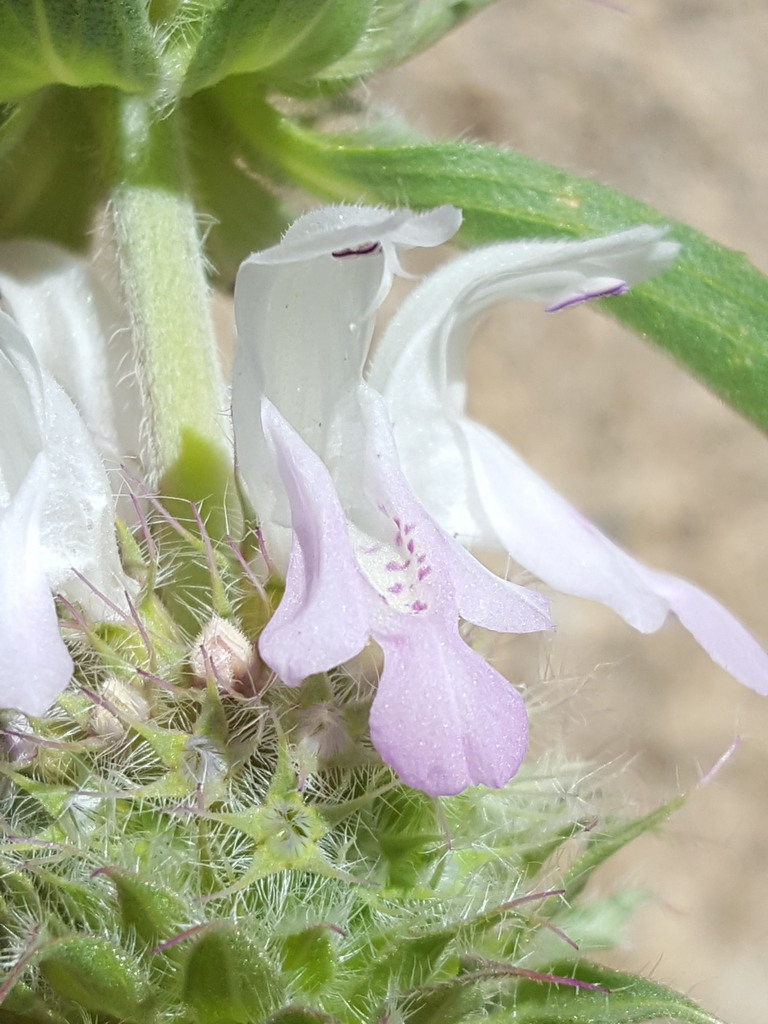
(c) Alex Abair, some rights reserved (CC BY), uploaded by Alex Abair · licence
Family: Lamiaceae · Type: Herb · Native
Conservation status: CNPS 2B.3
Monarda pectinata (Plains bee balm) is a native California herb in the Lamiaceae family, recognized by Great Plains species reaching extreme western range limit in eastern Mojave Desert mountains.
Plains bee balm is a rare (CNPS 2B.3) California native perennial found in the eastern desert mountains, specifically the New York Mountains, in washes, rocky slopes, and pinyon-juniper woodland at elevations of 1,150 to 1,500 meters. Flowering from May to August, this plant produces white to pink flowers with purple-spotted lower lips, 12 to 25 millimeters long. Growing with slender stems 15 to 35 centimeters tall that have short, downward-curled hairs, the plant has a distinctive appearance. Its leaves are 1.5 to 4 centimeters long, generally oblong to lanceolate, with edges that are entire to slightly serrate and surfaces that are nearly smooth to finely hairy, especially along the veins. The flower's calyx tube is 6 to 8 millimeters long with long-acuminate lobes 2 to 4 millimeters in length.
Identification and appearance
Key characters: Great Plains species reaching extreme western range limit in eastern Mojave Desert mountains
Habitat and range
Habitat: Washes, rocky slopes, pinyon/juniper woodland
Elevation: 1150-1500 m
Outside California: to western Great Plains, northern Mexico
Bloom period
Monarda pectinata blooms May-Aug.
Conservation status
CNPS 2B.3
How to tell it apart
vs Salvia: Monarda has flowers with equal calyx lobes, while Salvia has distinctly two-lipped calyxes.; vs Monardella: Monarda has radial flowers with equal lobes, while Monardella has typical two-lipped mint flowers.; vs Phlomis: Monarda is a small herb under 5 feet, while Phlomis is a shrub with densely woolly leaves.; vs Stachys: Monarda has radial calyxes with equal lobes, while Stachys has distinctly two-lipped calyxes.; vs Taraxacum: Monarda has tubular two-lipped flowers on square stems, while Taraxacum has yellow daisy-like flower heads.
Frequently asked questions
Is Monarda pectinata native to California?
Yes. Monarda pectinata is native to California (recorded as native).
When does Monarda pectinata bloom?
Monarda pectinata blooms May-Aug.
What plant family does Monarda pectinata belong to?
Monarda pectinata is in the Lamiaceae family, genus Monarda.
Is Monarda pectinata rare or endangered?
Monarda pectinata carries California Rare Plant Rank 2B.3, state rank SH.
What habitat does Monarda pectinata grow in?
Monarda pectinata grows in Washes, rocky slopes, pinyon/juniper woodland.
Related species
Other California species in the same genus, family, or bioregion.
Sources: Jepson eFlora · CalPhotos · CDFW CNDDB
Last updated 2026-10-07
Data from The California Species Project — 14,000+ California species with verified data from CNPS, CDFW, USFWS, Cal-IPC, and more.