Monardella linoides subsp. oblonga
Tehachapi monardella, Tehachapi Monardella
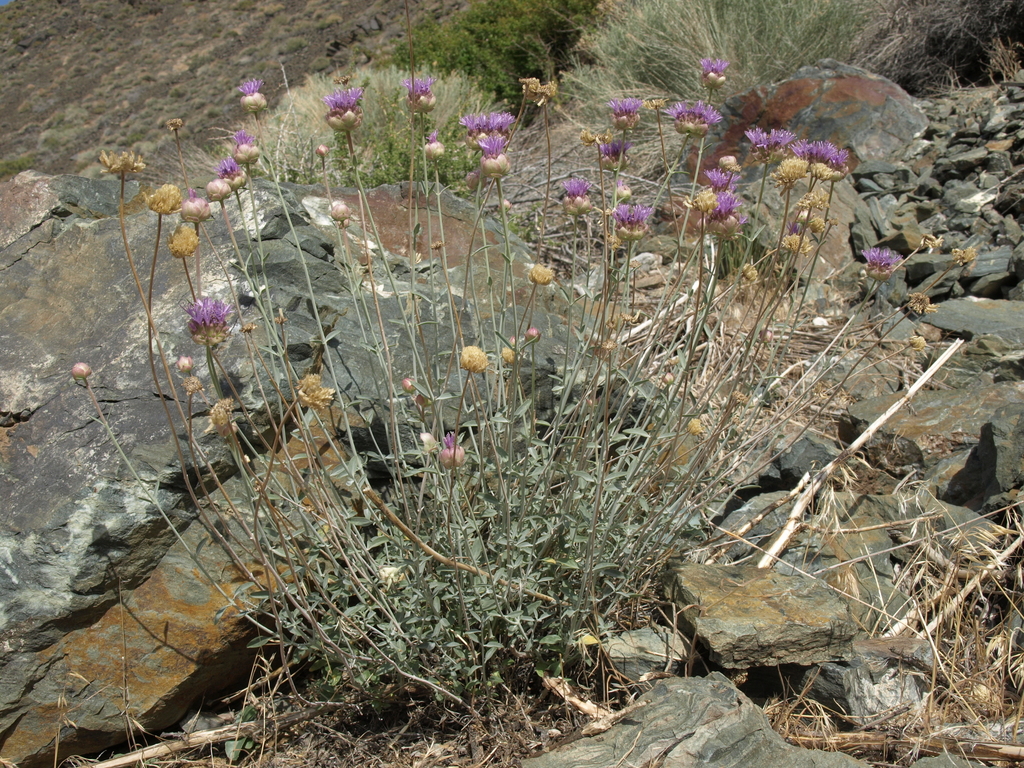
(c) Jim Morefield, some rights reserved (CC BY) · licence
Family: Lamiaceae · Type: Subshrub · Native
Conservation status: CNPS 1B.3
Monardella linoides subsp. oblonga (Tehachapi monardella) is a native California subshrub in the Lamiaceae family, recognized by silvery habit and rose-purple bracts.
Tehachapi monardella is a rare (CNPS 1B.3) California native shrub found in the Tehachapi and northern Transverse Ranges on gravelly, dry slopes and flats in chaparral and conifer woodland to forest at elevations of 1,500 to 2,600 meters. Flowering from June to August, this plant produces pale lavender to violet flowers in compact clusters with rose-purple bracts 10 to 20 millimeters wide. Growing with silvery ash-gray stems 15 to 25 centimeters tall that are finely and densely puberulent, it forms multiple stems in clusters. Its narrow leaves are obovate, 10 to 20 millimeters long and 4 to 7 millimeters wide, giving the plant a delicate, compact appearance. The flower's pale lavender corolla tube extends 2 to 3 millimeters beyond the calyx, creating an elegant and distinctive floral structure.
Identification and appearance
Key characters: 9 sympatric species; silvery habit and rose-purple bracts are diagnostic
Habitat and range
Habitat: Chaparral, conifer woodland to forest, gravelly, dry slopes, flats
Elevation: 1500-2600 m
California counties: Kern, Ventura, Los Angeles, Tulare, Inyo
Bloom period
Monardella linoides subsp. oblonga blooms Jun-Aug.
Conservation status
CNPS 1B.3
How to tell it apart
vs Mentha: Mint has multiple flower clusters spaced along the stem; Monardella has one terminal pom-pom head per stem.; vs Salvia: Sage has flowers spaced along an elongated spike; Monardella's flowers are densely packed into a rounded head.; vs Veronica: Speedwell has flowers in a loose spike and isn't aromatic; Monardella's flowers form a dense head with mint scent.; vs Phacelia: Phacelia's flower clusters uncurl like a fern; Monardella's form a compact, stationary head with a bract collar.; vs Valeriana: Valerian has tiny flowers in branched clusters; Monardella has larger mint flowers in a single terminal head.
Frequently asked questions
Is Monardella linoides subsp. oblonga native to California?
Yes. Monardella linoides subsp. oblonga is native to California (recorded as native).
When does Monardella linoides subsp. oblonga bloom?
Monardella linoides subsp. oblonga blooms Jun-Aug.
Where in California does Monardella linoides subsp. oblonga grow?
Monardella linoides subsp. oblonga occurs in Kern, Ventura, Los Angeles, Tulare, Inyo, at elevations of 1500-2600 m.
What plant family does Monardella linoides subsp. oblonga belong to?
Monardella linoides subsp. oblonga is in the Lamiaceae family, genus Monardella.
Is Monardella linoides subsp. oblonga rare or endangered?
Monardella linoides subsp. oblonga carries California Rare Plant Rank 1B.3, state rank S2.
Related species
Other California species in the same genus, family, or bioregion.
Sources: Jepson eFlora · CNPS Rare Plant Inventory · Index of California Plant Names · CalPhotos · CDFW CNDDB
Last updated 2026-10-07
Data from The California Species Project — 14,000+ California species with verified data from CNPS, CDFW, USFWS, Cal-IPC, and more.