Monardella odoratissima subsp. pallida
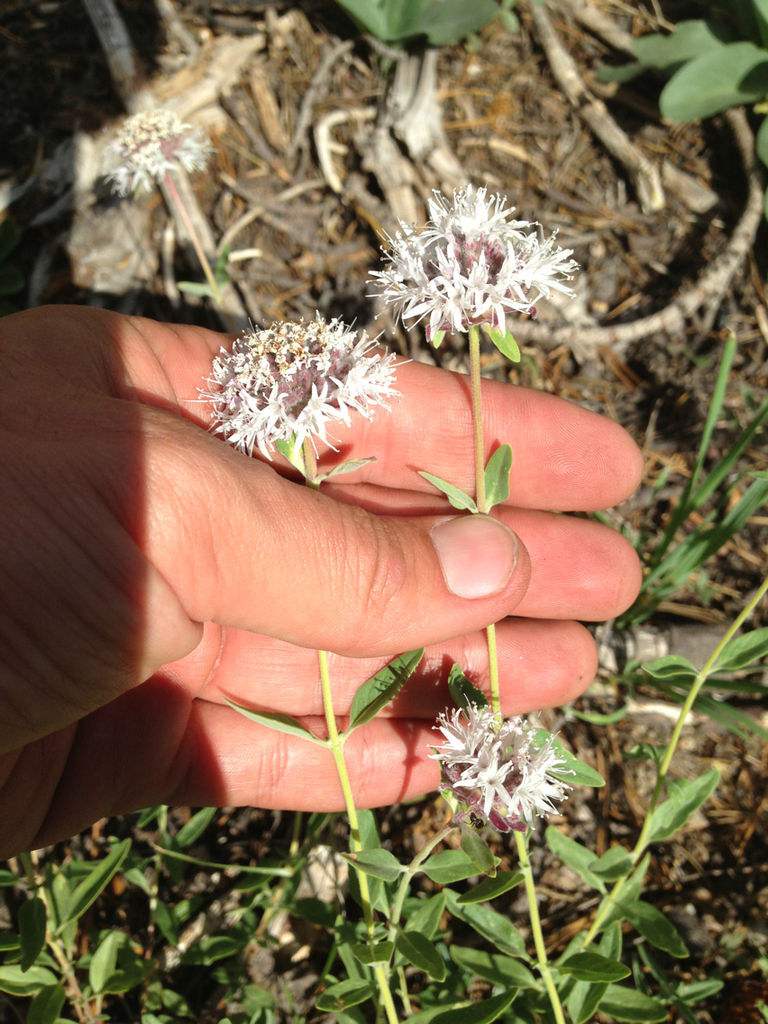
Photo: parent species Monardella odoratissima · (c) Ken-ichi Ueda, some rights reserved (CC BY) · licence
Family: Lamiaceae · Type: Subshrub · Native
Monardella odoratissima subsp. pallida is a native California subshrub in the Lamiaceae family, recognized by white flowers and reflexed outer bracts.
Monardella odoratissima subsp. pallida is a California native shrub found in the Klamath Ranges, northern Coast Ranges, California Range Highlands, and Sierra Nevada Highlands in montane forest and rocky slopes at elevations of 1,000 to 3,100 meters. Flowering from June to September, this plant produces white flowers occasionally tinged with lavender or purple in compact clusters 13 to 25 millimeters wide. Growing with green or ash-gray stems 15 to 45 centimeters tall that are hairy, it develops dense, aromatic foliage. Its leaves range from 25 to 43 millimeters long, varying from green-glabrous to ash-gray-hairy, with distinctive lance-linear bracts that are leaf-like at the tip and scarious at the base. The flower clusters are subtended by reflexed leaves, creating a distinctive architectural appearance in its montane habitat.
Identification and appearance
Key characters: 13 sympatric species; white flowers and reflexed outer bracts are diagnostic
Habitat and range
Habitat: Montane forest, rocky slopes
Elevation: 1000-3100 m
California counties: Fresno, Plumas, Butte, Nevada, El Dorado, Siskiyou, Tulare, Trinity, Tehama, Tuolumne, Shasta, Mono, Sierra, Mariposa, Placer, Calaveras, Alpine, Amador, Mendocino, Lassen, Sutter, Inyo, Kern, Glenn, Humboldt, Madera, Modoc, San Diego, Colusa, Lake, Merced, Sonoma
Outside California: Oregon, western Nevada
Bloom period
Monardella odoratissima subsp. pallida blooms Jun-Sep.
How to tell it apart
vs Mentha: Mint has multiple flower clusters spaced along the stem; Monardella has one terminal pom-pom head per stem.; vs Salvia: Sage has flowers spaced along an elongated spike; Monardella's flowers are densely packed into a rounded head.; vs Veronica: Speedwell has flowers in a loose spike and isn't aromatic; Monardella's flowers form a dense head with mint scent.; vs Phacelia: Phacelia's flower clusters uncurl like a fern; Monardella's form a compact, stationary head with a bract collar.; vs Valeriana: Valerian has tiny flowers in branched clusters; Monardella has larger mint flowers in a single terminal head.
Frequently asked questions
Is Monardella odoratissima subsp. pallida native to California?
Yes. Monardella odoratissima subsp. pallida is native to California (recorded as native).
When does Monardella odoratissima subsp. pallida bloom?
Monardella odoratissima subsp. pallida blooms Jun-Sep.
Where in California does Monardella odoratissima subsp. pallida grow?
Monardella odoratissima subsp. pallida occurs in Fresno, Plumas, Butte, Nevada, El Dorado, Siskiyou, Tulare, Trinity and other counties, at elevations of 1000-3100 m.
What plant family does Monardella odoratissima subsp. pallida belong to?
Monardella odoratissima subsp. pallida is in the Lamiaceae family, genus Monardella.
What habitat does Monardella odoratissima subsp. pallida grow in?
Monardella odoratissima subsp. pallida grows in Montane forest, rocky slopes.
Related species
Other California species in the same genus, family, or bioregion.
Sources: Jepson eFlora · Index of California Plant Names · CalPhotos
Last updated 2026-10-07
Data from The California Species Project — 14,000+ California species with verified data from CNPS, CDFW, USFWS, Cal-IPC, and more.