Monardella sheltonii
Coyote mint
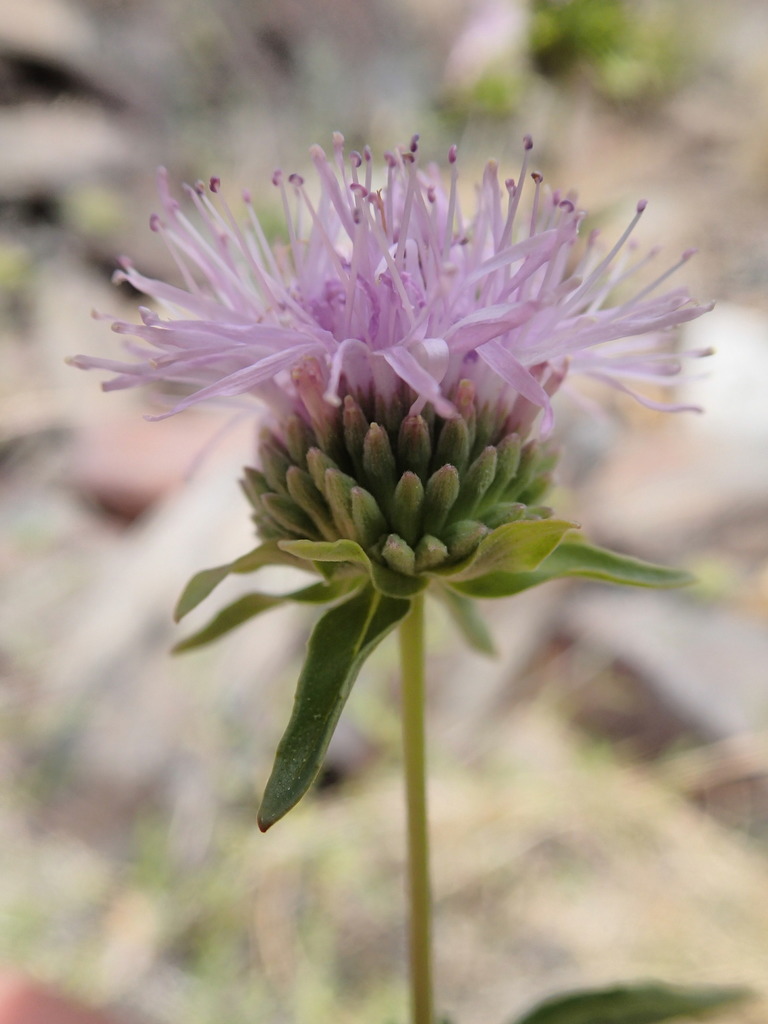
no rights reserved · CC0
Family: Lamiaceae · Type: Subshrub · Native
Monardella sheltonii (Coyote mint) is a native California subshrub in the Lamiaceae family, recognized by very fine, even pubescence on leaf undersides.
Coyote mint is a California native shrub found in the Klamath Ranges, southern Cascade Range, and northern Sierra Nevada in rocky openings, montane forest, oak woodland, and chaparral, often on serpentine soils at elevations of 425 to 1,600 meters. Flowering from June to August, this plant produces rich purple flowers in compact clusters 10 to 29 millimeters wide. Growing with erect, open stems 30 to 45 centimeters tall and spreading from a rhizomatous base, it forms a loose, somewhat glabrous subshrub. Its lanceolate leaves are 16 to 34 millimeters long, dark green on top, with densely puberulent undersides that give a soft, fine-textured appearance. The flower bracts are notable for being leaf-like, strongly reflexed, and extending beyond the calyx.
Identification and appearance
Key characters: 15 sympatric species; very fine, even pubescence on leaf undersides is diagnostic
Habitat and range
Habitat: Rocky openings, montane forest, oak woodland, chaparral, often serpentine
Elevation: 425-1600 m
California counties: Humboldt, Yuba, Mariposa, Butte, Tulare, Nevada, El Dorado, Modoc, Santa Barbara, Plumas, Sierra, Placer, Calaveras, Alpine, Glenn, Amador, Fresno, Sacramento, Trinity, Tuolumne, Shasta, Siskiyou, Tehama, Lake, Lassen, Sonoma, San Benito, Colusa, Stanislaus
Bloom period
Monardella sheltonii blooms Jun-Aug.
How to tell it apart
vs Mentha: Mint has multiple flower clusters spaced along the stem; Monardella has one terminal pom-pom head per stem.; vs Salvia: Sage has flowers spaced along an elongated spike; Monardella's flowers are densely packed into a rounded head.; vs Veronica: Speedwell has flowers in a loose spike and isn't aromatic; Monardella's flowers form a dense head with mint scent.; vs Phacelia: Phacelia's flower clusters uncurl like a fern; Monardella's form a compact, stationary head with a bract collar.; vs Valeriana: Valerian has tiny flowers in branched clusters; Monardella has larger mint flowers in a single terminal head.
Frequently asked questions
Is Monardella sheltonii native to California?
Yes. Monardella sheltonii is native to California (recorded as native).
When does Monardella sheltonii bloom?
Monardella sheltonii blooms Jun-Aug.
Where in California does Monardella sheltonii grow?
Monardella sheltonii occurs in Humboldt, Yuba, Mariposa, Butte, Tulare, Nevada, El Dorado, Modoc and other counties, at elevations of 425-1600 m.
What plant family does Monardella sheltonii belong to?
Monardella sheltonii is in the Lamiaceae family, genus Monardella.
What habitat does Monardella sheltonii grow in?
Monardella sheltonii grows in Rocky openings, montane forest, oak woodland, chaparral, often serpentine.
Related species
Other California species in the same genus, family, or bioregion.
- Monardella sinuata — Curly leaved monardella
- Monardella sinuata ssp. gerryi — Gerry's curly- leaved monardella
- Monardella sinuata subsp. nigrescens — northern curly- leaved monardella
- Monardella sinuata subsp. sinuata — southern curly- leaved monardella
- Monardella sp.
- Monardella stebbinsii — Stebbins' monardella
Sources: Jepson eFlora · Index of California Plant Names · CalPhotos
Last updated 2026-10-07
Data from The California Species Project — 14,000+ California species with verified data from CNPS, CDFW, USFWS, Cal-IPC, and more.